




























Views
Downloads

7.NS.A.3 Worksheet: Fraction Operations — Grade 7 Aligned

Paste this activity's link or code into your existing LMS (Google Classroom, Canvas, Teams, Schoology, Moodle, etc.).
Students can open and work on the activity right away, with no student login required.
You'll still be able to track student progress and results from your teacher account.
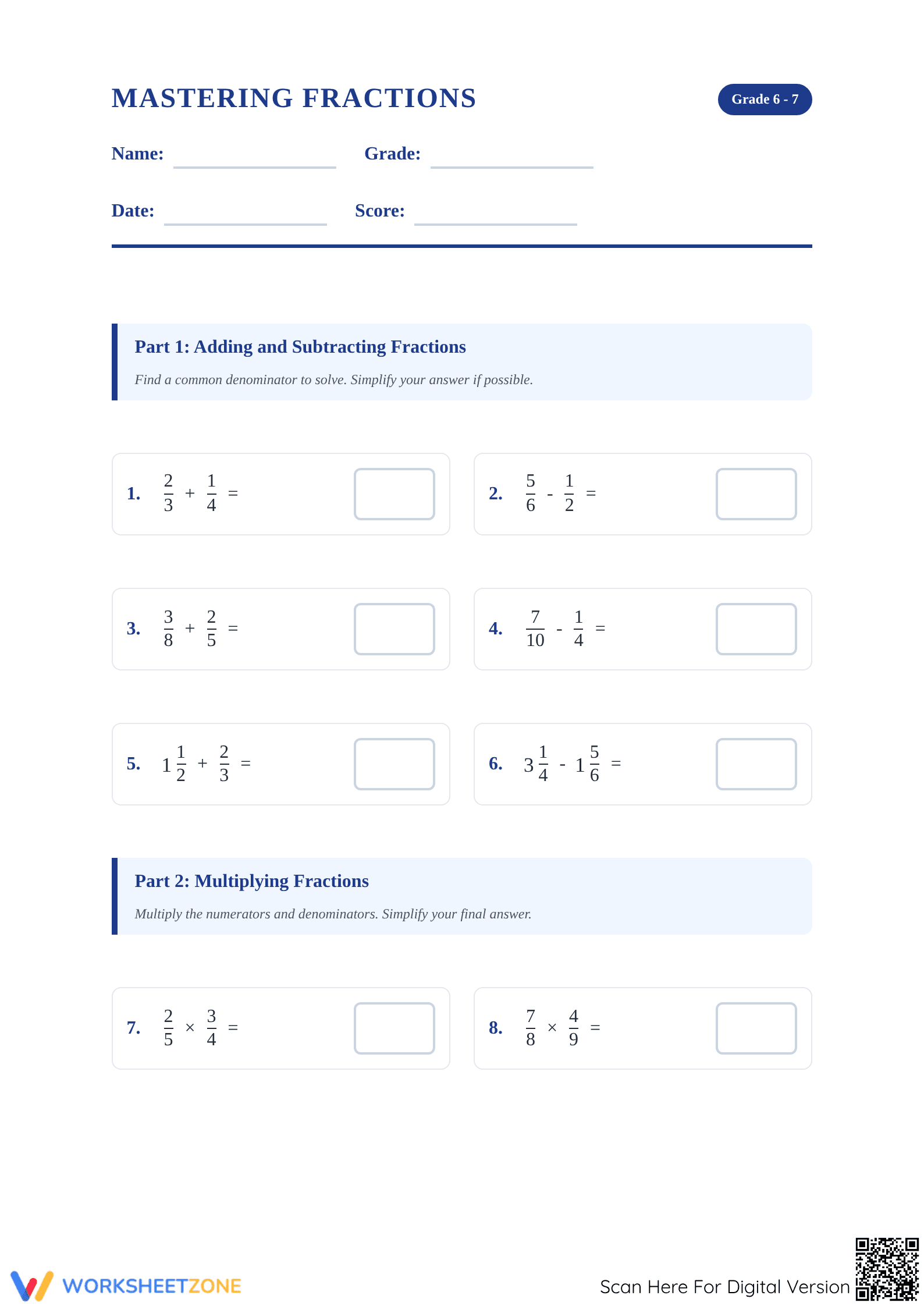
Equip your middle school students with the analytical tools needed to master rational number arithmetic. This comprehensive worksheet provides targeted practice on adding, subtracting, multiplying, and dividing fractions. Students progress from basic operations to complex multi-step challenges and real-world application problems, ensuring a deep conceptual understanding of fraction mechanics and their practical utility in mathematics.
At a Glance
- Grade: 7 · Subject: Math
- Standard:
CCSS.MATH.CONTENT.7.NS.A.3— Solve real-world and mathematical problems involving the four operations with rational numbers- Skill Focus: Fraction arithmetic and word problems
- Format: 4 pages · 22 problems · Answer key included · PDF
- Best For: Comprehensive unit review or formative assessment
- Time: 45–60 minutes
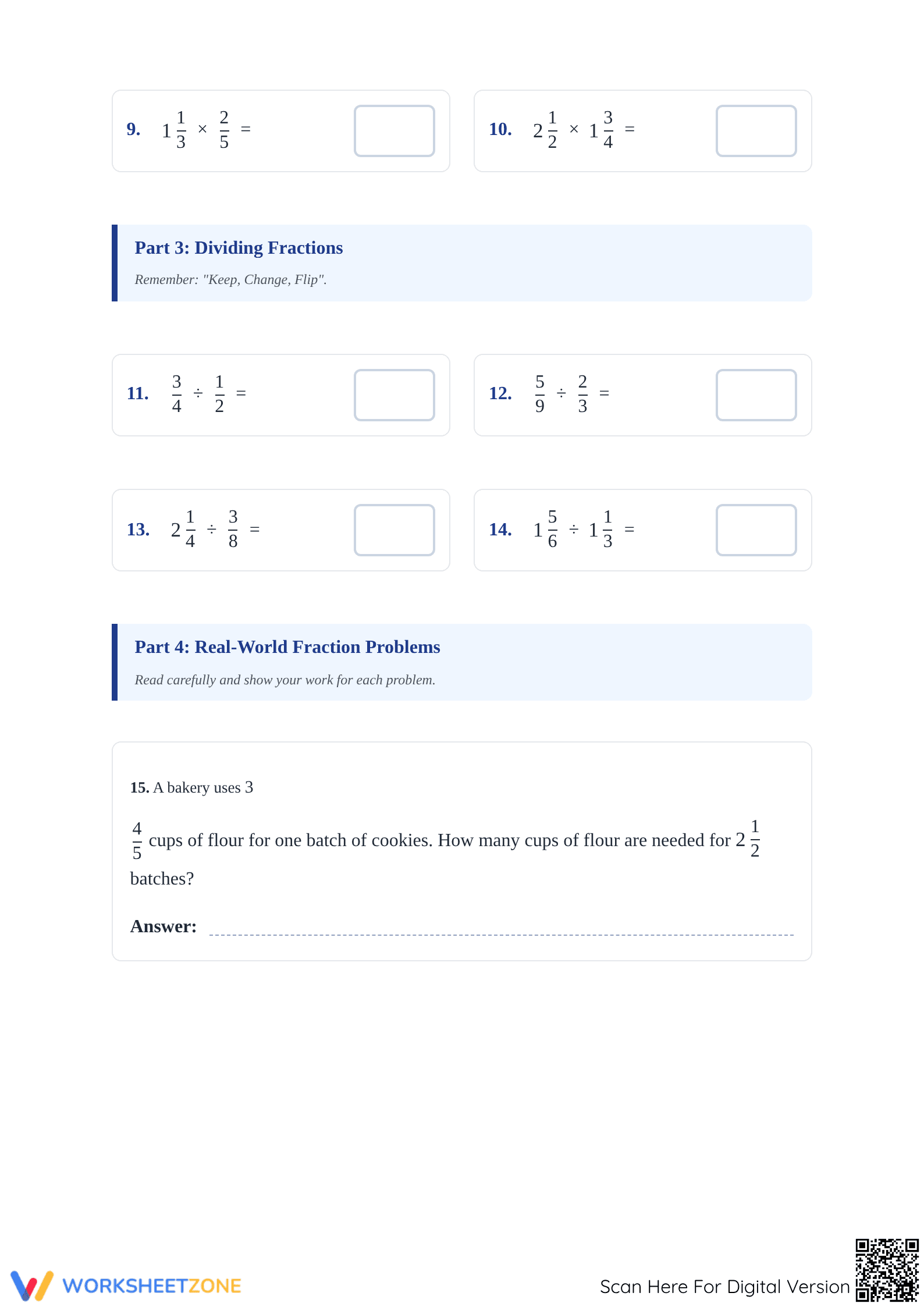
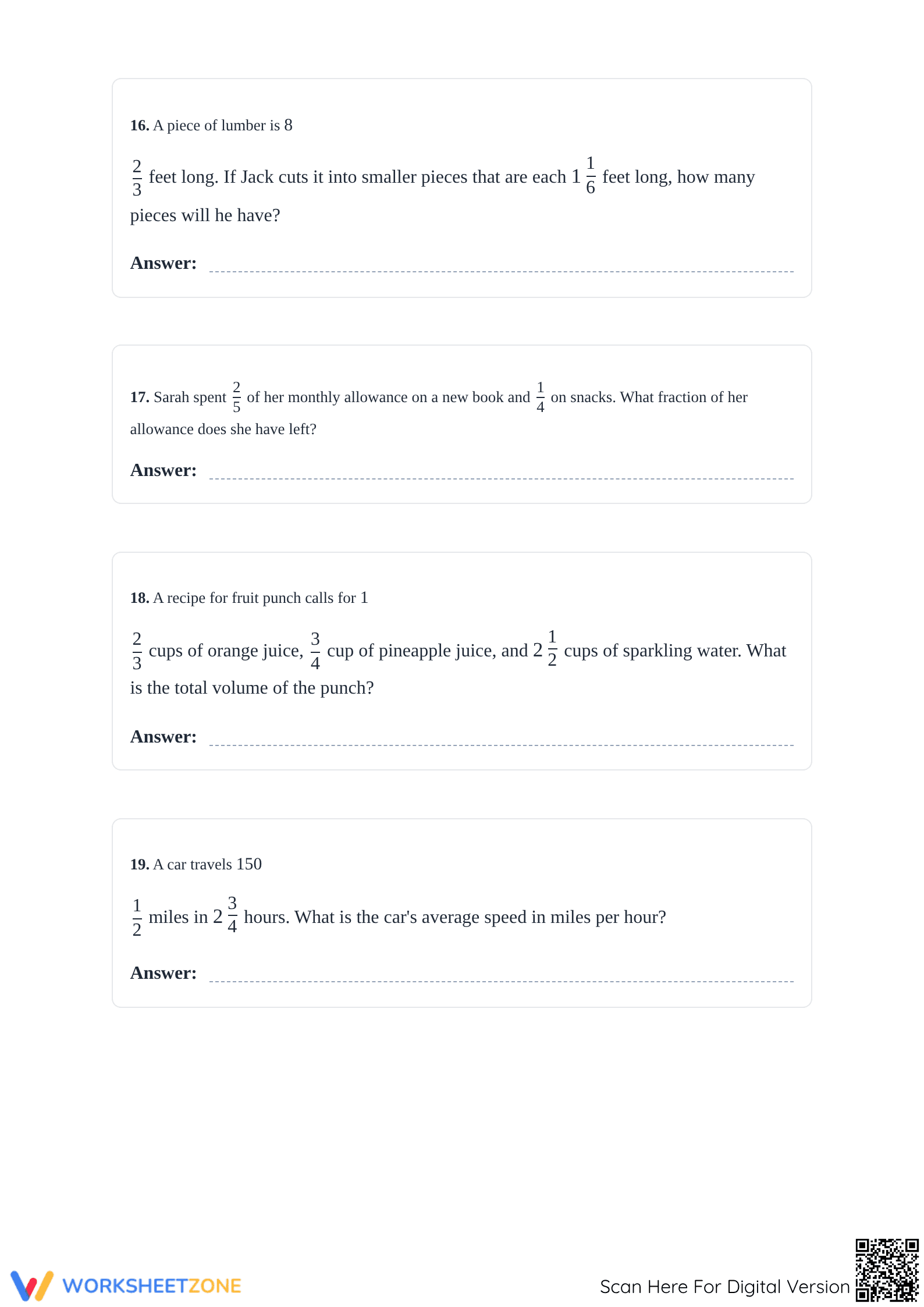
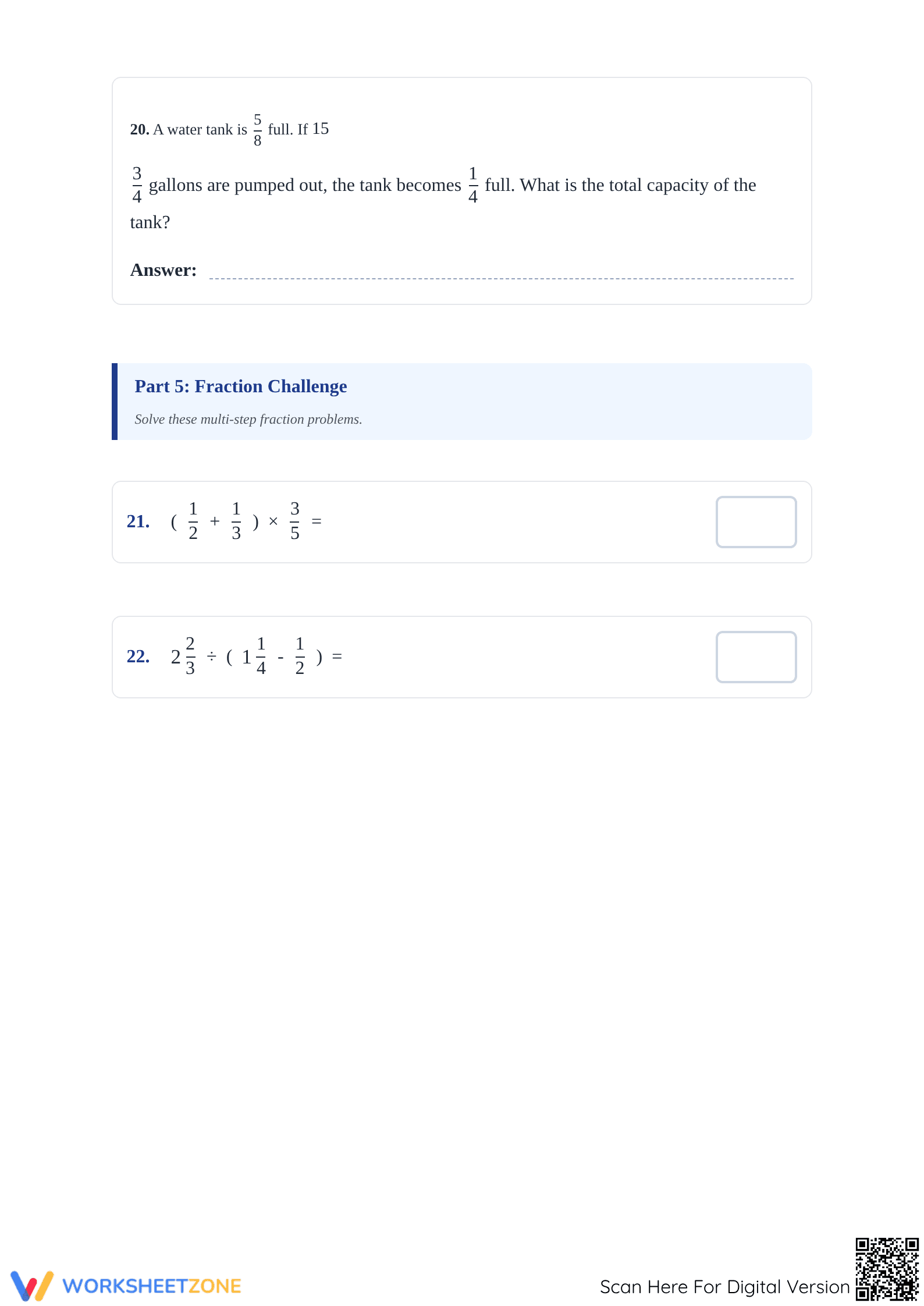
This extensive 4-page resource is divided into five strategic sections. It begins with 6 problems on addition and subtraction, followed by 4 multiplication and 4 division tasks. The core of the worksheet features 6 intensive real-world word problems involving lumber, baking, and finance, concluding with a "Fraction Challenge" section containing 2 multi-step expressions. A complete answer key is provided for immediate feedback.
Mastery Evidence
Each section of this worksheet maps directly to specific sub-skills of the rational number standard, allowing teachers to identify precise student misconceptions. The transition from computational fluency in Parts 1-3 to the interpretive demands of the word problems in Part 4 provides a clear rubric for student mastery. Educators can utilize the "Fraction Challenge" results to determine which students have reached the "Exceeding" tier of procedural complexity.
Standards Alignment
Aligned primarily to `CCSS.MATH.CONTENT.7.NS.A.3`, this worksheet requires students to solve mathematical problems involving the four operations with rational numbers. It also supports `CCSS.MATH.CONTENT.6.NS.A.1` by requiring the interpretation and computation of quotients of fractions. Both standard codes can be copied directly into lesson plans, IEP goals, or district curriculum mapping tools.
How to Use It
Use this worksheet as a summative assessment at the end of a fractions unit to gauge total student proficiency. Alternatively, assign the "Real-World Problems" section during small-group instruction to observe how students translate verbal scenarios into mathematical expressions. Expect students to spend approximately 50 minutes on the full set, allowing for productive struggle during the concluding challenge section.
Who It's For
Designed for Grade 7 math students, this resource is equally effective for Grade 6 acceleration or Grade 8 remediation. It provides necessary scaffolds like "Keep, Change, Flip" reminders while maintaining high rigor. Pair this with a fraction bar anchor chart or direct instruction on common denominators to support diverse learners during the initial parts of the set.
The development of procedural fluency with fractions is a critical precursor to success in algebra and higher-order mathematics. According to research from RAND AIRS 2024, students who master rational number operations in middle school demonstrate significantly higher achievement in secondary STEM courses. This worksheet targets CCSS.MATH.CONTENT.7.NS.A.3, focusing on the integration of addition, subtraction, multiplication, and division within complex, multi-step mathematical contexts. By moving students from isolated computation to contextualized problem-solving, the resource adheres to the evidence-based recommendations for instructional rigor and depth. The inclusion of real-world scenarios ensures that students can identify the appropriate operation to apply in varied situations, a key metric for evaluating mathematical literacy. This standalone resource serves as a robust tool for assessing student readiness for the quantitative demands of the NAEP assessments and state-level standards proficiency benchmarks.


