




























Views
Downloads
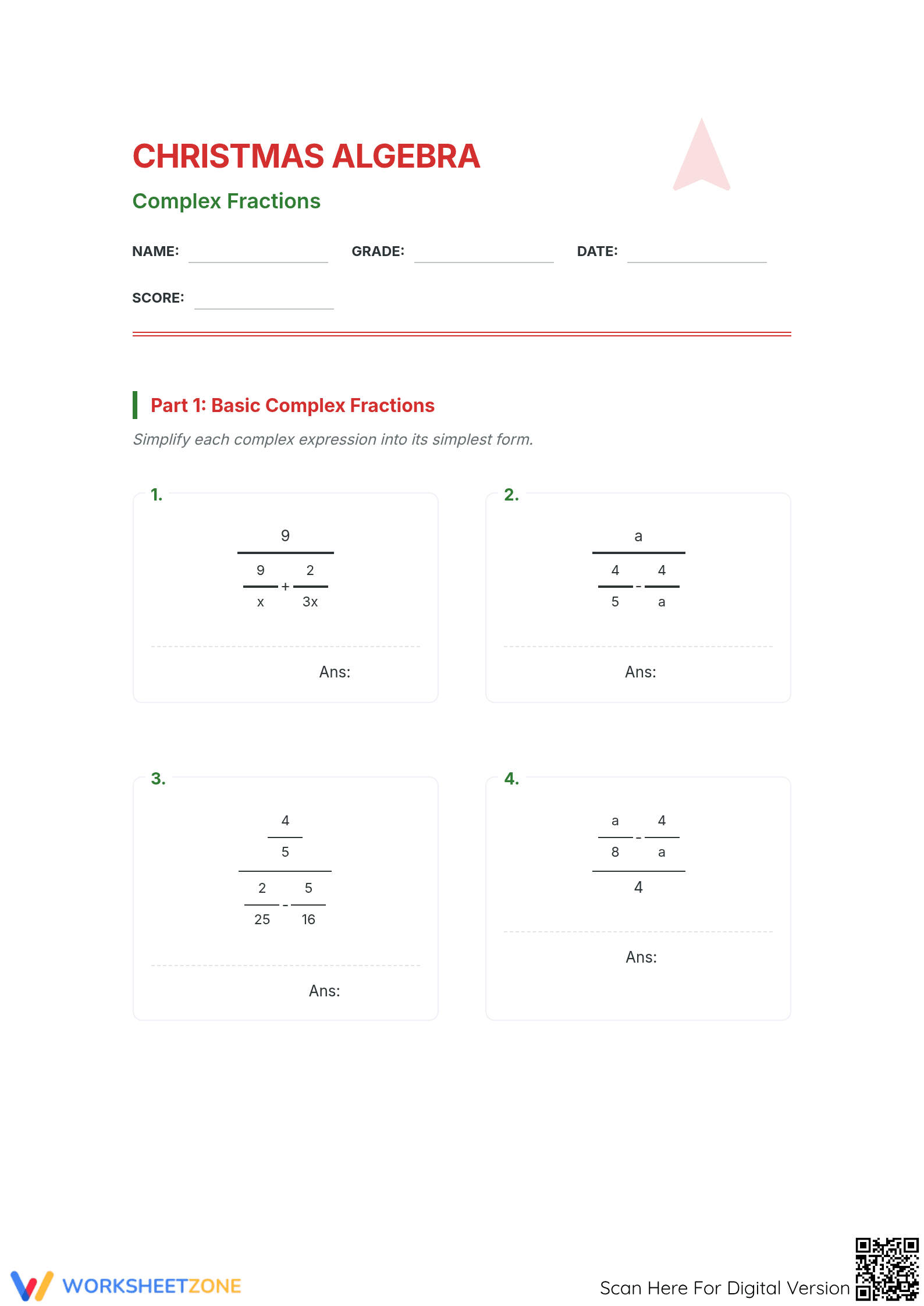


Printable Christmas Algebra: Complex Fractions Worksheet

Paste this activity's link or code into your existing LMS (Google Classroom, Canvas, Teams, Schoology, Moodle, etc.).
Students can open and work on the activity right away, with no student login required.
You'll still be able to track student progress and results from your teacher account.
This festive Christmas-themed algebra worksheet provides students with a rigorous review of complex fractions. By simplifying expressions containing fractions within fractions, learners strengthen their understanding of rational expressions and algebraic manipulation. This resource transforms a challenging topic into a seasonally appropriate practice session that ensures student engagement during the busy holiday period.
At a Glance
- Grade: 8–9 · Subject: Algebra
- Standard:
HSA-APR.D.7— Add, subtract, multiply, and divide rational expressions and simplify complex fractions- Skill Focus: Simplifying algebraic complex fractions
- Format: 3 pages · 14 problems · Answer key included · PDF
- Best For: Holiday-themed skill reinforcement and algebra review
- Time: 40–50 minutes
This three-page PDF packet features 14 problems divided into three sections. Part 1 focuses on basic complex fractions with simple numerical components. Part 2 introduces advanced algebraic fractions requiring common denominators. Part 3 presents a Master Challenge with multi-step expressions testing algebraic fluency. The layout includes dedicated workspace and is accompanied by a full answer key.
Zero-Prep Workflow
The zero-prep design allows teachers to implement this activity in under two minutes. Step 1: Print the packet for each student, taking sixty seconds for a class set. Step 2: Distribute the worksheets; the clear headers provide immediate context without lengthy instructions. Step 3: Review solutions using the included answer key during the final minutes of class for immediate feedback.
Standards Alignment
Primary alignment is HSA-APR.D.7. Students must understand that rational expressions form a system analogous to rational numbers, closed under addition, subtraction, multiplication, and division. They must accurately divide expressions to simplify complex fractions. This standard code can be copied directly into lesson plans, IEP goals, or district curriculum mapping tools to demonstrate alignment with rigorous frameworks.
How to Use It
Use this worksheet as a seasonal summative assessment or a sub plan. Assign the first page for practice after a lesson on rational expressions, then use the Master Challenge as an exit ticket. Teachers should observe how students handle finding common denominators in the denominator of the complex fraction to identify misconceptions regarding reciprocal multiplication.
Who It's For
This resource is designed for Grade 8 and Grade 9 Algebra students who have mastered fraction operations and are ready for variable manipulation. It is effective for learners needing structured practice in a festive format. The worksheet pairs naturally with a direct instruction lesson on rational expressions or a reference anchor chart detailing fraction division methods.
Simplifying complex algebraic fractions is a cornerstone of secondary mathematics, serving as a bridge between arithmetic and calculus. According to the RAND AIRS 2024 report, high-quality printable resources that offer tiered difficulty within a single skill set significantly improve student retention of abstract algebraic concepts. This worksheet aligns with standard HSA-APR.D.7 by requiring students to perform operations on rational expressions. By moving from basic numerical fractions to variable-heavy challenges, the resource supports the gradual release of responsibility model. Research from ScienceDirect TpT Analysis suggests that themed, seasonally relevant worksheets increase student persistence when facing complex multi-step problems. This 14-problem set provides the necessary repetition for students to internalize procedural steps required for algebraic mastery, ensuring they are prepared for standardized testing and future STEM coursework while maintaining engagement during seasonal classroom transitions.


