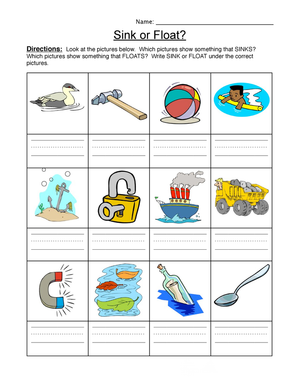
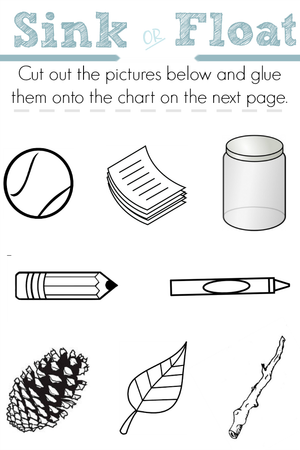
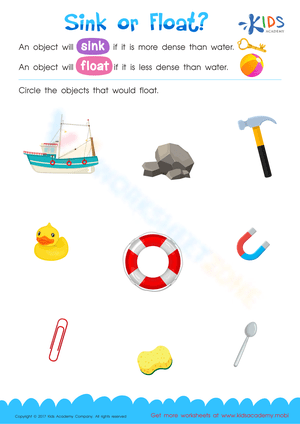
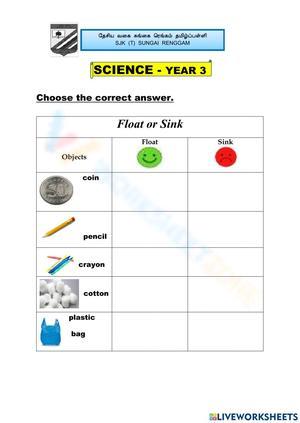
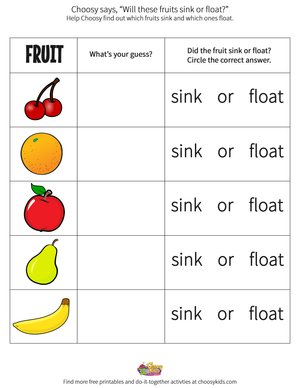
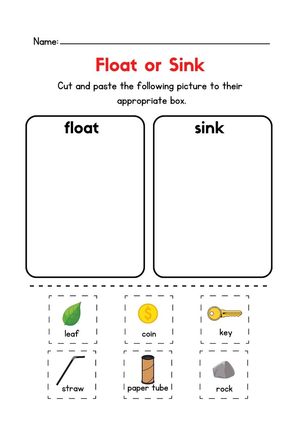
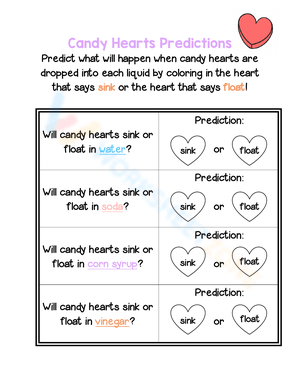
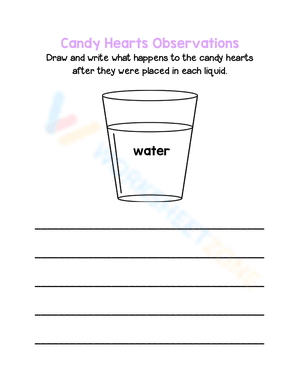
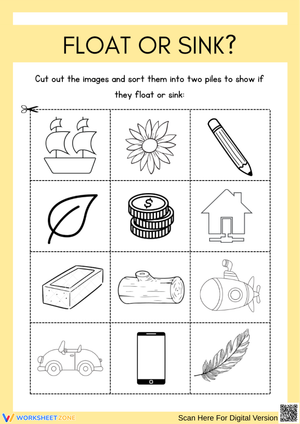
Sink or float printable worksheets for kindergarten give teachers a recording tool that turns water table testing from sensory play into early scientific method practice. Each worksheet pairs a prediction step with an observation step, a two-column format pre-readers can navigate without needing sentence-level writing. Available formats include prediction charts, cut-and-paste sorting activities, and drawing-based recording sheets, giving teachers options that fit different lesson structures and center setups.
The Skills Each Worksheet Builds
The core work happening in each worksheet is classification — students sort objects into two categories based on directly observed physical behavior. But the more important skill, and the one these worksheets make visible in student work, is prediction. Before any object touches the water, students commit to a guess. That moment of commitment, where a child picks up a penny and decides whether it will sink or float before finding out, is where genuine scientific thinking starts. Recording the prediction on paper separates this from water play; it gives each guess a claim status that can be confirmed or overturned.
Students also practice comparing properties across different material types. Over repeated testing with metal, wood, plastic, and natural materials like leaves and small rocks, students begin to notice consistent patterns — metal goes down, wooden objects stay up. That informal pattern recognition builds the conceptual groundwork for later instruction on density and buoyancy in second and third grade. The worksheet record makes those patterns visible in a way that a verbal group discussion alone cannot.
Student Mistakes That Surface During Sink or Float Testing
The most consistent error in kindergarten classrooms is prediction by size rather than by material. Give a child a large dry kitchen sponge and a small metal coin, and they will routinely predict the sponge sinks — it's bigger, so it must be heavier, so it must go down. When the sponge floats and the coin sinks, the surprise is productive only if the teacher names the distinction directly: it's not about how big the object is; it's about what it's made of. Without that explicit correction in the moment, some students leave the experiment thinking the results were just random.
A second issue: students who erase or cross out their original prediction after seeing the result. The prediction column is meant to capture what students thought before testing, and protecting that record is worth a brief conversation before any object goes in the water. Tell students directly that a wrong prediction isn't a mistake to hide — it's information. A simple procedural fix works well: have the class fill in all predictions together first, then fold or cover that section before recording observations. That small step preserves the integrity of the two-column format.
Building These Worksheets Into Your Water Experiment Lessons
Give sink or float printable worksheets for kindergarten to students before anything touches the water, not after. In practice, teachers sometimes demo the first object, get students excited, and then distribute recording sheets — at which point the prediction column becomes fiction. Hold up each object for the class to examine, pass it around the circle if time allows, and have students mark their predictions before any water is involved. Having students hold the penny or the cork grounds the prediction in physical information — weight, texture, a sense of density they can feel in their hands — rather than a random guess.
A clear plastic bin works far better than an opaque bucket for whole-group demonstrations. Every student, including those sitting at the back edge of the carpet, can see exactly where the object settles. Remove each item before adding the next — if objects accumulate, rising water levels create ambiguous results and floating items stack on top of sinking ones in ways that confuse observers. For center time later in the week, the cut-and-paste sorting worksheets work without a water station at all; students recall the class experiment and sort printed images into "sink" and "float" columns. These work well for morning work or the ten minutes before a transition, once students have the shared experiment as a reference point.
One demonstration worth building into any unit using these worksheets: test a flat sheet of aluminum foil first — it floats. Remove it, crumple it into a tight ball, drop it in again — it sinks. Students who just formed the rule "foil floats" get a productive disruption. That moment opens a conversation about how shape affects buoyancy, and it gives the observation column on students' worksheets new purpose: recording not just whether something sank, but what conditions made the difference.
Adjusting the Set for a Range of Kindergartners
The picture-based prediction charts need no modification for pre-readers — the format is already language-minimal. For students still developing fine motor control, the cut-and-paste worksheets reduce writing demands while keeping the classification work intact. ELL students benefit from the same picture-heavy formats; the concept translates directly to demonstration without requiring language mediation at the recording stage.
For students who are ready for more, ask them to dictate or write one sentence explaining their prediction before testing begins. Those responses reveal whether a student is predicting by size, by material, by feel, or by some other attribute — information that shapes the next lesson more precisely than a group discussion does. Introducing the crumpled-foil demonstration specifically for this group also challenges any overgeneralizations they've formed quickly, without disrupting the main lesson for students still building basic understanding.
Standard Alignment
These worksheets most directly support NGSS 2-PS1-1, which asks students to "plan and conduct an investigation to describe and classify different kinds of materials by their observable properties." The formal performance expectation sits at second grade, but kindergarten teachers regularly introduce sink or float as an entry point for this concept thread. The predict-observe-record structure built into each worksheet mirrors the investigation language of the standard directly, meaning the student work produced here is documented preparation — not a detour — for the second-grade expectation. The categorization work also connects to CCSS.MATH.CONTENT.K.MD.A.2, which addresses direct comparison of objects by measurable attribute, since students are comparing material properties and sorting objects across each activity.
Frequently Asked Questions
Do students need to be at the water table to use these worksheets?
Not all of them. The cut-and-paste sorting worksheets and some prediction charts work as independent seat work after a class demonstration — students recall what they observed together and sort printed images accordingly. The prediction-vs-observation worksheets, though, only function as intended when paired with actual testing. Without the hands-on component, students fill in the observation column as a second guess rather than a real record, which removes the point of having two separate columns in the first place.
How do I keep students from filling in the prediction column after the fact?
Timing is everything. If sink or float printable worksheets for kindergarten are handed out after the first object goes in the water, the prediction column never captures a genuine hypothesis — students are filling it in after the fact. Walking through all predictions as a whole group before any water is involved sets the expectation clearly. Alternatively, have students fold their worksheet so only the prediction rows are visible, then unfold to record observations once testing is complete. Both approaches protect the part of the activity that matters most: the moment of intellectual commitment before the answer is known.
What objects give the clearest results for kindergartners?
The most reliable choices are those with immediate, repeatable, unambiguous behavior. For sinking: metal coins, glass marbles, metal paperclips, and small smooth rocks. For floating: wooden craft sticks, corks, dry kitchen sponges, and plastic building blocks. A few categories are worth avoiding:
- Wet or previously used sponges — these can sink once saturated, contradicting what students observed when the sponge was dry, without any useful instructional payoff
- Untreated balsa wood — behavior varies by grain and moisture history, making results inconsistent across test runs
- Compressed foam pieces — unpredictable depending on density and prior compression, which frustrates students without generating productive confusion
Once students have a stable framework for predicting by material type, introduce edge cases like the foil ball deliberately, as a planned challenge rather than an accidental inconsistency.
Can these worksheets serve as formative assessment?
The completed prediction-and-observation worksheet, collected after the experiment, gives a useful individual snapshot. Look at whether each student's predictions showed any consistent logic — even wrong predictions based on a rule (always predicting by size, for instance) reveal more about student thinking than random guessing does. The observation column tells you whether the student attended to the actual result. These artifacts are worth keeping in science folders, especially when sink or float printable worksheets for kindergarten come back around during a unit review or a second experiment cycle, because comparing two sets of completed worksheets across time shows conceptual growth directly.












 Interactive Worksheet Maker
 Quiz Maker
 Word Search Maker
 Crossword Puzzle Maker
 Word Scramble Generator
 Sentence Scramble Generator
 Handwriting Worksheet Generator
 Name Tracing Generator
 Fill In The Blank Generator