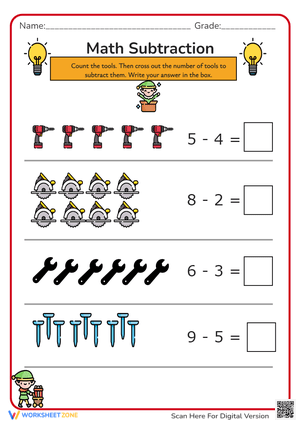
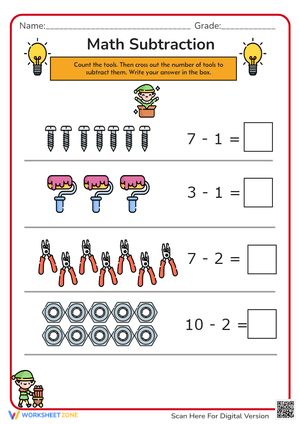
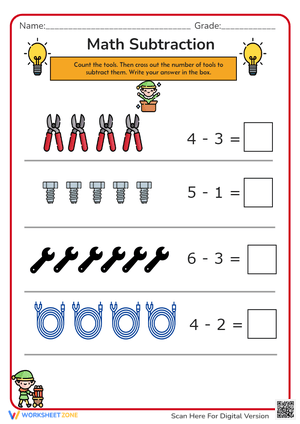
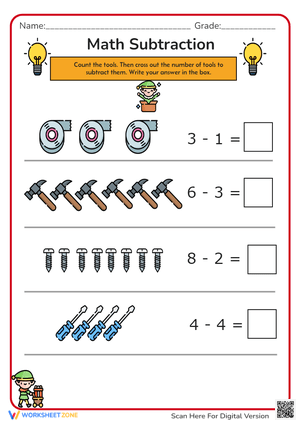
These kindergarten subtraction and counting back worksheets give teachers a printable set built around one specific early strategy: starting at the minuend and counting backward to find what remains after removal. The resources stay within 10, which keeps the cognitive demand manageable while students are still building reliable number-sequence fluency. Each worksheet moves students through a consistent routine — count back, track the jumps, record the difference — reinforcing the same mental language teachers use during whole-group instruction.
What Students Practice Across the Set
The worksheets target several concrete subtraction skills that Kindergartners need before any fact becomes automatic. The work stays visual and procedural because most five-year-olds are not yet ready to retrieve differences from memory — they need a repeatable strategy to run through every time they encounter a subtraction problem.
- Backward counting from a given number: Students practice the number sequence in reverse, starting from numbers like 8 or 6 and landing accurately on smaller targets — a skill that takes more deliberate practice than forward counting and rarely feels automatic at this age.
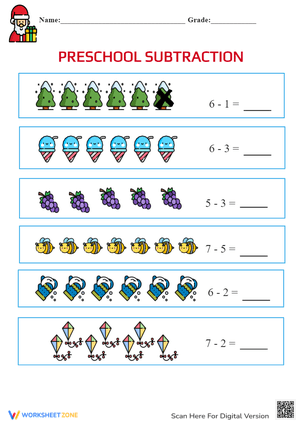
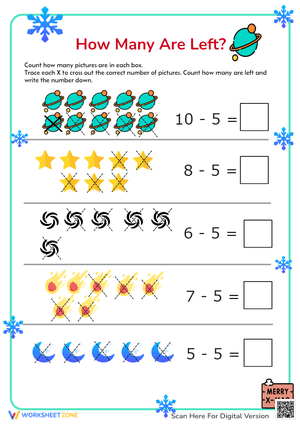
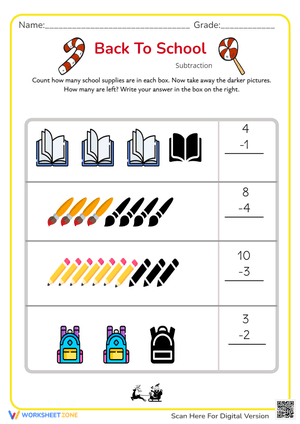
- Cross-out picture problems: Drawings of objects let students mark, cross out, and count what remains before writing the matching equation.
- Number path use: Students place a finger or draw a hop on a 0–10 number path, marking each backward step so they don't lose their place mid-problem.
- Equation notation: Problems present subtraction sentences with a missing difference, connecting the visual action to the symbolic form 7 − 2 = ___.
- Dual-representation problems: Some worksheets pair a cross-out picture with a number path for the same problem, letting students verify their answer across two different models of the same subtraction action.
Common Errors to Anticipate and Address
The most persistent mistake in this work is the off-by-one error: a student begins the count-back at the minuend itself rather than the number below it. For 8 − 3, they say "8, 7, 6" and write 6 instead of 5. They counted three steps, but they treated the starting number as step one. This error is nearly invisible when grading — the answer looks close enough to suggest carelessness rather than strategy confusion. You have to watch a child solve aloud to catch it. Asking students to tap backward on a number path while saying each number aloud is the fastest way to surface this habit before it becomes fixed.
A second breakdown happens when the subtrahend reaches 4 or 5. Students who count back one or two steps reliably will often abandon the strategy on harder problems and recount from zero instead. They forget where they started. Circling the minuend at the top of each problem — or pointing to it as a "home base" before beginning the backward count — reduces this significantly. It's a small physical prompt that makes a real difference in how accurately students work through the harder facts within 10.
Bringing These Worksheets Into Your Weekly Lesson Plans
The strongest use for most of these resources is as a same-day follow-up to hands-on instruction. After students have counted back using counters on a tens frame or toy animals removed from a group, a short worksheet gives them a chance to run the same procedure independently while the routine is still fresh. That transition from objects to print is exactly where Kindergartners need repeated, structured attempts — not more teacher talk, but more solo practice within a familiar procedure.
For math centers, place one worksheet alongside a dry-erase number line and a small bin of counters. Students who default to counting all objects will gravitate toward the number line once it's within reach. Morning work is another reliable slot: three or four count-back problems at the start of math block activate the strategy before a new lesson builds on it. For intervention groups, reduce the problem count to four or five and work through the first one together before releasing students to continue independently.
These kindergarten subtraction and counting back worksheets also send home well. The format — cross out, count back, write the answer — is self-explanatory enough that a caregiver can support without a separate instruction sheet.
Standard Alignment
These worksheets address CCSS K.OA.A.2, which asks Kindergartners to solve addition and subtraction word problems and equations within 10. The count-back strategy directly supports this standard because it gives students a transferable procedure for any subtraction within 10 rather than a fixed set of facts to recall. Under the Common Core learning progression, K.OA.A.2 builds toward the fluency standard in first grade (1.OA.C.6), so the strategy habits established in Kindergarten — starting at the larger number, counting back deliberately, landing on the correct difference — carry real instructional weight for what students face the following year. Teachers tracking standards mastery through informal checks can pull individual problems from the set as focused formative evidence of progress on K.OA.A.2 without using every worksheet as a formal assessment.
Adjusting the Set for a Range of Learners
Students arrive in Kindergarten at very different points with number sequences. Some children count backward from 10 without hesitation; others still pause going from 7 to 6. For students at the earlier stage, use only the worksheets where the starting number is 5 or below. When a student loses focus on the strategy and starts guessing, swap written equations for the picture-only problems that require only marking and counting. A printed number path taped to the desk — separate from the worksheet itself — lets those students work without hunting for visual support on every problem.
Students who move quickly through within-10 problems benefit from a different kind of challenge: solving the same subtraction fact two ways. A student who can count back to solve 9 − 4 can then draw a cross-out picture that matches, check that both methods give 5, and write a sentence about which approach felt easier. That comparison strengthens understanding without pushing outside Kindergarten expectations. For kindergarten subtraction and counting back worksheets to work across a full class, teachers don't need three separate sets — adjusting how each worksheet is used (with or without a number path, with or without partner verification) creates meaningful differentiation from the same printed resource.
Frequently Asked Questions
What does "counting back" mean, and how is it different from just subtracting?
Counting back is a specific procedure: start at the minuend and say numbers backward, one count per unit being subtracted, until the full subtrahend has been accounted for. For 6 − 2, a student says "5, 4" — two backward steps from 6 — and lands on 4. It produces the same result as subtracting, but it gives students a concrete routine to follow rather than a fact to recall. Most Kindergartners find it easier to track than counting all remaining objects from one, especially when the starting number is above 5.
When should students stop relying on number paths and solve from memory?
Not in Kindergarten. The Common Core standard at this grade level asks for problem-solving within 10, not tool-free fluency — that expectation arrives in first grade with 1.OA.C.6. Letting Kindergartners use a number path as long as they need one is appropriate pacing, and removing it prematurely tends to push students toward guessing rather than accelerating strategy development. The goal this year is accurate strategy use, not speed.
Can these worksheets function as an informal assessment?
Yes, with a small adjustment. Remove the number path from one worksheet and ask students to solve using any method they choose. The results reveal a lot quickly: who counts back with confidence, who draws pictures to check, and who guesses. That kind of open problem-solving check works well at the end of a subtraction unit. The kindergarten subtraction and counting back worksheets in this set include enough problem variety that a teacher can select a handful of items as focused formative evidence without treating the whole set as a formal test.
Are these worksheets appropriate for students who haven't yet mastered counting backward?
Only in a limited way. A student who cannot reliably count backward from 8 or 9 will find count-back practice frustrating rather than instructive. A better starting point is oral backward-counting work — chanting from 5 while clapping, moving a counter backward along a number line — before any written subtraction is introduced. Once backward sequences from 10 feel automatic, the worksheets become useful practice rather than a source of confusion. Watch specifically for students who solve accurately on very small numbers but lose count when the minuend is 7, 8, or 9 — those students often need more targeted backward-sequence rehearsal before the strategy transfers consistently.













 Interactive Worksheet Maker
 Quiz Maker
 Word Search Maker
 Crossword Puzzle Maker
 Word Scramble Generator
 Sentence Scramble Generator
 Handwriting Worksheet Generator
 Name Tracing Generator
 Fill In The Blank Generator