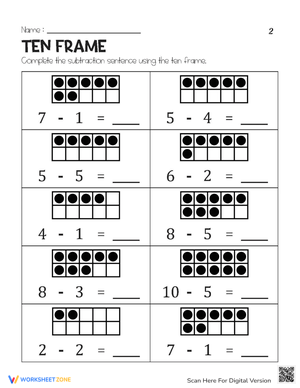
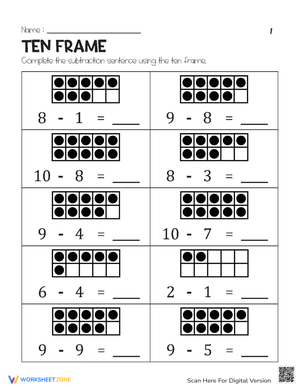
Kindergarten Subtraction and Ten Frames printable worksheets
These kindergarten subtraction and ten frames printable worksheets give teachers an immediately usable visual entry point into one of Kindergarten's most concrete early operations. The ten-frame structure does something loose collections of objects cannot — it holds the starting quantity in place while students cross out, remove, or mark what gets taken away, leaving the remainder visible without a full recount. The result is a resource that fits morning work, math centers, small-group reteaching, and take-home practice without requiring the format itself to change across settings.
The Specific Skills These Worksheets Target
Each worksheet covers subtraction within 10, with several worksheets that stay within 5 for students who need a lighter starting point. The tasks move from picture-based removal — crossing out counters inside a printed ten frame — to completing a matching subtraction equation, and eventually to writing the full equation from the picture alone without a model sentence provided.
- Identifying a starting quantity displayed in a ten frame
- Crossing out or marking the amount being subtracted
- Counting the remaining counters and recording the difference
- Connecting the ten-frame image to a written subtraction sentence (for example, 7 − 3 = ___)
- Distinguishing the starting number from the amount removed — a distinction students consistently collapse in the earliest weeks of instruction
The format stays predictable across every worksheet in the set, and that consistency matters. Five-year-olds have real cognitive load limits. When a child does not have to decode a new layout on every new worksheet, more working memory is available for the subtraction itself.
Ten Frames and the Problem They Actually Solve
Random dot arrangements — the kind printed on many early math worksheets — force children to count the entire group from scratch each time. A ten frame eliminates that problem because the spatial layout carries information. A full top row tells a child there are at least 5. A partially filled bottom row narrows the count quickly. When subtraction is introduced, students are not starting fresh from a random scatter; they are reading a structure they already recognize.
The crossed-out counter is the critical visual in this format. Students learn early that a circled X means "gone." What they struggle with is accurately reading the remaining quantity when the crossed-out counters are still visible in the frame. That is not a failure of the format — it is a developmental pattern worth watching, and the ten frame makes it visible in a way that a number line does not.
Where These Worksheets Land in the School Day
Most kindergarten subtraction and ten frames printable worksheets work best when introduced through a teacher-modeled lesson before students ever see the worksheet. The first time, use a projected or oversized ten frame with physical counters, state the starting number aloud, remove a small amount, and ask students to say how many remain. Then distribute the worksheet — the visual match between the physical model and the printed layout makes the task immediately readable for young students.
From there, a three-part weekly routine holds up well. On Monday, students work through simpler problems within 5 alongside the teacher in a whole-group or small-group setting. Midweek, students practice independently using a matching worksheet with numbers within 10. By Friday, pull two or three problems from the set as a quick review check — not graded, just observed. That Friday observation tells you more about retention than the midweek independent worksheet does.
- Math centers: Pair each worksheet with a small tray of two-color counters so students build the starting number physically before crossing out on paper.
- Small-group reteaching: Read the ten-frame picture aloud together, pointing to each counter, before any student writes anything. This surfaces tracking errors immediately.
- Exit tickets: Cut individual problems from a worksheet and use them at the door — two problems, thirty seconds, clear information about who got it and who did not.
- Take-home practice: The printed ten-frame format is readable for families without additional instructions. Parents understand "cross out and count what's left" on first glance.
Recurring Errors in Early Subtraction — and What to Do With Them
The most consistent error in early subtraction is recounting the crossed-out counters instead of skipping them. A student sees 7 counters, crosses out 3, and then counts all 7 again — including the removed ones — and writes 7 as the answer. The ten-frame layout makes this error visible rather than hidden. Because the counters sit in fixed positions, a teacher watching from across a small table can see a child's finger moving across removed counters and redirect before the wrong answer gets recorded.
A second error involves misreading the equation structure. When a worksheet shows 9 − 4 = ___, students who are still orienting to print will sometimes write 4 as the answer, treating the second number as the result, or copy 9 as the starting number they recognize. These are not arithmetic errors — they are reading errors about what the equation is asking. Pairing the ten-frame picture with the equation catches this pattern because the picture answer sits right there for comparison.
There is also a subtler habit: students who cross out accurately but recount the remainder from 1 every single time, even when the ten frame's top-row grouping offers a faster path. They have not yet internalized the five-anchor. This does not need correcting through the worksheet — it needs a brief conversation during small-group time, when a teacher can ask "how many are in the top row?" before any individual counting begins.
Standard Alignment
These worksheets align to CCSS K.OA.A.1, which asks Kindergarten students to represent addition and subtraction using objects, fingers, mental images, drawings, or equations. The ten-frame format addresses that standard directly — the printed counter array is the drawing-based representation the standard describes, and the matching equation ties the visual to the symbolic form students are expected to use.
They also connect to CCSS K.OA.A.2, which covers solving addition and subtraction word problems and equations within 10. In classroom terms, K.OA.A.2 is where Kindergarten students move from modeling removal to reading a number sentence and producing the difference independently. This set includes both picture-first and equation-first problems, which gives teachers a way to address both directions of that standard within a consistent, familiar format.
Adjusting the Set for Different Stages of Readiness
The ten-frame model handles differentiation naturally because the number range within a single frame — 0 through 10 — spans the full Kindergarten subtraction expectation. For students who are not yet solid within 5, use worksheets that cap the starting number at 5. The frame shows a half-filled top row at most, which reduces visual complexity without changing the task structure or requiring a completely different worksheet.
For students moving ahead, the adjustment is in equation format rather than number size. Instead of completing a partially written sentence (8 − 3 = ___), give them a worksheet that shows only the ten-frame picture and asks them to write the entire equation from scratch. That shift — from filling in a blank to producing a complete number sentence — requires holding the starting number, the removed amount, and the difference in mind simultaneously, which is a meaningful step up within the same Kindergarten standard.
- More support: Physical counters alongside each worksheet, problems within 5, teacher reads the equation aloud before the student writes anything
- At grade level: Crossing out printed counters and completing the equation independently, working within 10
- Extension: Writing the full equation from the picture without a model sentence, and working with missing-number problems such as 6 − ___ = 2
Frequently Asked Questions
Do students need to know how to write numbers before using these worksheets?
Not fully. Most problems involve completing a partially written equation, so students fill in one digit rather than forming an entire number sentence from scratch. For students still developing number formation, accept verbal answers during small-group time and use the worksheet as a discussion prompt while the student dictates the answer aloud.
How many problems per worksheet is reasonable for independent Kindergarten practice?
Four to six problems is a solid range. More than that and attention tends to drift before the last row is complete; fewer than four does not provide enough repetition to reveal a pattern. For exit tickets or quick observational checks, two or three problems are sufficient.
Can these worksheets replace hands-on manipulative work?
No. Kindergarten subtraction and ten frames printable worksheets work best when they follow concrete work with physical objects — they are the practice layer, not the introduction. Moving too quickly to paper before students have handled real counters produces accurate-looking worksheet work that does not reflect genuine understanding.
Do these worksheets work for students who have not yet mastered addition within 5?
They work as long as teachers pull the within-5 worksheets and provide counting support alongside them. Subtraction does not require prior mastery of addition — it requires a solid understanding of removing from a group and counting what remains. The ten-frame structure actually makes addition and subtraction relationships visible at the same time, which is why many teachers introduce kindergarten subtraction and ten frames printable worksheets alongside addition work rather than strictly sequencing subtraction afterward.
Clear All