Oval Printable Worksheets for Kindergarten
These oval printable worksheets for kindergarten give teachers a focused set of resources for one of early geometry's trickier teaching moments — the point where children realize a shape can be curved and closed without being a perfect circle. The set covers tracing, visual discrimination, real-world matching, and open-ended drawing, giving teachers options across different parts of the math block.
What Students Practice Across the Set
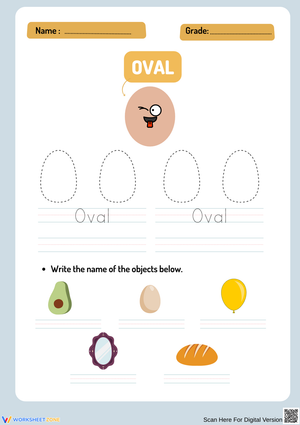
Each worksheet targets a specific skill rather than trying to do everything at once. The tracing worksheets use dashed ovals at multiple sizes — starting larger, where the continuous curved path is easier to follow, then moving to smaller forms that demand more pencil control. Some include directional arrows showing students where to start the stroke, which matters for building the kind of automatic letter-formation habits that carry over into handwriting. The continuous curve of an oval is the same motor path that underlies letters like O, C, Q, and G, and it's worth telling students that explicitly — it gives the tracing work a purpose beyond shape recognition.
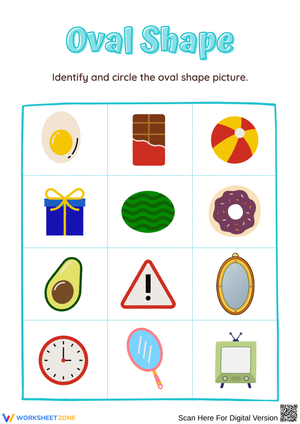
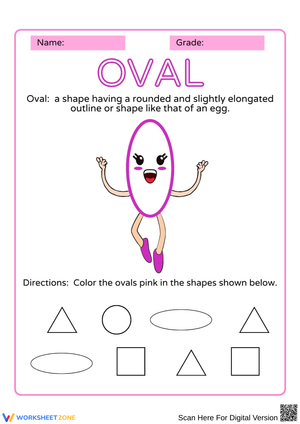
Visual discrimination worksheets place ovals among circles and rectangles with rounded corners, which are exactly the comparisons that cause confusion. Find-and-color worksheets ask students to mark only the ovals in a mixed field of shapes — not a simple task when a slightly stretched circle sits right next to a true oval. Real-world matching worksheets connect the shape to familiar objects: eggs, footballs, mirrors, and watermelon slices. Students draw a line from the 2D shape to its real-world counterpart, which asks them to generalize the oval across orientation and size rather than recognizing it only in one standard presentation. One worksheet turns the oval into a starting point for a drawing — students can transform the shape into a fish, a face, or a submarine — and that activity works best after recognition is already solid, because students who haven't internalized the shape will let their oval drift toward a circle the moment they stop monitoring it.
Common Student Errors to Watch For and Address
The most consistent confusion we see in student work is treating the oval as a failed circle — a shape the student drew imprecisely, rather than a distinct shape in its own right. Ask a kindergartener to identify an oval and many will say "circle," because they associate roundness with circles and haven't yet developed a working concept of elongation. A child who names a circle without hesitation will still look at a wide, flat oval and say "that's kind of a circle" — not because they weren't paying attention, but because the cognitive category "stretched round shape" takes genuine repetition to stabilize. Presenting the oval across multiple worksheet formats, rather than returning to the same tracing activity several times, builds that repetition more effectively.
A second pattern appears on visual discrimination worksheets: some students mark rectangles with rounded corners along with the ovals. Those shapes share a rounded edge, and at a glance they feel related. This tells you the student is working from "rounded means oval" rather than "continuously curved, closed, and without corners means oval." A brief whole-group pause to compare those two shapes side by side before students work independently prevents this from hardening into a persistent misconception.
Fitting These Worksheets Into Your Weekly Planning
Tracing worksheets work well as morning work during the week the oval is introduced. Students settle in, and the controlled pencil movement brings focus down before whole-group instruction begins. The find-and-color and matching worksheets belong after direct instruction — sending students to those activities cold tends to produce guessing rather than reasoning, especially with a shape that doesn't carry the same universally recognized name that circle or square does.
For math centers, slide the find-and-color worksheets into dry-erase pockets. Students mark the ovals with a whiteboard marker, check their work with a partner, then wipe the sheet clean for the next rotation. The reusability helps, but so does the novelty — kindergarteners who are tired of pencil-and-paper tasks respond differently to a whiteboard marker. One effective anchor task to run alongside this center: put a bowl of plastic eggs, smooth river stones, and round counters on the table and have students sort by oval versus circle before they touch the worksheet. That physical sort primes students for the 2D discrimination work in a way that verbal explanation alone doesn't.
Reserve the creative drawing worksheet for Friday or for the final day of the oval unit. Students who haven't locked in the shape will need a visual reference nearby — posting a side-by-side comparison of a circle and an oval with brief labels gives them something to check against before they start drawing.
Adapting the Worksheets for a Range of Learners
For students still developing pencil control, the large tracing ovals are the right entry point. If grip is shaky, oval stamps or stencils let students produce the shape accurately while fine motor strength catches up. A first pass with the finger — tracing the dashed lines before picking up a pencil — slows the movement enough that students feel the continuous curve rather than rushing through it.
Students who move through tracing quickly can use the oval printable worksheets for kindergarten as a launch point for an extension: fill an entire sheet with a scene containing at least five oval objects, then label each one. That task shifts the work from identification to production and application, which is the right direction for students who already have the shape concept solid.
For students receiving pull-out support, pairing the worksheets with hands-on clay or shape blocks — working with a physical oval first, then moving to the 2D paper version — reduces cognitive load by giving students a concrete referent before the abstract 2D form appears. Narrating aloud while working ("it's round but stretched, not perfectly round") reinforces the vocabulary these students need for the visual discrimination tasks.
Standard Alignment
These worksheets align with CCSS.MATH.CONTENT.K.G.A.2, which asks kindergarteners to correctly name shapes regardless of their orientation or overall size. In classroom terms, this standard sits at the center of most early-year geometry units, and the oval works naturally as an extension of circle study — it pushes students to define "round" more precisely than they typically do at first exposure. The visual discrimination worksheets address K.G.A.2 directly by presenting ovals in multiple sizes and orientations alongside near-look-alike shapes. The real-world matching worksheets connect to CCSS.MATH.CONTENT.K.G.A.1, which asks students to describe environmental objects using shape names. The oval printable worksheets for kindergarten in this set support both standards within the same instructional unit, so teachers don't have to treat identification and real-world application as separate lessons.
Frequently Asked Questions
How do I explain the difference between a circle and an oval to a five-year-old?
A physical demonstration works faster than any verbal definition. Take a loop of string, hold it in a circle, then pull two opposite sides to stretch it into an oval. That shift from round to elongated takes about ten seconds and lands more clearly than most explanations manage. Egg and football are the most reliable real-world reference pair afterward: a circle is like a wheel, an oval is like an egg. Once students have that comparison in memory, they have something concrete to check against when sorting shapes independently.
When in the school year should these be introduced?
Most kindergarten geometry units open with circles, squares, and triangles in the fall. Ovals work best when introduced immediately after the circle unit, while that concept is still fresh — mid-year for many classrooms following a spiral curriculum. Bringing in the oval right after the circle makes the comparison active and specific rather than asking students to file away another shape name with nothing to contrast it against.
Can the worksheets serve as a formative check, or are they strictly practice?
The oval printable worksheets for kindergarten in this set function as informal formative tools. A completed find-and-color worksheet tells you quickly whether a student can distinguish ovals from other rounded shapes under independent conditions. If a student misses the same shape type across two different worksheets, that's a reliable signal for a brief small-group review before the unit moves forward. These aren't a substitute for a standards-aligned geometry assessment, but they give you usable information without carving out a separate testing moment in an already full day.
Are there handwriting connections worth making explicit to students?
Yes, and students respond well when you name it. The continuous curved stroke used to trace an oval matches the motor path for letters like O, C, Q, and G. Pointing this out briefly — not as a full handwriting lesson, just a quick observation before students begin — gives them a reason to take the tracing work seriously. The worksheets that include directional stroke arrows are especially useful for this connection, because they establish where to start the curve, which is exactly the kind of habit that carries into letter formation later in the year.
Clear All