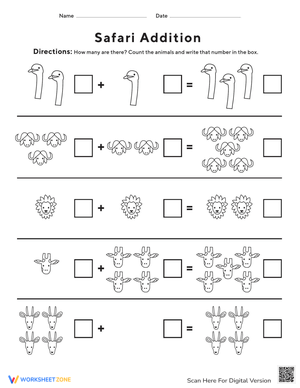
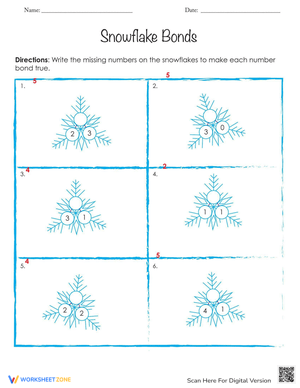
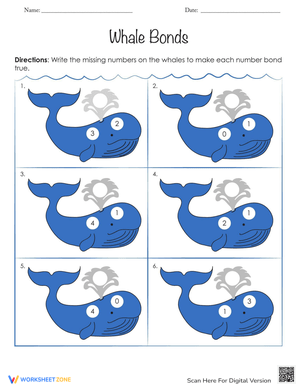
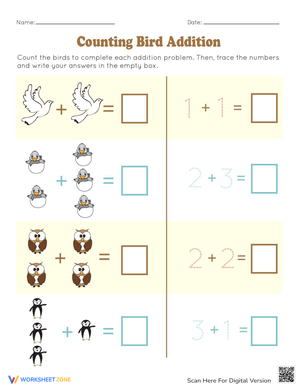
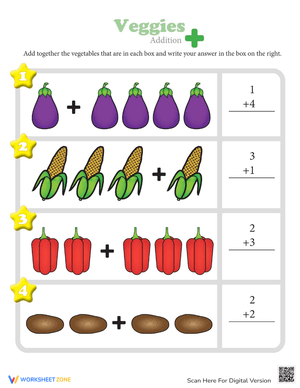
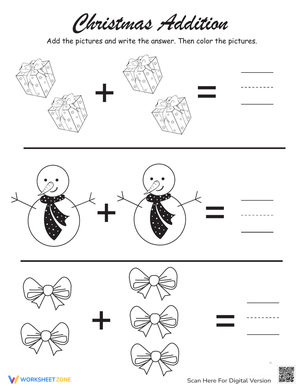
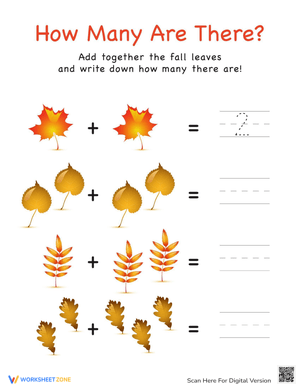
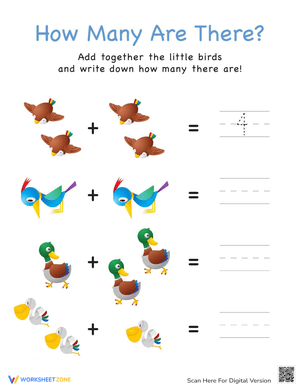
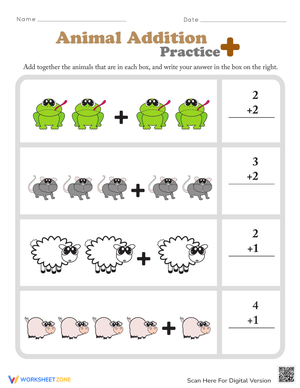
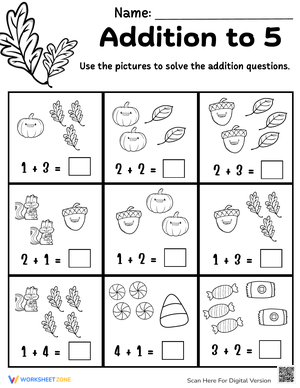
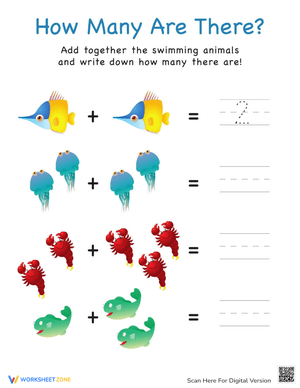
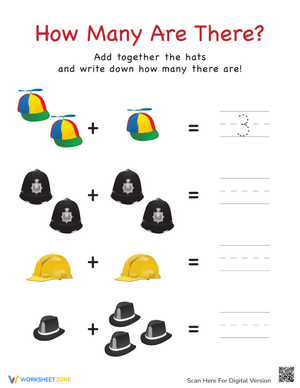
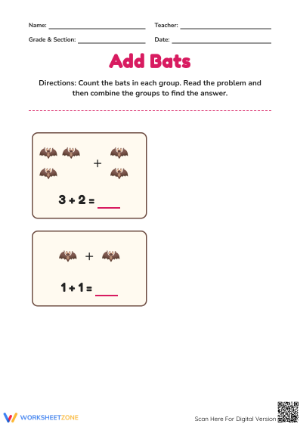
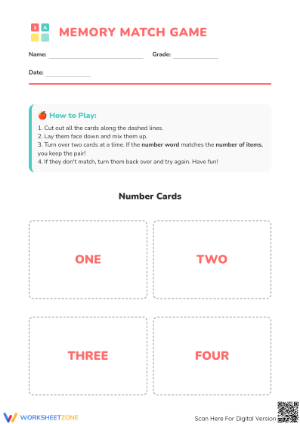
These addition within 5 worksheets for kindergarten give teachers a focused, printable set built around the specific moment when students are first grasping what it means to put two groups together. The numbers stay at or below five across every task, which keeps cognitive demand manageable so children can spend their attention on the concept of combining rather than on the strain of tracking a large count.
The Specific Skills Each Worksheet Targets
Each worksheet works within a narrow skill range on purpose. Tasks pull students through several representations of the same underlying idea—counting objects in two groups, reading a ten frame, recognizing dot patterns, tracing or writing an equation—so they practice transferring understanding across formats without the sum ever growing past five. Specific formats students work with include:
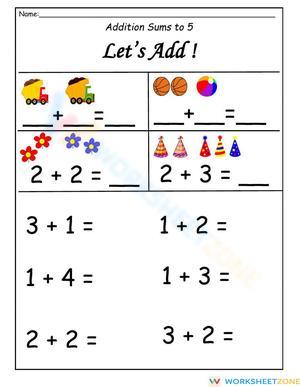
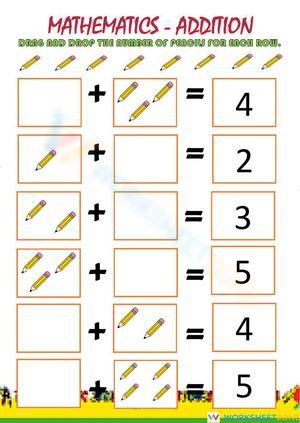
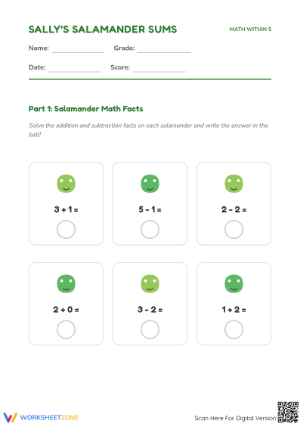
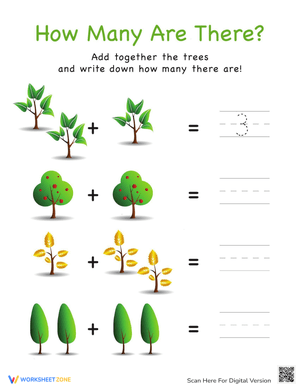
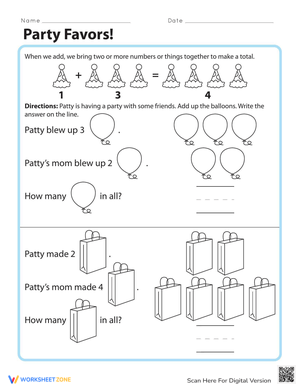
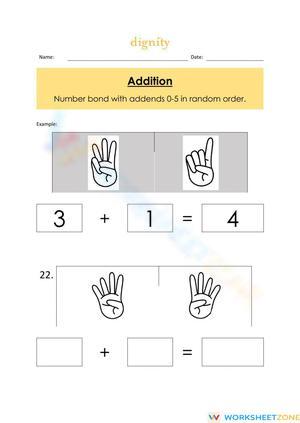
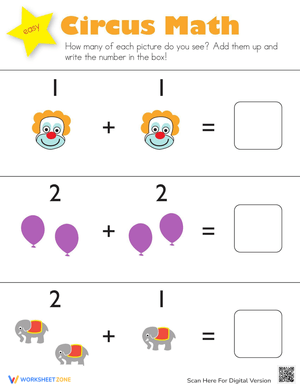
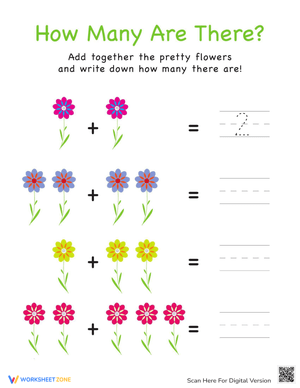
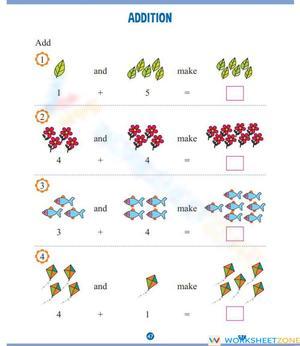
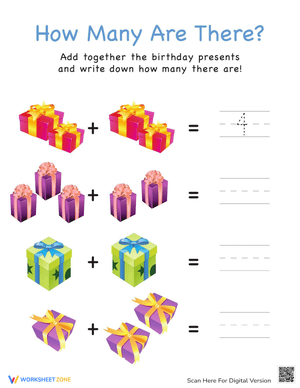
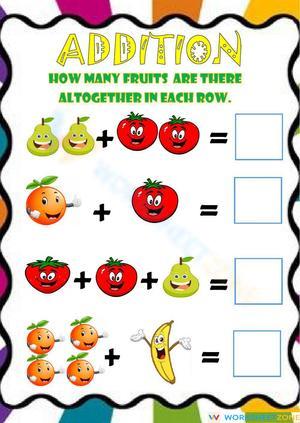
- Picture addition: Two sets of drawn objects (bears, apples, stars) with blank boxes for each part and the total.
- Ten frame tasks: Students fill empty cells or count marked ones to find how many altogether.
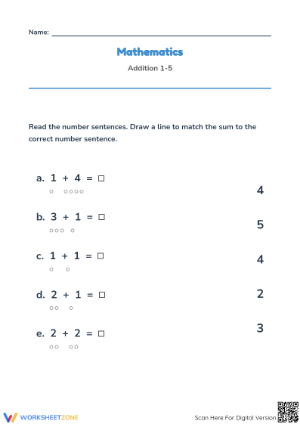
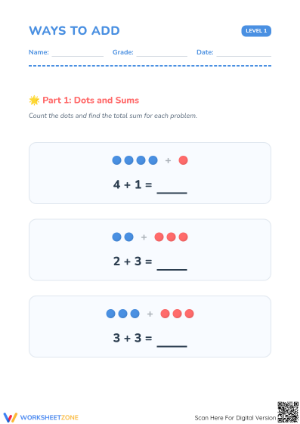
- Dot and dice patterns: Children combine two familiar arrangements, practicing quick quantity recognition before connecting it to a written equation.
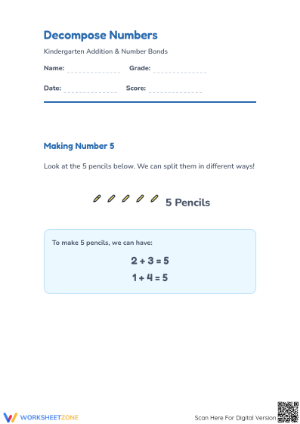
- Equation tracing and writing: Students write forms such as 2 + 3 = 5, with numerals large enough to trace confidently.
- Short story prompts: One or two sentences set a small scene—"2 frogs sat on a log. 1 more hopped over."—and students fill in the equation.
The variety across the set matters more than any single format. A child who reads a ten frame correctly in isolation may still write "2 + 3 = 23" when asked to record the equation—because the equation step is a different cognitive task than the visual one. Moving through multiple representations reveals exactly where that gap lives.
Mistakes Students Make That These Worksheets Help You Catch
The most consistent error at this level is not miscounting but misunderstanding what the plus sign instructs the student to do. A child who counts both groups separately will sometimes write two separate totals—"2" and "3"—in the answer box instead of finding the combined total of five. They counted correctly; they just did not join the groups. Watching for this during a picture-addition task is one of the clearest early diagnostic moments the set offers.
A second pattern that appears regularly in student work is what teachers sometimes call "recount from one." A student counts the first group, arrives at 2, then when counting the second group restarts from 1 rather than continuing from 2. With sums this small the answer is often still correct by chance, but the strategy does not hold as numbers grow. The dot-pattern worksheets are particularly useful here because a familiar arrangement prompts some students to recognize the first group instantly, nudging them naturally toward counting on from a known quantity rather than restarting every time.
Building These Worksheets Into Your Teaching Week
The most effective placement is immediately after hands-on modeling—not before it, and not as a standalone task without any in-class groundwork. A five-minute warm-up with actual counters on a mat, where the teacher builds "2 bears and 1 bear" and asks how many in all, makes the transition to pencil and paper feel like recording rather than guessing. That sequence is where addition within 5 worksheets for kindergarten deliver the most value: as a recording step that follows concrete experience, not as an introduction to the concept.
Morning work is a reliable slot. A short task settles students into math thinking before the formal lesson begins, and because the numbers are small, most children finish without frustration in roughly five to eight minutes. Centers are another strong fit—once students know the routine from whole-group instruction, these worksheets run with minimal teacher oversight, which frees you to pull a small group. For reteaching, the single-skill focus makes it straightforward to pinpoint whether a student's difficulty is with counting, one-to-one correspondence, or the meaning of the operation itself.
A practical storage note: organize PDFs by format type rather than by week. A folder for picture addition, one for ten frames, one for equations—that structure lets you pull exactly the right reteaching worksheet in two minutes instead of scrolling through a chronological stack when the lesson is already in motion.
Standard Alignment
These worksheets address CCSS K.OA.A.1, which asks kindergarteners to represent addition using objects, fingers, drawings, and equations, and K.OA.A.2, which covers solving addition word problems within 10—practiced here at the more accessible within-5 level. In practical classroom terms, K.OA.A.1 is the entry point: students demonstrate the concept through drawing and objects before equation notation becomes meaningful to them. The set is built around that sequence. Visual and concrete representations appear on most worksheets before any equation line asks students to write the number sentence independently.
Adjusting the Set for a Range of Learners
Even within one kindergarten class, students sit at very different points on this skill. Some are still solidifying one-to-one correspondence, while others already recognize small dot patterns and are beginning to count on from the larger number. A few targeted adjustments make the same worksheets work across that range.
- For students who need more support: Provide counters to place directly on the printed pictures. Cover the lower portion of each worksheet so only one problem is visible at a time—visual clutter alone can stall a child who is close to understanding the concept.
- For students ready to push further: Ask them to write a second equation with the addends flipped (3 + 2 = 5 alongside 2 + 3 = 5). The sum stays within five, but students begin building intuition for the commutative property without leaving the skill range.
- For fine motor challenges: Choose worksheets that require circling, matching, or stamping rather than extended numeral writing. The math stays intact while the physical demand decreases.
- For English language learners: Pair each worksheet with a spoken sentence frame before students pick up pencils: "___ and ___ make ___ in all." Saying it aloud first reduces the chance that language confusion is masking genuine math understanding.
The set also converts easily into dry-erase practice. Slide a worksheet into a plastic sleeve, hand students a marker, and the same task becomes reusable across center rotations or small-group sessions without consuming additional paper.
Frequently Asked Questions
Do these worksheets work for students who are still learning to write numerals?
Several worksheets in the set rely on circling, matching, and drawing rather than writing equations. For students still forming numerals, those formats let the addition practice happen without being blocked by handwriting demands. When writing is part of the task, the numerals involved run from 0 through 5—a narrower range than most kindergarteners are still actively working to master.
How many worksheets should students complete in one sitting?
One worksheet per session is typically the right pace. More than that tends to produce rushed answers or fatigue-driven errors rather than genuine practice. A student who finishes quickly is giving you useful information—it signals readiness for a different format or a slightly broader problem type, not just more repetitions of the same task.
Can addition within 5 worksheets for kindergarten be sent home for family practice?
Picture-based and ten-frame worksheets travel home well because the visual models make the task self-explanatory for most families. Equation-only worksheets are less reliable for homework, because without visual support, a child who is still shaky on the concept has no way to reconstruct meaning at home. When sending work home, add one short manipulative suggestion to the directions—"use pennies or small toys to act out each problem"—so families have a concrete way to help if their child gets stuck.
How does this set fit alongside a published kindergarten math curriculum?
These resources work as supplemental practice alongside any published program—not as a replacement for teacher-led instruction or the manipulative work most curricula include. Use them to add practice repetitions after a concept has been introduced, to fill a center that needs a self-sufficient math task, or as a quick formative check at the end of a lesson. The addition within 5 worksheets for kindergarten in this set stay tightly focused on a single skill, which is exactly what makes them useful as a supplement rather than a standalone program.













 Interactive Worksheet Maker
 Quiz Maker
 Word Search Maker
 Crossword Puzzle Maker
 Word Scramble Generator
 Sentence Scramble Generator
 Handwriting Worksheet Generator
 Name Tracing Generator
 Fill In The Blank Generator