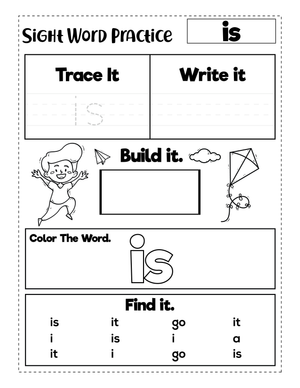
Kindergarten Sight Word Is worksheets
These kindergarten sight word is worksheets give teachers eight ready-to-print resources focused entirely on the word "is" — a Pre-Primer Dolch word that appears in nearly every sentence a new reader will encounter in their first months of school. Each worksheet targets a different skill, so the set builds the kind of varied, repeated exposure that moves a word from halting recognition into automatic recall. Teachers can pull individual worksheets for a specific purpose or work through the full set across a two-week unit.
What Each Worksheet in the Set Covers
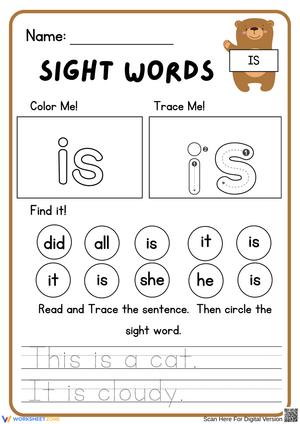
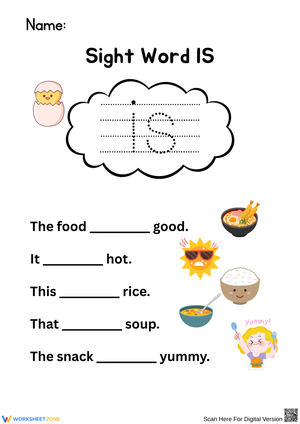
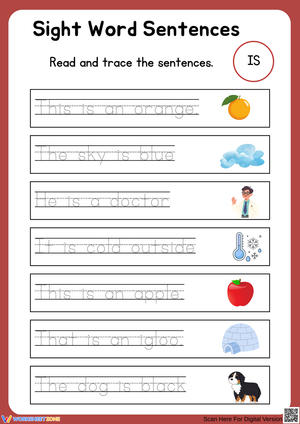
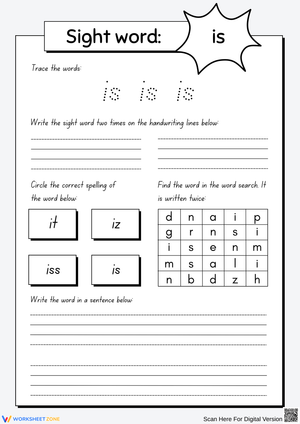
The set moves through four skill areas. Two worksheets focus on letter formation: students trace "is" along dotted lines, then copy it independently into blank boxes. A third asks students to circle every instance of "is" amid a cluster of look-alike words — "it," "in," "as," and "if" — forcing careful visual discrimination before any writing happens. Two worksheets place the word inside simple sentences, such as The sun is hot or She is running, where students read, underline the target word, and illustrate the sentence. One cut-and-paste worksheet has students reassemble the letters in the correct order and glue them down. The remaining two are informal checks: a word maze and a fill-in-the-blank sentence strip that teachers can use to gauge mastery before moving on.
Errors Teachers Will Spot and Should Address Early
The most common mistake with "is" is substitution. Students who can read the word in isolation will write "it" or "in" when completing a sentence from memory — the shapes are close enough that rushing produces the wrong word. Watch for this especially on the fill-in-the-blank worksheet, where a student writes The dog it big with full confidence. That tells you visual automaticity hasn't set in yet; the student is still pattern-matching rather than reading the whole word.
A second pattern shows up in the tracing worksheets. When children trace "is," the lowercase "s" often comes out reversed — a mirror image — particularly in October and November, when left-right directionality is still shaky for many five-year-olds. This is worth noting rather than correcting aggressively; it usually resolves with continued handwriting practice. What matters more is whether students are saying the word aloud as they trace, because silent tracing produces far less retention than tracing paired with verbal rehearsal.
Ways to Fit These Worksheets Into Your Weekly Routine
These resources work in three classroom slots that most kindergarten teachers already have: morning work, literacy centers, and small-group pull-out time. For morning work, one worksheet on the desk when students arrive sets a quiet, focused tone before the day officially starts — familiar format, low stakes, immediately doable. For literacy centers, drop the tracing or circle-the-word worksheets into dry-erase pockets so students can complete them with markers and wipe the surface clean for the next rotation. That approach stretches a single worksheet across a full week of center time without additional printing.
Small-group time is where the kindergarten sight word is worksheets earns its most targeted use. When you sit with three or four students who are still confusing "is" with "it," you can watch letter formation in real time, prompt verbal rehearsal, and catch reversals before they become habits. The sentence-reading worksheets work especially well here because you can hear whether students are guessing from picture context or actually reading the word.
Standard Alignment
These worksheets align with CCSS.ELA-LITERACY.RF.K.3.C, which requires kindergarteners to read common high-frequency words by sight. In classroom terms, this standard lives at the intersection of phonological awareness and early fluency — students are not decoding "is" phoneme by phoneme, they are recognizing it as a whole unit. The worksheets support progress toward this standard through repeated retrieval practice rather than phonics instruction, which is the appropriate approach for a word that doesn't follow standard CVC or consonant-blend rules. The fill-in-the-blank and sentence-reading worksheets also touch on CCSS.ELA-LITERACY.RF.K.4, which addresses reading emergent-reader texts with purpose and understanding.
Adjusting the Set for Students at Different Stages
Students who are still working on pencil grip benefit most from the tracing worksheet used early in the week, with the independent writing worksheets held back until grip and baseline control are steadier. For students who have already internalized "is" and need a challenge, pull the sentence-reading worksheets and ask them to generate their own sentence using the word before they underline it in the printed text — that production step moves them toward the next level of fluency.
For students receiving reading intervention, the cut-and-paste worksheet provides a concrete, manipulative-style experience without requiring strong fine motor control for handwriting. Pairing that worksheet with a brief oral component — having the student say the word, tap the letters, and say the word again — adds an auditory layer that pure paper-and-pencil work misses.
Frequently Asked Questions
Is "is" on the Dolch list or the Fry list?
Both. "Is" appears on the Dolch Pre-Primer list and in the Fry First 100. That overlap makes it a high-priority word: the two most widely used sight word systems both flag it as something kindergarteners need to own before they move into first-grade readers.
How many exposures does a kindergartner typically need before a sight word is automatic?
Research on early word learning points to somewhere between 20 and 40 meaningful encounters — meaningful meaning the student reads or writes the word in context, not just glances at a flash card. The range of activity types across the set helps reach that threshold without repeating the same task so many times that students stop paying attention to what they're doing.
Can I send these home for family practice?
The tracing and sentence-reading worksheets travel well as homework because they need no explanation — a parent can look at the worksheet and understand immediately what their child should do. Keep the cut-and-paste worksheet at school where scissors and glue sticks are readily available. When you do send a kindergarten sight word is worksheets home, a quick note reminding families to have the child say the word aloud while writing it makes at-home practice significantly more effective than silent copying.
When in the school year should I introduce this word?
Most kindergarten scope-and-sequence documents place Pre-Primer Dolch words in the first quarter, with "is" appearing as early as week three or four once students have some letter-sound foundation and understand what sight words are. The kindergarten sight word is worksheets set works best introduced after students have had a few weeks with simpler two-letter words like "a" and "I," so the baseline for what independent word recognition feels like is already established.
Clear All