Kindergarten onsets and rimes worksheets give early readers a concrete entry point into word structure at exactly the right developmental moment — after students can clap syllables, but before full phoneme segmentation is expected. An onset is the consonant or consonant cluster before the vowel in a syllable; the rime is the vowel and everything after it — in ship, sh is the onset and ip is the rime. This set covers the most productive short-vowel word families and provides multiple activity types so teachers can reach the same phonics target across whole-group lessons, small-group tables, and independent seat work.
The Specific Skills Each Worksheet Targets
Each worksheet isolates a distinct task within the onset-rime skill set rather than repeating one format across the whole unit. Activity types across the set include:
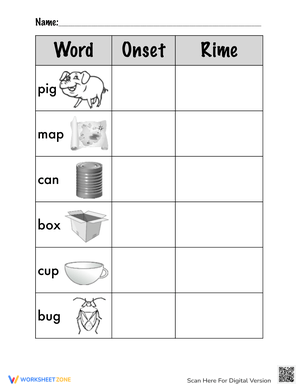
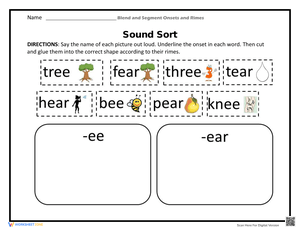
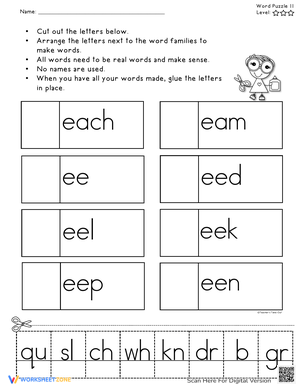
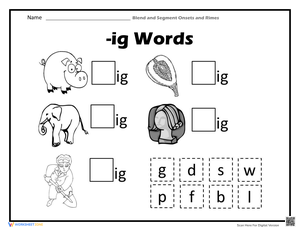
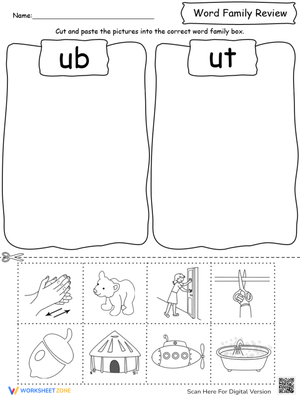
- Cut-and-paste word family sorting: Students cut picture or word cards and sort them under rime headers — -an, -ig, -op — pasting each card in the correct column. The physical act of sorting reinforces categorization in a way that circling answers does not.
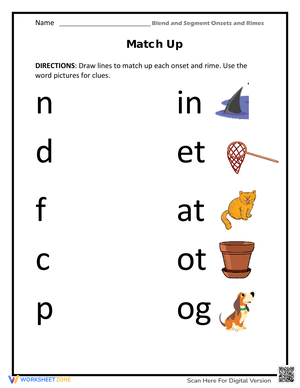
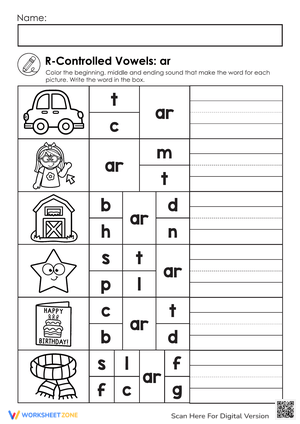
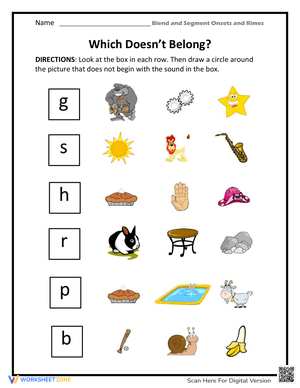
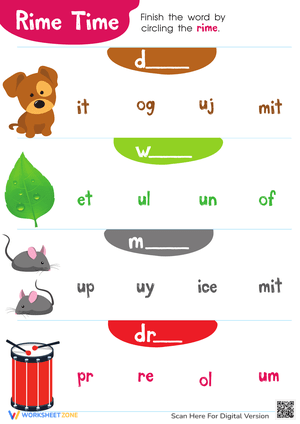
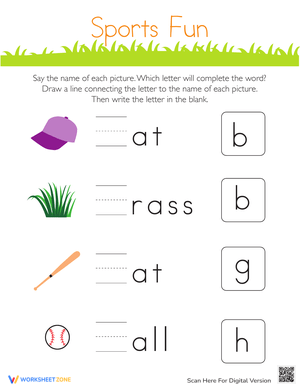
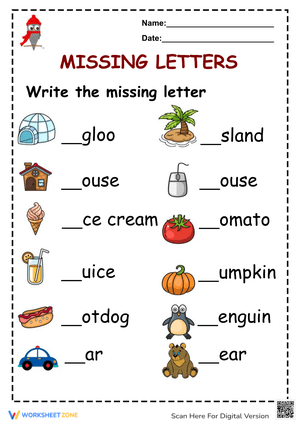
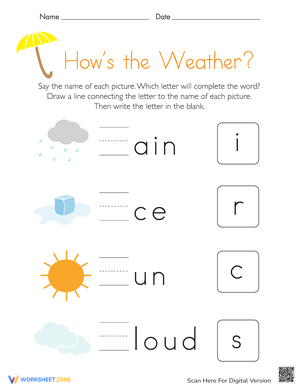
- Picture-to-onset matching: Images represent common CVC words; students identify the beginning consonant and write or circle the correct onset. This separates hearing the onset from blending it back — two skills that students often master on different timelines.
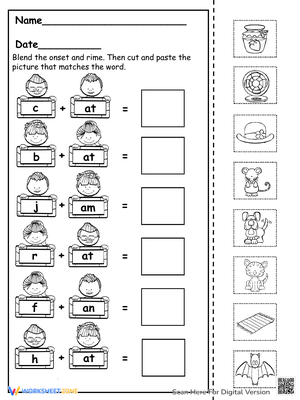
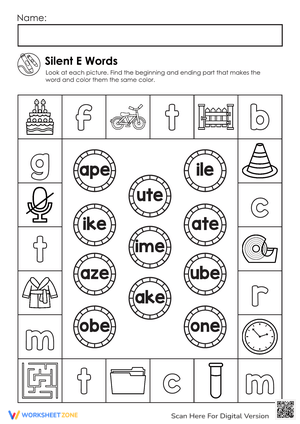
- Color-by-code blending: Students blend a printed onset and rime, read the resulting word, and color the labeled section a designated color. It keeps five-year-olds on task through independent practice without requiring constant teacher proximity.
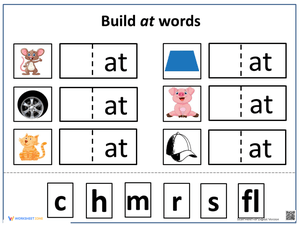
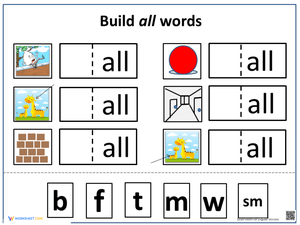
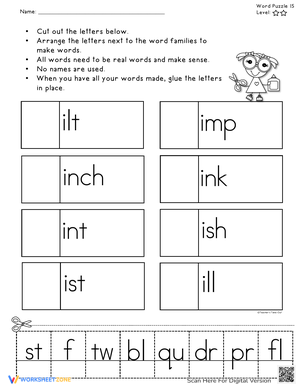
- Printable word-building sliders: Students slide onset strips past a fixed rime window — cycling through b, c, f, and h in front of -at — producing bat, cat, fat, and hat in sequence. Seeing one rime carry through four different words is what makes word families click for most students.
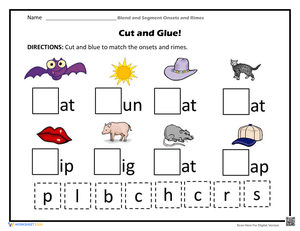
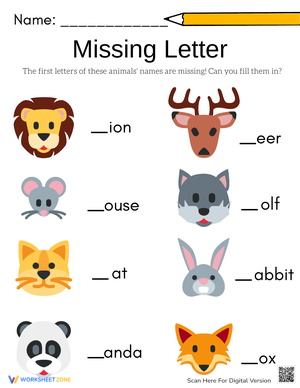
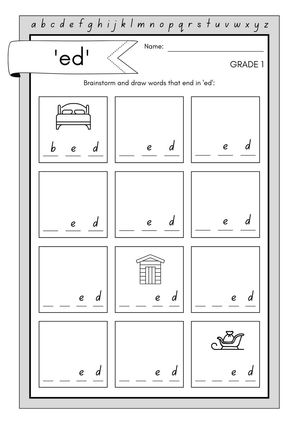
- Fill-in-the-onset completion: Students look at a picture, name the word, and write the missing onset to complete it beside the image. This format functions as the closest production check in the set and works well as a Friday exit task.
Selecting the Right Word Families to Start With
Not every rime is an equally useful entry point for kindergarteners. The most productive starting families are short-vowel rimes that map onto words children already say aloud — -at, -an, -ig, -op, and -ug each yield five or more concrete, familiar words students can attach to meaning immediately. Word families where several members are uncommon create unnecessary friction early on. -ell works because bell, fell, tell, and well are all within kindergarten oral vocabulary; -ib does not, because most of its words are rare or technical. The worksheets are sequenced around families with high word-count and strong oral familiarity, so students experience early success before moving into less obvious patterns later in the year.
Student Errors That Come Up Repeatedly — and How to Address Them
The most persistent mistake at this stage is sorting by initial sound rather than by rime: students put bat and bag together because both start with b, not because they share an ending pattern. They are still over-weighting the onset — the piece they learned to isolate first — and have not yet shifted attention to the vowel and what follows it. When you see a student sort this way consistently, oral practice before the worksheet does more good than another pass at the activity. Saying just the rimes aloud — "at, ag, at, ag" — and asking which pair sounds the same often clears the confusion in under two minutes.
A second error shows up in fill-in-the-onset tasks: students who know the word perfectly will write only the first phoneme of the onset instead of the full onset unit. A student who hears ship fills the blank with s rather than sh. This is a segmentation error, not a letter-sound error — the student is pulling out the first phoneme of the onset rather than treating the whole onset as one unit. That distinction matters because it points to different next steps: more onset-rime oral work, not additional consonant digraph drill.
How to Build These Worksheets Into Your Literacy Block
Kindergarten onsets and rimes worksheets work best as one piece of a multi-modal routine rather than carrying the full phonological awareness block on their own. A structure that holds across the week: introduce the target rime Monday with a whole-group oral blending chant — onset, pause, rime, blend — before any print appears. Use a picture-matching or fill-in worksheet Tuesday at guided reading tables so you can listen while students say the word before they write. Wednesday's center rotation is where the slider and cut-and-paste activities earn their time, because both formats require enough procedural steps that students stay occupied while you pull intervention groups. Reserve the color-by-code worksheet for Thursday independent practice. Friday's fill-in-the-onset task doubles as an informal check — collect the worksheets and sort them into three piles: secure, developing, and not yet. By Friday afternoon you know exactly who needs small-group time the following week.
One technique worth adopting from the start: ask students to write onsets in one crayon color and rimes in another on every writing task — blue for the onset, red for the rime, consistent across the whole unit. Within two weeks, most students begin tapping the two parts of new words during shared reading without any prompting at all. That transfer is the signal that the concept has moved from procedural to automatic.
Adjusting the Worksheets Across Readiness Levels
Students who are still building letter-sound correspondence need picture cues next to every item and a narrower choice set — two word families at a time rather than three or four. Pre-cutting the pieces for sorting tasks removes scissor control as a variable, which matters considerably in kindergarten. For these students, the goal of each worksheet is one clean phonics success without fine-motor frustration interrupting the reading work.
Students who move quickly through single-consonant onsets are ready for onset blends: tr, sl, cr, bl. These kindergarten onsets and rimes worksheets include options that pair familiar rimes like -op and -an with consonant cluster onsets, producing words like crop, slop, clan, and plan. The activity format stays identical — same slider structure, same sorting columns — while the phonics demand increases, so fluent students remain in the same classroom routine without needing an entirely separate task.
Standard Alignment
These worksheets address CCSS.ELA-LITERACY.RF.K.2.c, which requires kindergarteners to blend and segment onsets and rimes in single-syllable spoken words. That standard sits inside the RF.K.2 phonological awareness cluster — which also covers rhyme recognition, syllable segmentation, and phoneme-level tasks — and is typically introduced in the first trimester once students demonstrate solid rhyme awareness. The fill-in-the-onset and word-building activities target the segmentation half of the standard; the color-by-code and slider tasks target the blending half. Teachers whose districts formally benchmark phonological awareness in late winter will find that working through this set consistently from fall gives students well over a hundred practice opportunities before that assessment window arrives.
Frequently Asked Questions
What is the difference between a rime and a rhyme?
A rime — spelled without the h — refers to the vowel and any consonants following it within a syllable. In phonics instruction, rime typically means the consistent letter pattern shared by a word family: -at, -ig, -op. A rhyme is an auditory match — two words sound alike at the end. Words in the same word family always rhyme, but two rhyming words can belong to different orthographic families: light and bite rhyme but carry different spelling patterns in the rime position. For onset-rime instruction specifically, the focus is on those letter patterns, which is why word families are the organizing structure.
At what point in the kindergarten year should onset-rime instruction begin?
Most kindergarteners are ready for onset-rime work after they demonstrate solid syllable awareness — typically mid-fall. Students who can reliably clap syllables and identify rhymes by ear have the prerequisite phonological awareness to shift attention inward to within-syllable structure. If a student is still inconsistent with rhyme recognition, address that first rather than pushing onset-rime tasks before the foundation is in place.
How do these worksheets connect to phoneme-level work students do later in the year?
Onset-rime practice builds the segmentation habit — students learn that words divide into parts — before the number of parts increases. When phoneme isolation and full segmentation arrive later in the year, students who have internalized the onset-rime distinction pick up three- and four-phoneme segmentation faster. These kindergarten onsets and rimes worksheets are not a detour from phoneme work; they are the developmental step that makes phoneme work land cleanly when the time comes.
Can these worksheets replace decodable book practice?
No, and teachers should not expect them to. Worksheet practice builds pattern recognition and segmentation in a controlled format. Decodable readers give students the experience of applying those patterns to connected text under fluency conditions. The worksheets handle recognition and production in isolation; the books handle application in context. Both are necessary, and neither substitutes for the other.












 Interactive Worksheet Maker
 Quiz Maker
 Word Search Maker
 Crossword Puzzle Maker
 Word Scramble Generator
 Sentence Scramble Generator
 Handwriting Worksheet Generator
 Name Tracing Generator
 Fill In The Blank Generator