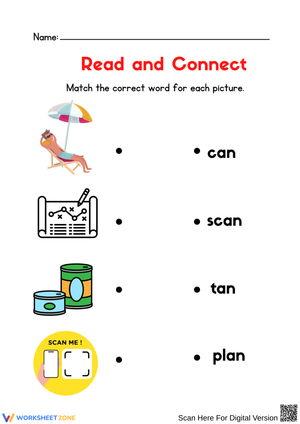
These cvc words reading worksheets for kindergarten give teachers a print-ready route to short-vowel decoding practice at exactly the point in the year when young readers are learning to hold three sounds in sequence and push them together into a whole word. The set covers all five short-vowel families and uses several task formats that keep students actively reading and blending rather than sorting shapes or filling in the first letter and guessing the rest.
What the Set Covers
Each worksheet stays within one short-vowel family — a, e, i, o, and u each have their own focused resources rather than appearing together on the same worksheet. That single-vowel structure is intentional: when students work within one vowel family at a time, errors are easier to isolate, and teachers can move between vowel families based on what they hear during guided reading rather than following a fixed calendar.
The formats across the set include:
- Blending lines: Students read each phoneme in sequence and then say the whole word. Several worksheets include a small arrow printed beneath the word to reinforce left-to-right tracking for students who are still inconsistent about where they start reading.
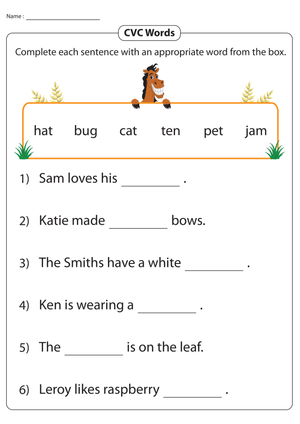
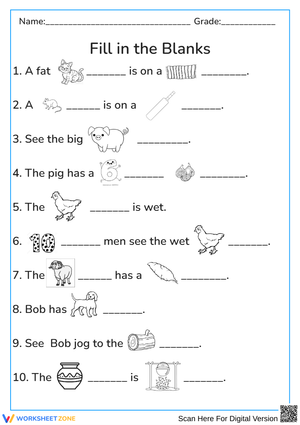
- Missing vowel completion: Students see a frame such as c_p or p_n and must identify and write the middle sound. This format is useful precisely because it prevents students from blending past the vowel without making a deliberate choice about it.
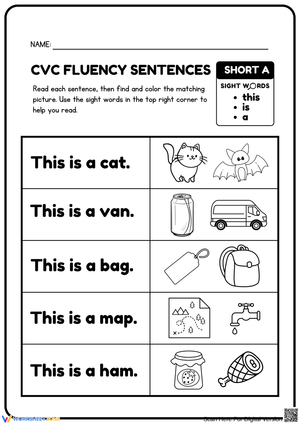
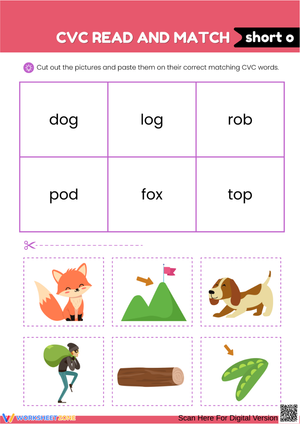
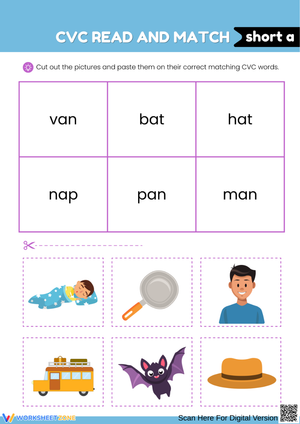
- Read and match: Students read a printed CVC word and draw a line to the correct picture. Best used after direct modeling — without it, some students reverse the task and use the picture to guess the word rather than reading print to confirm it.
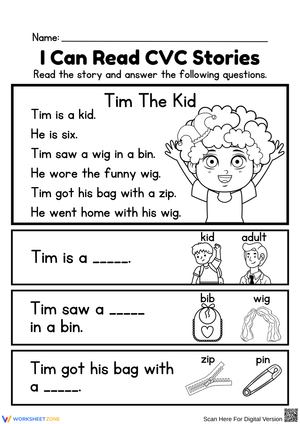
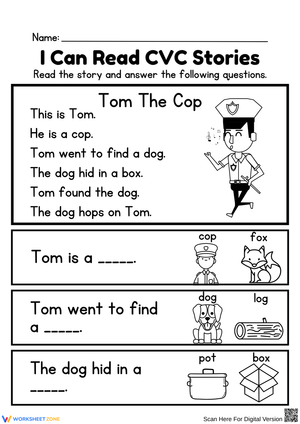
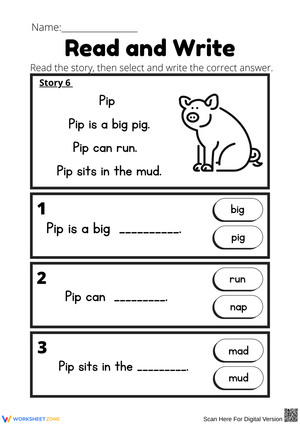
- Short decodable sentences: A handful of worksheets include one or two brief lines — "The hen sat." — that ask students to carry the short-vowel pattern past isolated word reading. These work as a bridge, not a starting point.
- Trace and read: Tracing the word before reading it slows the decoding process in a way that benefits students who are racing to finish and skipping the middle sound. This format is particularly useful in early fall before pencil fluency and phonics work have stabilized together.
Mistakes Students Make That These Worksheets Surface
The most consistent error at this stage is middle-vowel substitution. A student reads bit as bat, or hop as hip, not because they are guessing randomly but because they are locking onto the first and last consonants — which are familiar and stable — and pulling in a vowel that feels approximate. The missing-vowel format makes this error immediately visible because the student has to commit to the middle sound in writing rather than sliding through it during oral blending where it is easy to miss.
A second pattern is directional. Some kindergartners in early fall are not yet reliably tracking left to right across a three-letter word. They read tap as pat — not because they do not know the sounds, but because they have not yet fully internalized where to begin. The blending-line worksheets address this directly. If you see consistent reversal errors, the fix is not slowing phonics instruction; it is adding more explicit left-to-right tracking practice alongside the decoding work.
One real limitation of this format: students who succeed on isolated word tasks will sometimes stall on the short decodable sentence worksheets. They read sit correctly on its own but stall at "Can the dog sit?" because can and the are not CVC words. That is not a phonics failure — it is a signal that sight word instruction needs to run parallel to CVC decoding, not after it is complete.
Working These Worksheets Into Your Lesson Plan Without Overcomplicating It
A 10-minute block is enough time to do this well. Model one item aloud, release students to complete the rest, and do a fast check before the group transitions. In whole group, that sequence fits neatly between the morning phonics lesson and center rotations. In small group, each worksheet becomes a quick diagnostic snapshot — what the student says aloud before marking an answer is often more informative than what they circle.
For teachers who run reading groups, cvc words reading worksheets for kindergarten serve the diagnostic loop most effectively when the worksheet matches the error pattern from that group's most recent session. If a student read set for sit on Tuesday, the short-i worksheet goes in the folder for Thursday — not a general phonics review. That targeted pull is what separates worksheet practice from busywork.
- Literacy centers: Slide each worksheet into a dry-erase sleeve for repeated use without reprinting. Read-and-match and missing-vowel formats work especially well this way.
- Take-home practice: Send one familiar-format worksheet with a brief parent note naming the target vowel. Families can support practice more effectively when they know specifically what to listen for.
- Intervention folders: Organize by short vowel and pull the folder that matches the vowel family causing errors in the student's oral reading, rather than working through the set from start to finish in order.
- Morning warm-up: Use the most predictable formats — trace and read, read and match — so students can begin independently without waiting for directions. Familiar task structures also reduce the cognitive load of managing a new format alongside a new phonics pattern.
Standard Alignment
The worksheets align with CCSS.ELA-LITERACY.RF.K.3b, which calls on students to associate short and long sounds with common spellings for the five major vowels. In kindergarten, the CVC pattern is the primary instructional vehicle for this standard because it isolates the short vowel between two stable consonants, giving students a predictable letter context in which to practice vowel identification repeatedly. Most phonics sequences address RF.K.3b from mid-fall through spring, introducing vowel families one at a time in a deliberate order rather than all at once.
The blending-line and segmentation formats also connect to RF.K.2d, which targets phoneme blending and segmentation at the individual sound level. Teachers working within a structured literacy framework can use these worksheets as the print-based follow-up to the oral blending routines already built into their phonics block — the oral work comes first, and the written practice confirms whether it transferred to print.
Adapting the Set Across a Mixed-Readiness Class
The range of phonics readiness in a single kindergarten class in November is genuinely wide — some students are still working out consonant-letter correspondences while others are reading short decodable sentences without prompting. The cvc words reading worksheets for kindergarten in this set support that range because the task formats are distinct in what they actually require students to do, not just in visual complexity.
For students who need additional support, the trace-and-read and blending-line worksheets provide the most structured path. Preteach three to four target words by tapping out the phonemes on fingers before the student looks at print — that oral foundation means the written decoding task is reinforcement rather than first contact with the word.
For students working solidly at grade level, missing-vowel completion and read-and-match formats hit the target. Add one step: after finishing the worksheet, ask the student to read the full word list aloud without looking at the pictures. Stripping away the picture support is a quick check for whether the decoding is real or partially picture-driven.
For students already reading beyond the CVC stage, the short decodable sentence worksheets serve as a fluency check. Pair the task with a brief word sort by vowel sound afterward, or ask the student to generate two new words from the same vowel family in writing. That generative step requires deeper pattern knowledge than fill-in practice does, and it moves quickly enough that high-readiness students are not waiting for the group.
Frequently Asked Questions
When in the kindergarten year should students start CVC word practice?
Most structured phonics sequences introduce CVC words after students have solid consonant-letter knowledge and can segment three phonemes orally without support. In practice, that is typically mid-fall for students who entered kindergarten with some phonological awareness already in place. Starting CVC decoding before phoneme segmentation is secure tends to produce first-letter-plus-guess behavior rather than actual blending — the student looks at c, says cap, and moves on without reading the middle or final sounds.
Can these worksheets stand alone as a phonics program?
No, and they are not meant to. These are practice resources, not a teaching sequence. They work best as the print-based portion of a lesson that has already included oral phoneme work and explicit teacher modeling. Using a worksheet without the oral foundation first is a common misstep — the student who does not yet know how to blend will not figure it out from the worksheet alone, and you will spend the lesson explaining directions instead of watching students decode.
How should I sequence the short-vowel families when using this set?
Most phonics programs introduce short a first, then i, then o, then e, then u — based on how auditorily distinct the vowels are from each other. Short e and short i are easy to confuse, so spacing them out in the sequence reduces interference between the two sounds. Follow whatever order your core program uses and pull worksheets from the matching vowel folder rather than working through the set from beginning to end regardless of where students are.
Are these worksheets appropriate for English language learners?
The cvc words reading worksheets for kindergarten in this set use common, high-imageability words — cat, sun, pig, bed — that appear in most early ESL vocabulary sequences. For students still developing English phoneme awareness, picture-supported formats work better than text-only tasks. Preteaching three to four target words before the student sees the worksheet reduces the vocabulary barrier enough to keep the phonics work in the foreground rather than the word-meaning work.












 Interactive Worksheet Maker
 Quiz Maker
 Word Search Maker
 Crossword Puzzle Maker
 Word Scramble Generator
 Sentence Scramble Generator
 Handwriting Worksheet Generator
 Name Tracing Generator
 Fill In The Blank Generator