Hearing Syllables Printable Worksheets for Kindergarten
Hearing syllables printable worksheets for kindergarten give teachers a reliable, low-prep entry point for one of the earliest phonological awareness skills — the ability to break spoken words into beat units — before students can read a single word of print. Every worksheet uses picture prompts rather than text, keeping the task purely auditory: students name the image, clap or tap the beats, and record the count. The set spans several activity formats so teachers can rotate through them across multiple sessions instead of exhausting one approach in a single week.
The Specific Skills Each Worksheet Builds
Each worksheet asks students to do something slightly different with the same core competency — listening to a spoken word and identifying its syllable structure. Activity formats across the set include:
- Clap-and-circle pages: Students say the picture name aloud, clap once per beat, and circle the correct number (1, 2, or 3) beneath the image.
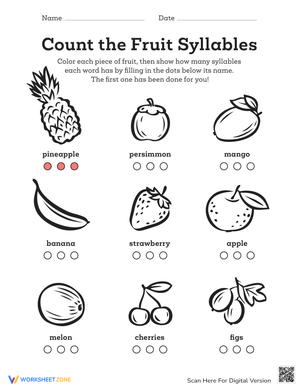
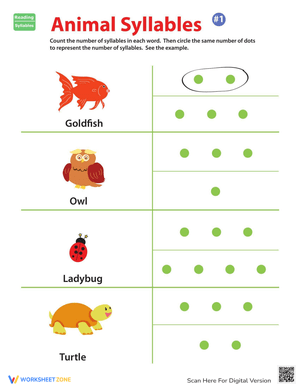
- Tap-the-dot formats: A row of three dots sits below each picture; students tap one dot per syllable and mark how many they used. The physical structure slows impulsive guessing in a useful way.
- Cut-and-sort activities: Pictures get sorted into columns labeled by syllable count. Committing to a column rather than a number makes partial understanding visible quickly.
- Color-by-syllable-count pages: Each syllable count carries an assigned color. Students self-monitor by checking whether the coloring looks consistent across the worksheet — a built-in comprehension check.
- Draw-a-line matching: Students connect each picture to the correct numeral. Works well as a quick formative check near the end of a unit.
Word selection stays within vocabulary kindergartners know orally — cat, tiger, butterfly, dinosaur — so students spend cognitive energy on counting beats rather than identifying unfamiliar pictures. Words with ambiguous regional pronunciations, like caramel or crayon, are kept out entirely because inconsistent teacher-to-teacher pronunciation creates inconsistent answers that obscure what students actually know.
Student Errors That Surface and What to Do About Them
The most predictable mistake is dropping the unstressed middle syllable in three-syllable words. A student who correctly claps "ti-ger" as two beats will still hear "el-phant" for elephant, compressing three syllables into two because that middle vowel gets reduced in natural speech. The same pattern shows up on banana (returned as two: "ba-na") and butterfly (clapped as "but-fly"). When this appears across a worksheet, it is rarely random — it is a specific auditory gap around unstressed syllables, not general confusion about what a syllable is. Addressing it means slowing the model word down — "el... uh... fant" — and asking students to repeat before they clap.
A second pattern involves over-clapping single-syllable words. Children who have locked in the kinesthetic habit will stretch a vowel and treat it as a second beat, clapping "fi-ish" for fish. The fix is simple: ask the student to say the word at normal talking speed before clapping. The stretched vowel disappears in conversational pronunciation. Marking these errors on the hearing syllables printable worksheets for kindergarten as they come back from students helps pinpoint who needs more work at the one-syllable level before three-syllable words are introduced.
How to Work These Worksheets Into Your Literacy Block
The most efficient placement is the 5 to 8 minutes at the start of a phonological awareness block, while the class is still gathered after morning meeting. Model the clapping strategy with four or five words before anything is distributed — say pizza, hold up two fingers, clap twice, and repeat. One modeling round takes about three minutes and clears up the bulk of procedural confusion before students work independently.
During small-group rotations, use one worksheet as the anchor task for a group of four to six students and sit with them through the first three or four items. Observe who claps before counting and who counts without any physical action — that distinction tells you quickly who has genuinely internalized beat structure and who is approximating. For center use, pair each worksheet with a small bin of counters or linking cubes so students can place one object per syllable before recording. That concrete step gives students a self-checking mechanism and significantly reduces random answers on independent work.
One underused warm-up: before any worksheet session, ask each student to clap the syllables in their own first name. Names are the most familiar words kindergartners own, and starting with personal vocabulary builds enough confidence that students tackle the first two or three items on the worksheet with noticeably less hesitation than when they go cold.
Standard Alignment
These worksheets address CCSS.ELA-LITERACY.RF.K.2b, which calls for students to count, pronounce, blend, and segment syllables in spoken words. In classroom terms, this standard sits early in the kindergarten phonological awareness sequence — typically introduced after students can segment sentences into individual words, and before phoneme-level work like isolating initial sounds begins in earnest. Syllable awareness at this stage is entirely auditory; the standard does not ask kindergartners to look at printed syllable patterns or apply division rules. Picture-prompt worksheets are the developmentally appropriate format because they honor that distinction.
Adjusting the Set for Different Learner Levels
Hearing syllables printable worksheets for kindergarten work across a range of readiness levels with small adjustments rather than entirely different materials. For students who are still uncertain with two-syllable words, narrow the work to clap-and-circle pages using only one- and two-syllable items, and add counters to make each beat tangible before any number gets circled. These students also benefit from hearing the teacher say the word with a brief pause between syllables — "ti... ger" — before they attempt it at natural speed. Note that cut-and-sort formats can frustrate students who are still developing scissor control; the syllable task gets lost when the motor challenge dominates. Substituting a point-and-circle version for those students keeps the cognitive demand the same while removing the physical barrier.
Students who move quickly through one- to three-syllable identification can extend by generating their own examples — naming three classroom objects with two syllables, or drawing something with three beats in its name. Cut-and-sort worksheets translate naturally into a creation task for this group: after sorting the provided pictures, students add a hand-drawn picture to each column. That extension keeps the same worksheet useful as a stretch activity without requiring a separate resource.
Frequently Asked Questions
Do students need to know letter sounds before working on syllable counting?
No. Syllable awareness is a phonological skill — it lives entirely in spoken language. Students need no letter-sound knowledge to clap and count beats. The research-backed sequence actually runs the other direction: building syllable awareness first gives students an ear for word structure that makes phonics instruction easier to absorb later in the year.
What is a reasonable accuracy benchmark by mid-year?
By mid-year, most kindergartners reliably count syllables in one- and two-syllable words at or above 80 percent accuracy. Three-syllable words are often still developing at that point. Students who are below 70 percent accuracy on one-syllable words by January benefit from more frequent, brief practice — three to five minutes daily — before three-syllable work is introduced.
Are cut-and-sort worksheets appropriate for every student?
Not always. Fine motor control varies widely in kindergarten, and students who struggle with scissors can become so focused on the cutting that the syllable task disappears entirely. For those students, a draw-a-line or write-the-number version preserves the cognitive demand while eliminating the motor obstacle. The goal is auditory discrimination — the format is just the vehicle.
How does syllable work connect to what comes next in reading instruction?
Syllable segmentation sits early on the phonological awareness continuum, below onset-rime tasks and well below phoneme-level work. Students who can reliably hear syllable beats are better positioned for phoneme segmentation — isolating beginning, middle, and ending sounds — which are direct prerequisites for phonics decoding. Using hearing syllables printable worksheets for kindergarten in the fall builds the auditory groundwork that makes phoneme-level instruction in winter and spring land more cleanly, because students already have a habit of listening carefully to the internal structure of words.
Clear All