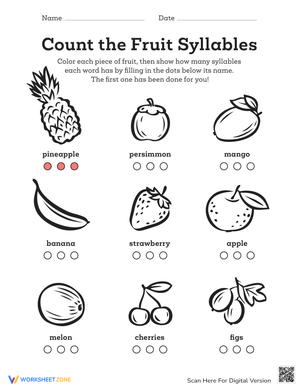
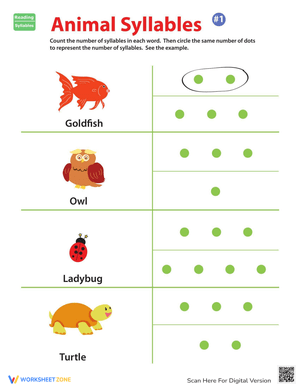
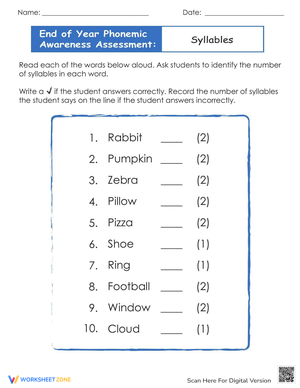
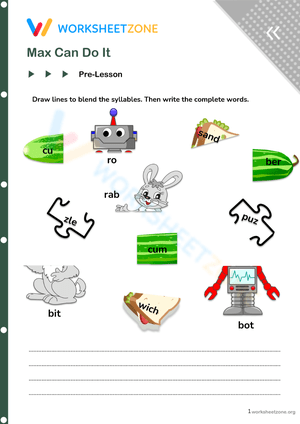
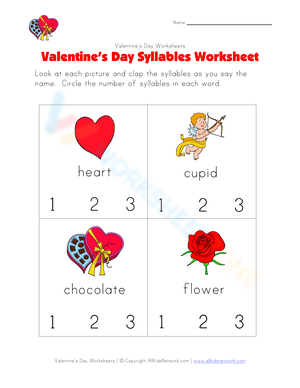
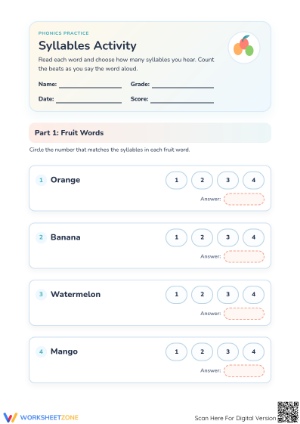
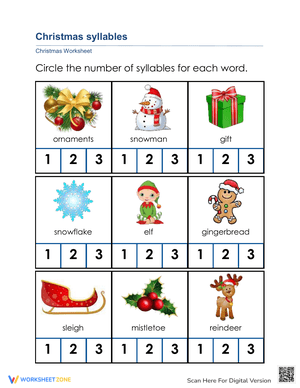
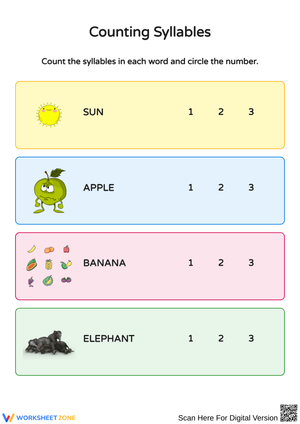
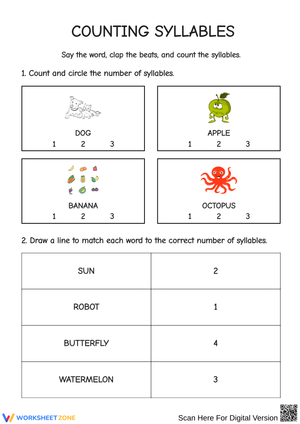
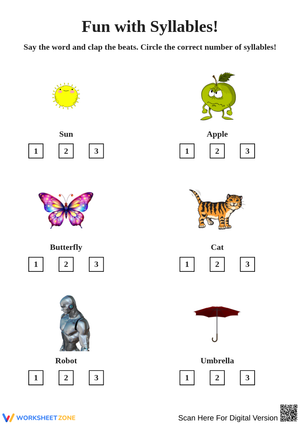
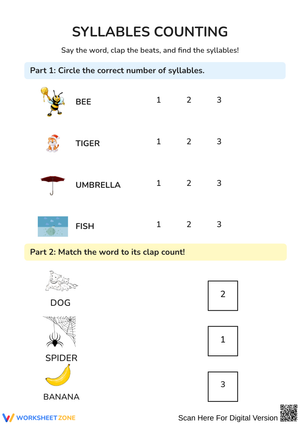
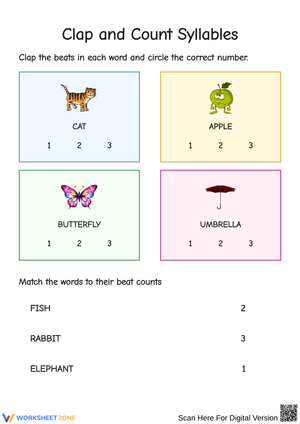
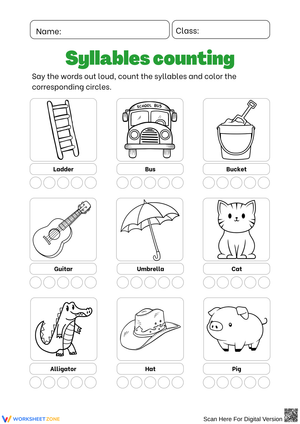
These kindergarten syllables printable worksheets resources give teachers picture-driven practice for syllable segmentation — one of the earliest phonological awareness skills students develop before phoneme-level work begins. Each worksheet centers on clear illustrations rather than printed words, because asking a five-year-old to decode text while simultaneously listening for syllable beats splits attention in a way that undermines the task. The set moves across formats: count-and-color circles, cut-and-sort by syllable count, and beat-marking activities where students clap, then record.
Skills These Worksheets Build
Syllable awareness sits at a specific place in the phonological hierarchy. Students can typically segment syllables before they can isolate individual phonemes — they hear "rain-bow" as two chunks long before they can pull out the /r/ at the start or identify the /n/ before the vowel break. These worksheets work at that natural entry point, with words ranging from one to three syllables drawn from animals, common foods, and familiar household objects. Students underline each beat, color numbered boxes, or sort image cards into columns marked 1, 2, and 3.
Across the set, the formats are deliberately varied. Some worksheets ask students to annotate directly — drawing a line between syllable breaks on the word printed below an image. Others provide a picture set and a number chart to match. A few use a clap-count-record sequence: say the word, clap the beats, write the number. These are not interchangeable activities. Each format trains a slightly different cognitive move — auditory segmentation, visual matching, or quantity recording — and together they build a more durable understanding than any single repeated task would.
Frequent Errors Worth Watching For
The most consistent mistake at this level is counting words instead of syllable beats. Show a student a picture of a hotdog and they will say "two" — correctly counting the words in the compound label, not the three beats in "hot-dog." The same pattern appears with "rain-coat," "sun-flower," and nearly every compound word in the set. Catching this during small-group instruction tells you immediately whether a student is processing the word as sound or as a visual label.
A quieter problem shows up with unstressed syllables. "Garden" and "chicken" both draw incorrect counts because the second syllable is de-emphasized in natural speech — students hear one beat where there are two. On the other end, "flower" trips some students in the opposite direction: they segment the diphthong and swear they hear three syllables. These worksheets surface both errors cleanly because the activity requires students to commit to a number. That commitment gives teachers something concrete to address in the moment rather than guessing at what a student was thinking.
Standard Alignment
These resources align with CCSS.ELA-LITERACY.RF.K.2.b, which calls for kindergarteners to count, pronounce, blend, and segment syllables in spoken words. In most classroom sequences, this standard enters instruction during the first quarter — often October through December — after rhyme awareness has been established and before the focus shifts toward onset-rime and individual phoneme work. Using these worksheets during that window positions syllable practice exactly where it belongs in the learning sequence.
How These Worksheets Fit Into Your Lesson Sequence
Small-group instruction is where these worksheets do the most work. With four students at a table, the teacher says a word, the group claps its beats together, and everyone records an answer. The value emerges in comparison — when three students write "2" and one writes "3" for "sandwich," the conversation that follows is worth more than fifteen minutes of whole-class instruction. The worksheet becomes a thinking record rather than a completion task.
For literacy centers, consistency in format matters more than most teachers expect at this age. If students have already completed a count-and-color worksheet during guided practice, they handle the same format independently without procedural confusion. Introduce a cut-and-paste sort without first modeling it and you will spend rotation time fielding questions about the instructions rather than observing phonological thinking. Keeping a completed example inside the center folder removes nearly all of that friction.
Meeting Different Learners With the Same Set
Students who are not yet ready to write numbers participate fully when you pair a kindergarten syllables printable worksheets with counting manipulatives — one bear or block per syllable clap, then a count of the objects before circling the answer. The worksheet stays the same; the support around it changes. Students who are further ahead extend the task without needing different materials: after completing a worksheet, they name three more classroom objects that fit a given syllable count, moving from recognizing syllables in given words to generating words that match a target.
One practical note: compound words are harder for students in the lower readiness range because the two-word mental image fights the beat count. For those students, start with single-object words — "banana," "umbrella," "elephant" — before asking them to work through compound-heavy sections of a worksheet. Pre-selecting which pictures a struggling student attempts is easier than preparing separate materials and still lets them work alongside the group.
Frequently Asked Questions
How do you introduce syllables before handing out the worksheets?
Start with students' own names. Have the class stand in a circle and clap the beats in each name — "Ma-ri-a" gets three claps, "Lee" gets one. Names carry personal investment, so attention stays higher than it does with vocabulary words. After two or three sessions with names, the transition to a kindergarten syllables printable worksheets feels natural because students already have a physical reference for what a syllable beat sounds like. The chin-drop method reinforces this: students hold a small hand mirror, say a word slowly, and watch how many times their jaw drops. Every syllable carries a vowel, and every vowel opens the jaw — students who have been clapping without really hearing the breaks often catch their first accurate count this way.
What formats run well in independent literacy centers?
The format students have already practiced with a teacher. A count-and-color worksheet students have done in guided practice runs independently in a center without any explanation from you. Introduce a cut-and-paste sort only after modeling it whole-group or small-group first. A completed example taped to the inside of the center folder gives students a reference at a glance and keeps the teacher free to work with other groups throughout the rotation.
How many syllables should kindergarteners reliably handle by end of year?
Most students move through one- and two-syllable words in the first half of the year and into three-syllable words in the second half. Four-syllable words appear in some extension work, but the grade-level standard focuses on words up to three beats. The words on a kindergarten syllables printable worksheets in this set stay within that range — one-syllable words serve as the entry check, and three-syllable words like "umbrella," "elephant," and "banana" represent the ceiling for this grade level.
Why do students miss compound words so reliably?
Because the conceptual split in a compound word does not always align with its syllable breaks. "Rainbow" has two parts students might name, and it also has two syllables — in that case, the counts match. "Butterfly" has two conceptual parts but three syllables, and students who are counting labels rather than beats will say "two" every time. Requiring students to clap and then write a number separates the word-counting instinct from the beat-counting task, which is exactly what these worksheets are built to reinforce.












 Interactive Worksheet Maker
 Quiz Maker
 Word Search Maker
 Crossword Puzzle Maker
 Word Scramble Generator
 Sentence Scramble Generator
 Handwriting Worksheet Generator
 Name Tracing Generator
 Fill In The Blank Generator