


























Views
Downloads
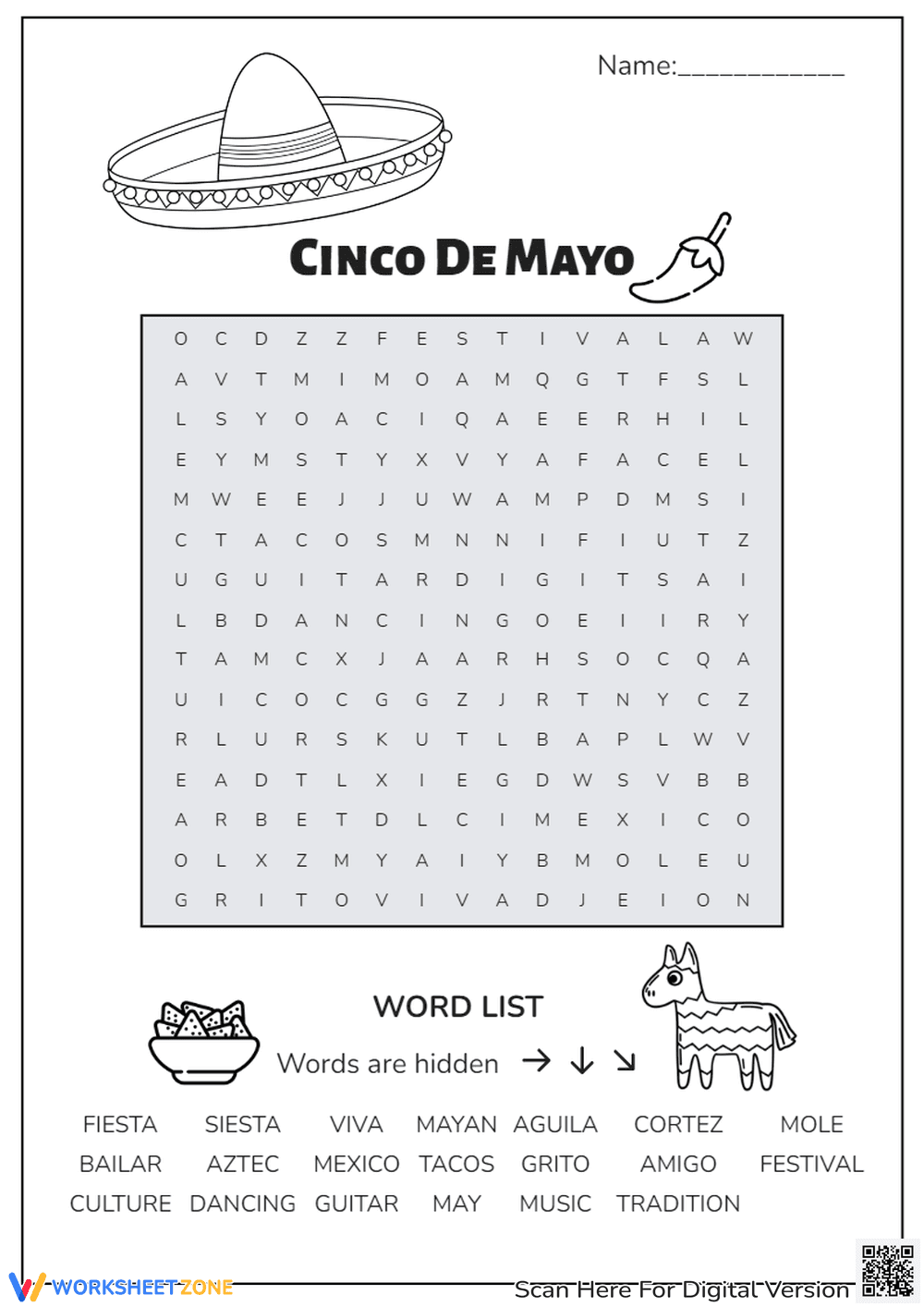

Cinco de Mayo Word Search | Essential Grade 3-5 Ready
Paste this activity's link or code into your existing LMS (Google Classroom, Canvas, Teams, Schoology, Moodle, etc.).
Students can open and work on the activity right away, with no student login required.
You'll still be able to track student progress and results from your teacher account.
This Cinco de Mayo word search provides an engaging way for students in Grades 3, 4, and 5 to explore Mexican heritage and holiday vocabulary. By identifying 21 thematic terms, learners reinforce spelling patterns and build domain-specific language skills while celebrating cultural traditions. It serves as a perfect supplemental activity for social studies or ELA blocks.
At a Glance
- Grade: 3-5 · Subject: ELA / Holidays
- Standard:
CCSS.ELA-LITERACY.L.4.6— Acquire and use accurately grade-appropriate general academic and domain-specific words- Skill Focus: Vocabulary Acquisition & Spelling
- Format: 1 page · 21 problems · Answer key included · PDF
- Best For: Holiday celebrations and morning work
- Time: 15–20 minutes
The resource consists of a single-page PDF featuring a 15x15 letter grid and a clear word bank. It includes 21 hidden terms ranging from cultural icons like "Guitar" and "Music" to historical references like "Aztec" and "Mayan." The layout is clean and includes festive illustrations of a sombrero, chili pepper, and piñata, making it visually appealing for elementary students.
Zero-Prep Workflow
- Print: Generate the required number of copies for your class (1 minute).
- Distribute: Hand out the sheets as students enter the classroom or during a transition period (1 minute).
- Review: Discuss the vocabulary terms as a whole group to ensure students understand the cultural significance of each word (5 minutes).
Total teacher preparation time is under two minutes, making it an ideal sub-plan or fast-finisher option for busy holiday weeks.
Standards Alignment
This worksheet aligns with `CCSS.ELA-LITERACY.L.4.6`, which requires students to acquire and use accurately grade-appropriate general academic and domain-specific words and phrases. By interacting with terms like "tradition," "culture," and "festival," students expand their lexicon within a specific historical and cultural context. Both standard codes can be copied directly into lesson plans, IEP goals, or district curriculum mapping tools.
How to Use It
Use this puzzle during the first 15 minutes of class on May 5th to activate prior knowledge about the holiday. As a formative assessment, observe which students struggle with scanning patterns or letter recognition to identify those who may need additional visual processing support. It also works well as a quiet activity following a direct instruction lesson on Mexican history. Expected completion time is between 15 and 20 minutes.
Who It's For
This resource is designed for general education students in grades 3 through 5, but it is also highly effective for English Language Learners (ELL) who are building basic holiday vocabulary. Pair this worksheet with a short informational text about the Battle of Puebla or a colorful anchor chart displaying Mexican symbols to provide a comprehensive learning experience for all students.
According to the Fisher & Frey (2014) framework for intentional vocabulary instruction, word-level activities like this Cinco de Mayo word search help solidify the orthographic representation of new terms in a student's memory. By focusing on 21 specific words related to Mexican heritage, the worksheet supports the CCSS.ELA-LITERACY.L.4.6 standard, which emphasizes the acquisition of domain-specific language. Research from the RAND AIRS 2024 report suggests that thematic word play increases student engagement and retention of cultural concepts compared to rote memorization. This activity provides a low-stakes environment for students to practice letter-pattern recognition and spelling, which are foundational components of literacy development in the upper elementary grades. Educators can confidently integrate this tool into their holiday curriculum to meet language standards while fostering an inclusive classroom environment that values global traditions and historical awareness.


