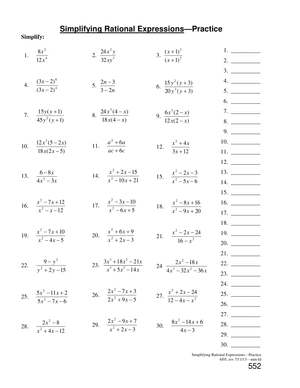
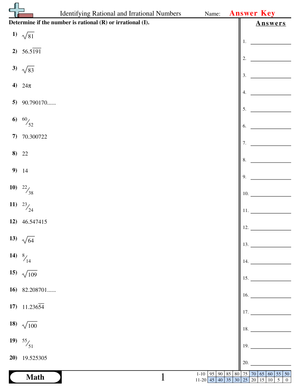
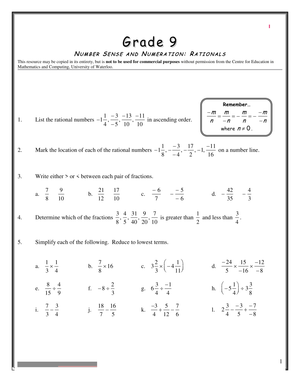
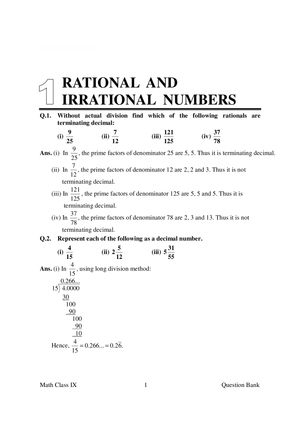
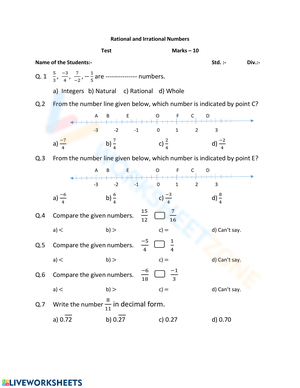
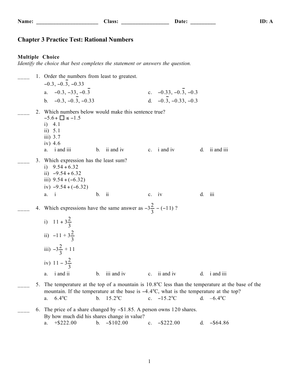
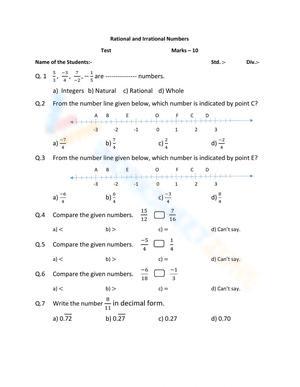
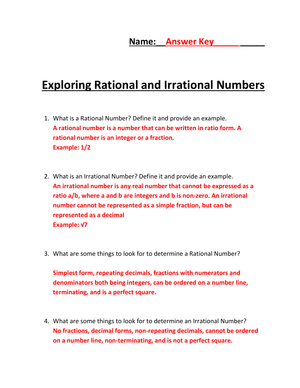
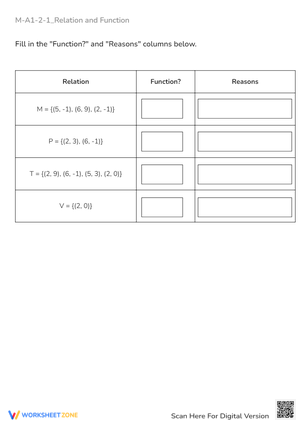
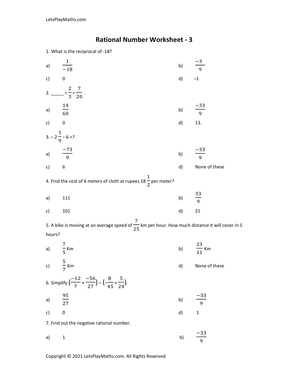
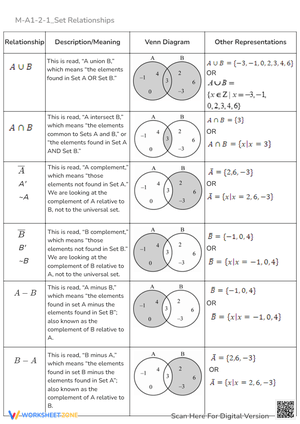
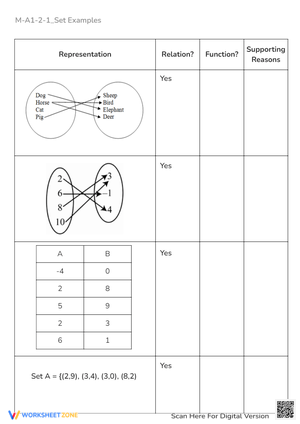
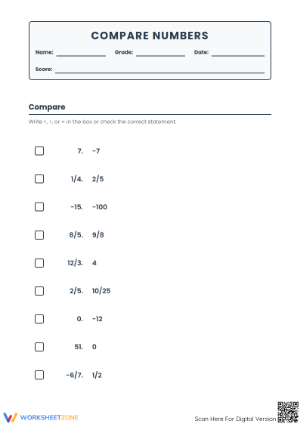
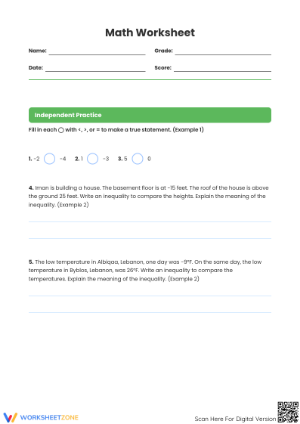
These integers and rational numbers printable worksheets for 9th grade address a transition moment that catches many students off guard: the shift from treating number types as vague categories to understanding the real number system as a precise, nested hierarchy where classification has direct consequences for computation. Each worksheet targets a distinct piece of that understanding — from sorting values into overlapping sets to applying sign rules across fraction operations — so teachers can assign them selectively rather than working through the set in sequence.
What Each Worksheet Covers
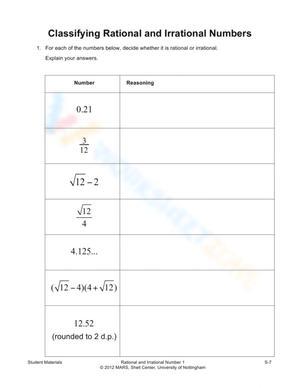
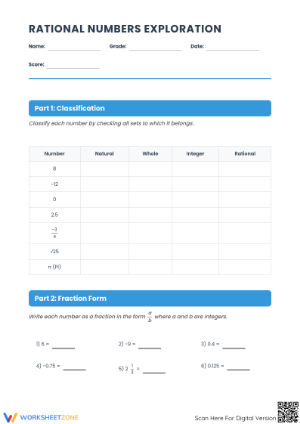
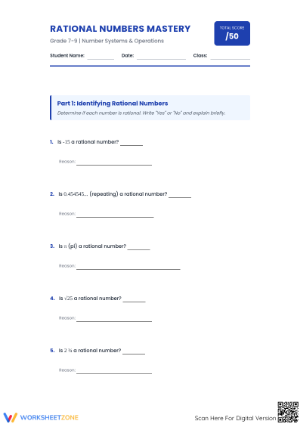
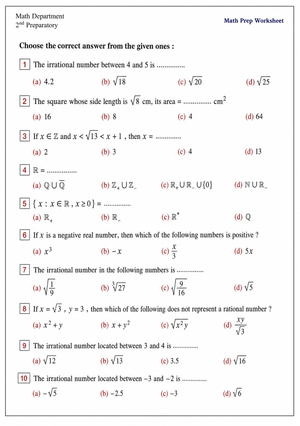
The set spans five main skill areas. Number classification worksheets ask students to sort values — including negatives, zero, fractions, and repeating decimals — into the correct sets: natural numbers, whole numbers, integers, and rationals. The key learning is understanding that these sets are nested, not parallel, so a value like negative four belongs to integers and rationals simultaneously, not one or the other.
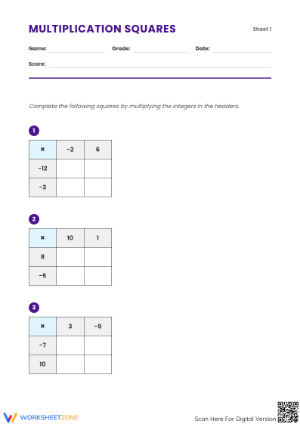
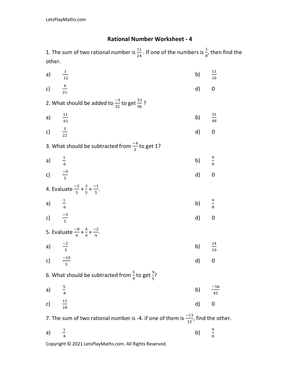
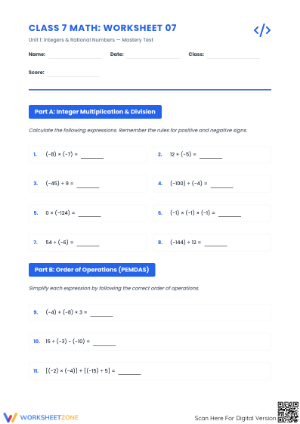
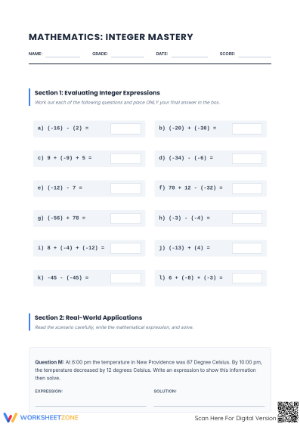
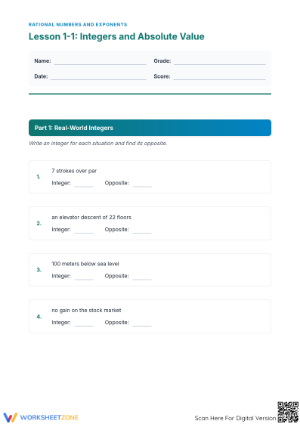
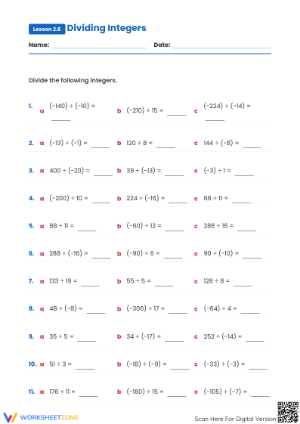
Operations worksheets cover adding, subtracting, multiplying, and dividing negative rational numbers, with problems that deliberately mix integer and fraction forms. Separate worksheets address absolute value and number line placement, which serve as the conceptual bridge to coordinate graphing later in the year. A final group puts these skills into context through word problems built around financial transactions, elevation changes, and temperature drops — scenarios where the sign of a number carries real meaning beyond the math classroom.
Student Mistakes Worth Catching Early
The single most persistent error in this unit is ordering negatives by magnitude rather than value. Students who have spent years reading number size as equivalent to number value will rank negative eight as greater than negative two because 8 is greater than 2. They're not confused about the definition — they can recite "more negative means smaller" — but when a problem moves quickly, the magnitude-first instinct takes over. The number line worksheets surface this error before it becomes embedded in students' procedures.
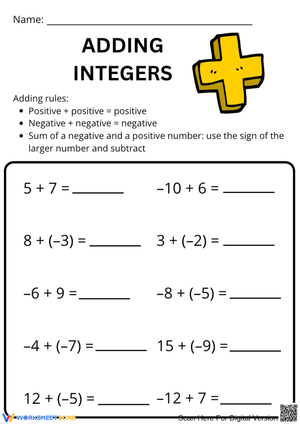
A second error appears in decimal classification. When students see 0.142857142857..., they declare it irrational because it looks long and irregular. They haven't recognized it as 1 divided by 7 — a repeating decimal that is perfectly rational. Spending five minutes showing students how to identify a repeating block before assigning the classification worksheet reduces this error substantially. A third pattern worth watching: students who have correctly memorized the multiplication rule ("negative times negative is positive") misapply it to addition. They write negative three plus negative five equals positive eight with complete confidence. The sign rules for multiplication and for addition are the most commonly conflated procedures in this entire unit.
How to Build These Worksheets Into Your Lesson Plans
The classification worksheet works especially well as a first-week diagnostic. Incoming 9th graders vary widely in how solidly they understand number set membership — some arrive with a clear mental map from 8th grade, others have a vague sense that "rational means fraction." Running the classification worksheet on day two gives teachers concrete data before committing to pacing. If most students correctly place negative four-fifths and zero but stumble on repeating decimals, you know exactly where to slow down.
These integers and rational numbers printable worksheets for 9th grade also fit naturally into a station-rotation structure during the first full unit. One station handles classification, another runs through sign-rule operations, a third covers word problems. Rotating every 12 minutes lets a class of 30 cycle through all three in a single period while keeping the work cognitively focused rather than fatiguing. A 10-minute whole-class debrief on the one or two problems students flagged as uncertain gives the teacher a real-time formative check before moving on.
The number line and absolute value worksheets land best just before the coordinate plane unit — not during the integers unit itself. Students who revisit number line placement after a few weeks of interval retain the concept more durably than students who learn it and immediately move forward. That spaced retrieval approach gives the idea time to consolidate, and the worksheet functions more like a confidence-builder than new instruction.
Standard Alignment
The number classification and operations worksheets align directly with CCSS.MATH.CONTENT.HSN-RN.B.3, which asks students to explain why the sum or product of two rational numbers is rational. That standard sounds abstract, but it has a practical classroom implication: students need to understand why the answer stays rational, not just that it does. Several worksheets include written-justification prompts for exactly this reason — computation alone doesn't satisfy the standard.
The absolute value and number line worksheets reinforce CCSS.MATH.CONTENT.6.NS.C.7 and 8.NS.A.1, standards many 9th graders arrive having studied but not yet consolidated. Treating these as review-and-extend rather than new instruction is the right frame — students recognize the vocabulary but often cannot apply it precisely when the format or number type changes.
Adjusting the Work for a Range of Learners
For students still building fluency with basic fraction operations, the word problem worksheets become far more accessible when the numerical values stay simple. Use problems with integer answers or single-digit fractions before introducing negative mixed numbers. That keeps the focus on the conceptual layer — what does a negative balance mean? — rather than the procedural one, where the arithmetic itself becomes the obstacle instead of the thinking.
These integers and rational numbers printable worksheets for 9th grade give stronger students room to push further through the justification prompts. A student who finishes the operations worksheet in 15 minutes can be redirected to write a counterexample showing why the sum of two irrational numbers is not necessarily irrational — a task that connects directly to the rational/irrational boundary they have been classifying all unit. That's genuinely harder thinking, not just more of the same problems.
For students who need a more structured entry point, the classification problems that present pre-labeled values to sort lower the initial demand before students face open-response classification questions. Moving from a guided sort to independent classification — rather than starting cold — gets more students to the same endpoint without the freeze-up that unfamiliar open formats cause for students who need a clear first step.
Frequently Asked Questions
Is every integer also a rational number?
Yes. A rational number is any value expressible as a fraction p divided by q, where p and q are both integers and q is not zero. Every integer qualifies because it can always be written with a denominator of one — negative five becomes negative five over one, which satisfies the definition exactly. The integers are a subset of the rationals, not a separate category sitting beside them.
How do students tell a rational decimal from an irrational one?
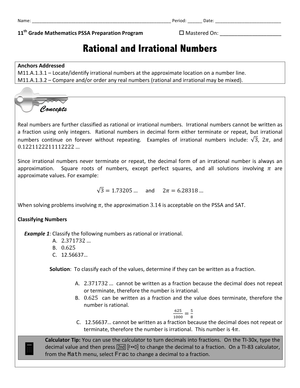
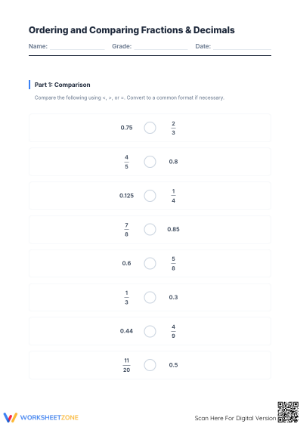
The distinction is in the decimal's behavior, not its length. A rational decimal either terminates — it stops at some point, like 0.75 — or it repeats a fixed block of digits forever, like 0.3333... or 0.142857142857.... An irrational decimal does neither: it continues infinitely without ever settling into a repeating pattern. The square root of two and pi are the standard examples. Students find it useful to practice converting familiar fractions to decimals by long division so they can see the repeating block appear naturally before they are asked to classify unfamiliar values.
Why does zero belong to both the integers and the rationals?
Zero is an integer because integers include all the whole numbers and their negatives, and zero sits at the center of that set — it is neither positive nor negative. It is rational because it can be written as zero over any nonzero integer, which satisfies the definition exactly. Students sometimes assume zero is a special exception that needs memorizing. It isn't. It follows the same rules as every other integer.
What's the most efficient way to teach sign rules for operations on negative rationals?
Separate the rules by operation type and teach them in sequence rather than simultaneously. Students who encounter multiplication and division sign rules at the same time as addition and subtraction sign rules tend to conflate them — a confusion that can take weeks to untangle. Spending at least two full class periods on addition and subtraction of negatives before introducing multiplication gives students enough practice to distinguish the operations clearly. These integers and rational numbers printable worksheets for 9th grade are ordered with that sequence in mind, so teachers can work through the addition and subtraction worksheets, run a quick formative check, and then move to the multiplication set without doubling back.














 Interactive Worksheet Maker
 Quiz Maker
 Word Search Maker
 Crossword Puzzle Maker
 Word Scramble Generator
 Sentence Scramble Generator
 Handwriting Worksheet Generator
 Name Tracing Generator
 Fill In The Blank Generator




 BACK TOSCHOOL