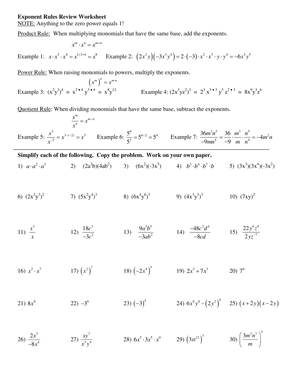
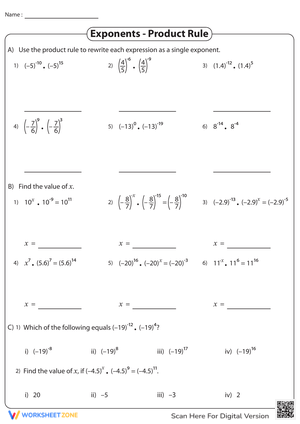
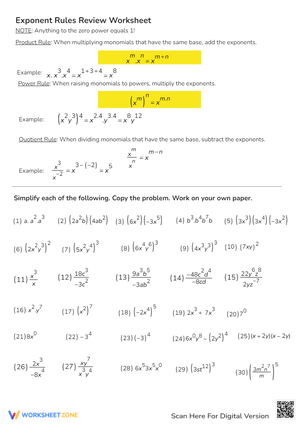
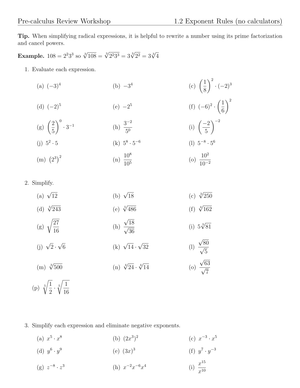
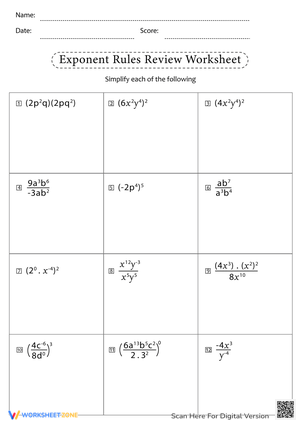
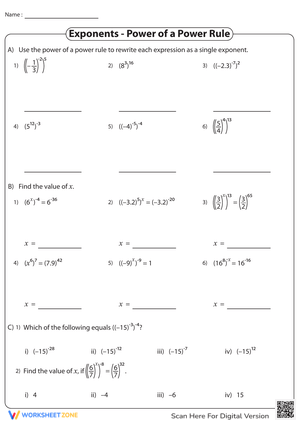
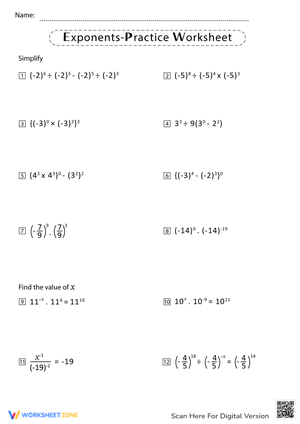
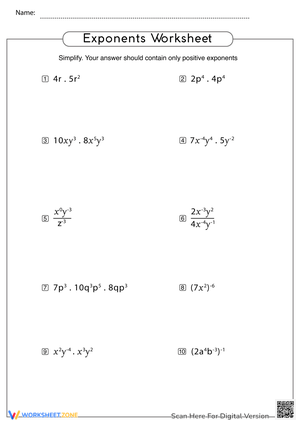
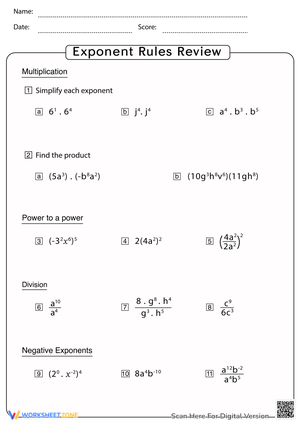
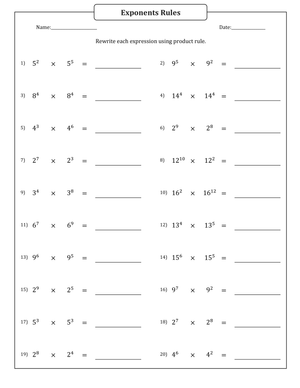
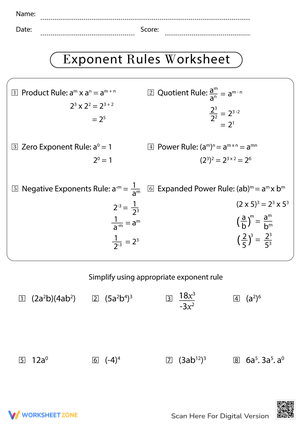
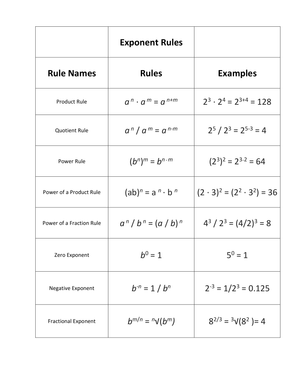
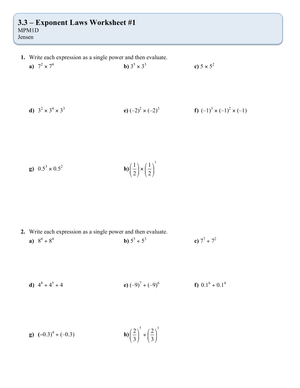
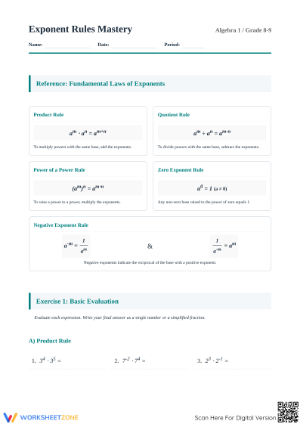
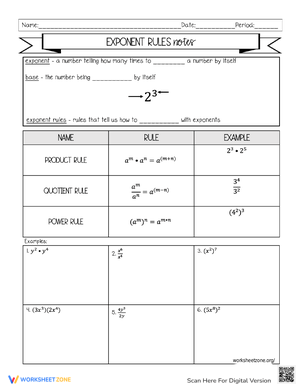
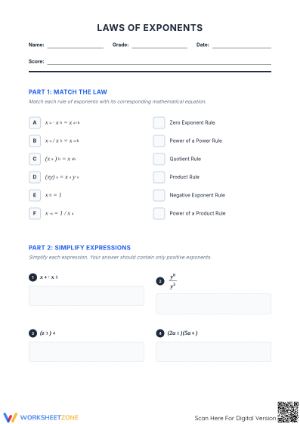
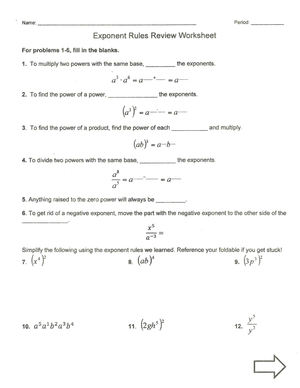
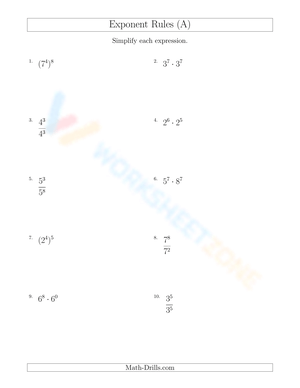
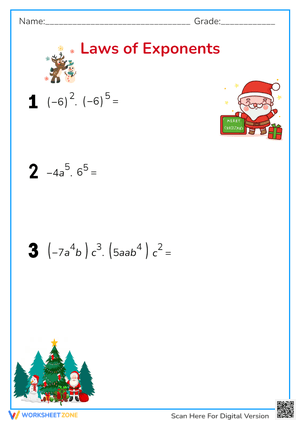
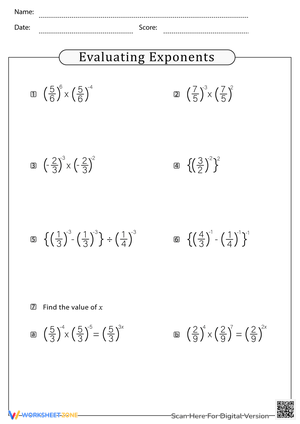
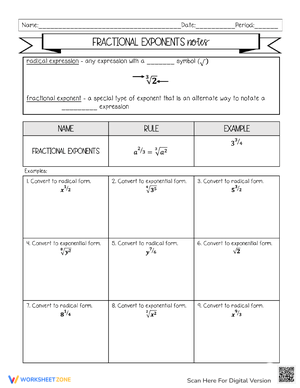
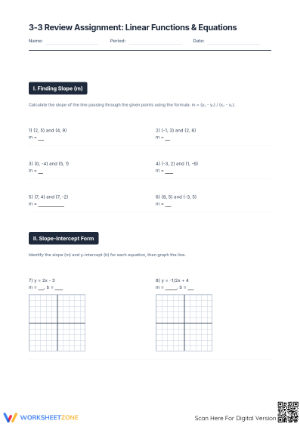
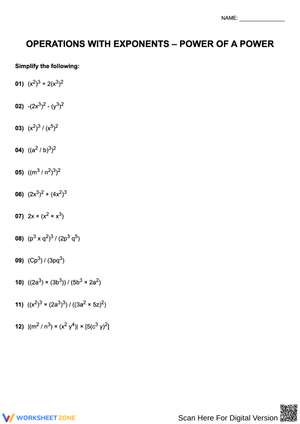
These exponent rules review worksheets for 9th grade give Algebra 1 teachers a ready set of targeted practice resources for the six integer exponent properties students need before they reach polynomial operations or exponential functions. Each worksheet targets a specific rule or combination of rules, which means teachers can assign them precisely — single-rule practice immediately after instruction, then mixed-problem review once students have built some procedural fluency.
The Six Rules Students Work Through
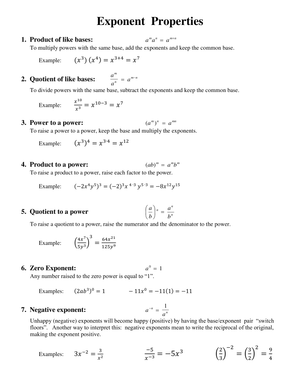
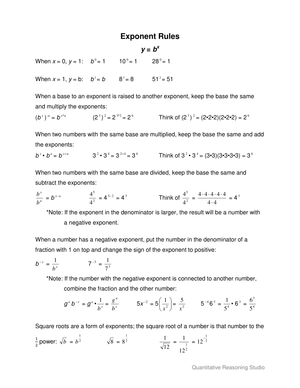
The set covers all six foundational exponent properties for Algebra 1:
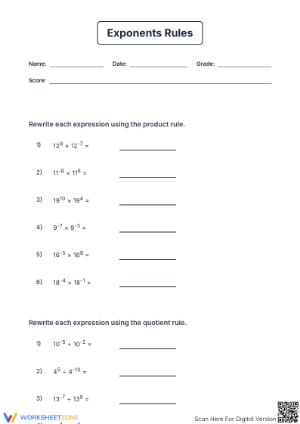
- Product Rule — multiplying expressions with the same base; students add the exponents and keep the base fixed. x³ · x⁴ becomes x⁷.
- Quotient Rule — dividing same-base expressions; students subtract the denominator's exponent from the numerator's. y⁶ ÷ y² becomes y⁴.
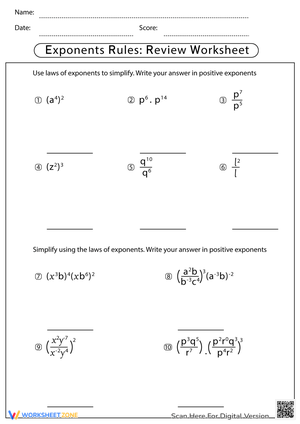
- Power of a Power Rule — an exponential expression raised to another exponent; students multiply the two exponents. (z²)³ becomes z⁶.
- Power of a Product Rule — a product inside parentheses raised to a power; the exponent distributes to every factor, including any coefficient. (2x)² becomes 4x².
- Zero Exponent Rule — any non-zero base raised to the zero power equals one. Students need enough repetition here to stop second-guessing the result or confusing it with zero.
- Negative Exponent Rule — a negative exponent means the base moves to the opposite position in a fraction and the exponent becomes positive. x⁻³ becomes 1/x³.
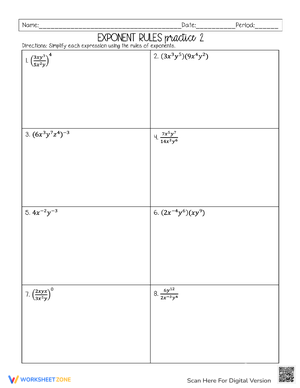
Later worksheets in the set combine two or more of these rules within a single expression. A problem like (2x³y⁻²)⁴ asks students to apply the power of a product rule, the power of a power rule, and the negative exponent rule in sequence. That layering is where students either demonstrate secure understanding or reveal that one of the rules was memorized without being internalized.
Error Patterns That Appear Reliably in Student Work
Three mistakes surface in nearly every Algebra 1 class working through this material. The first is multiplying the bases during the product rule. A student who sees 3² × 3³ will write 9⁵ rather than 3⁵ — they treat the repeated base as a multiplication problem and lose track of the rule entirely. This error tends to persist because it feels logically consistent to the student. Isolating it in single-rule worksheet practice, where the only variable is what happens to the exponents, helps teachers catch it before it carries forward into polynomial multiplication.
The second pattern is reading a negative exponent as a negative value. Students evaluate 4⁻² as negative 16 rather than one-sixteenth. Worksheets that place 4⁻² directly alongside (−4)² force students to distinguish between the sign of the base and the sign of the exponent — two things that look similar on the surface but mean entirely different operations.
The third error is specific to the power of a product rule when coefficients appear. In (3y²)³, students apply the exponent to the variable and forget the coefficient, writing 3y⁶ instead of 27y⁶. Problems that isolate this step — where the expression contains only a coefficient and a single variable, with no other complexity added — address the habit directly before students reach multi-variable expressions where the same oversight becomes much harder to catch.
Where These Worksheets Fit in an Exponent Unit
The most effective sequence is rule-by-rule practice early in the unit, followed by mixed-review work as assessment approaches. Assigning one worksheet per property immediately after direct instruction, then returning to a mixed-rules worksheet two or three days before the quiz, gives students retrieval practice distributed across the full unit rather than concentrated in one cramming session the night before.
A classroom activity that pairs naturally with these worksheets — particularly in the 10-to-15-minute structured practice window after notes — is a paper-passing routine. Groups of four each receive one multi-step problem. The first student performs one simplification step and passes the worksheet; the second student performs the next step; and so on until the problem is fully simplified. When a student disagrees with a previous step, they mark it and the group pauses to reason through the disagreement together. Teachers who have run this routine report that the coefficient-forgetting error surfaces faster here than it does in individual practice, because students scrutinize each other's notation in real time. The exponent rules review worksheets for 9th grade set lends itself to this format because the multi-step combination problems are complex enough to require three or four passes but not so long that groups lose track of the original expression.
Posting the answer key at a station after a timed work block lets students self-check without waiting. The practical benefit is that teachers can spend that time circulating and noting where students erase, skip, or rewrite — observational data that is more useful for planning a reteach than scanning a graded stack of worksheets at the end of the day.
Using the Set Across Different Readiness Levels
For students who arrive with significant gaps — especially those who confuse the product rule with base multiplication — the most useful adjustment is pairing each worksheet problem with a table showing the exponent pattern numerically. Writing out x³, x², x¹, x⁰, x⁻¹ as a column and filling in the computed values gives students the conceptual grounding that the symbolic rule alone rarely provides. The pattern of dividing by x at each step makes the zero and negative exponent results feel like natural outcomes rather than arbitrary definitions students are expected to memorize.
Students who move through the core problems quickly can extend into expressions that combine exponent rules with fraction simplification, or into rational exponents — rewriting x^(1/2) using what they know about the power of a power rule, for instance. These extension problems do not require a separate resource; they can be added to the bottom of any mixed-rules worksheet. Students at the core level finish the assigned problems; students who finish early work the extension without requiring separately prepared packets.
Standard Alignment
The core content in these worksheets addresses CCSS 8.EE.A.1, which requires students to know and apply the properties of integer exponents to generate equivalent numerical expressions. That standard is introduced formally in 8th grade, but in 9th grade Algebra 1 it is consolidated and extended — students apply the same six properties to algebraic expressions with variable bases, and procedural errors carry forward into every subsequent unit. The content also connects to CCSS HSN-RN.A.2, which asks students to rewrite expressions involving radicals and rational exponents using the properties of exponents, and to CCSS HSA-APR.A.1, which covers polynomial arithmetic — a unit that breaks down quickly when students enter it without secure exponent rule fluency. In classroom sequence, these worksheets belong at the start of the exponent unit, before exponential functions and before polynomial multiplication begins.
Frequently Asked Questions
What does each worksheet in the set actually cover?
Each worksheet in the exponent rules review worksheets for 9th grade set addresses one or more of the six integer exponent properties: the product rule, the quotient rule, the power of a power rule, the power of a product rule, the zero exponent rule, and the negative exponent rule. Single-rule worksheets isolate one property per problem. Mixed-review worksheets present all six in random order without identifying which rule applies — which is the format students encounter on unit tests and in later coursework.
How many problems is appropriate for each worksheet type?
For single-rule practice, a range of 20 to 30 problems builds procedural fluency without diminishing returns — students who correctly complete 20 consecutive product-rule problems have demonstrated the rule reliably. For mixed-review or multi-step problems, 10 to 15 is the right range; those expressions take longer to simplify, and 15 well-chosen problems assess rule flexibility more accurately than 30 rushed ones. Assigning more than 15 multi-step problems in a single sitting tends to produce fatigue rather than additional learning.
How do these worksheets support students who need targeted reteaching after a unit?
For students who did not demonstrate mastery on a specific rule — those who missed every negative exponent problem on the quiz but handled the product rule reliably — individual worksheets serve as focused reteach practice rather than full-unit review. That specificity matters: handing a struggling student a mixed-review worksheet tells them nothing about where the gap actually is. Assigning the negative exponent worksheet alone does.
Can the set work as a formative assessment tool during instruction?
Single-rule worksheets function well as formative checks after direct instruction on each property. Scanning for systematic errors — every coefficient-involving problem missed, or every negative exponent written as a negative number — reveals the pattern across a class quickly. The exponent rules review worksheets for 9th grade format makes this analysis easier than a mixed-problem quiz does, because the rule isolation means a cluster of wrong answers on one worksheet points to one specific gap rather than an unidentifiable tangle of several overlapping misconceptions.














 Interactive Worksheet Maker
 Quiz Maker
 Word Search Maker
 Crossword Puzzle Maker
 Word Scramble Generator
 Sentence Scramble Generator
 Handwriting Worksheet Generator
 Name Tracing Generator
 Fill In The Blank Generator




 BACK TOSCHOOL