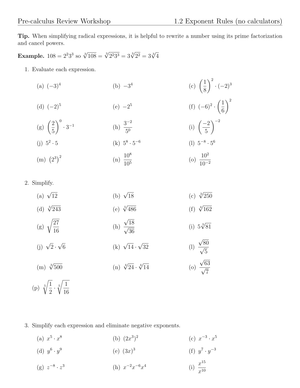
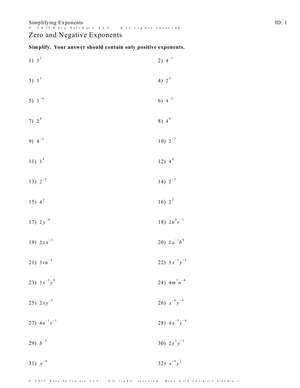
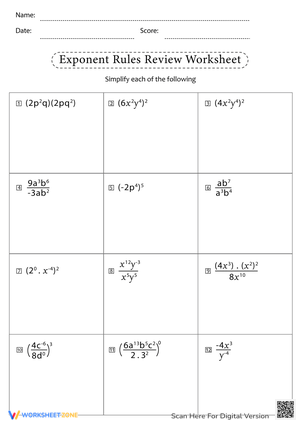
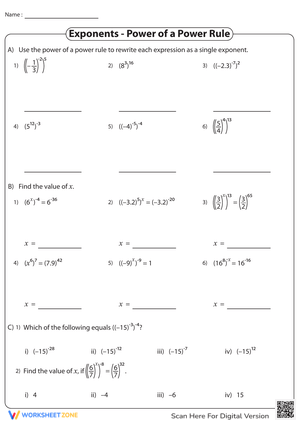
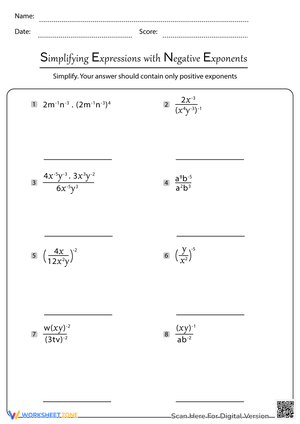
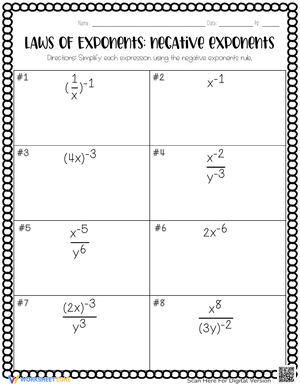
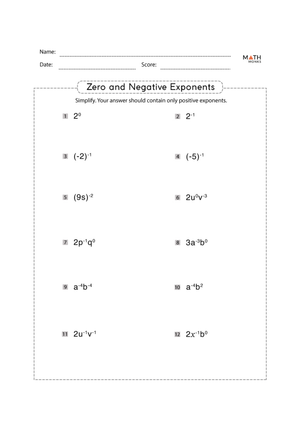
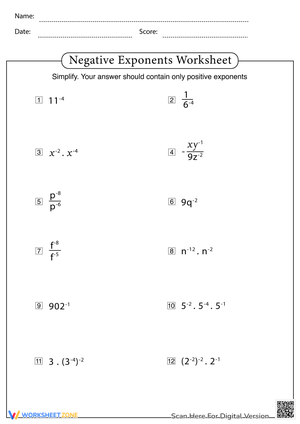
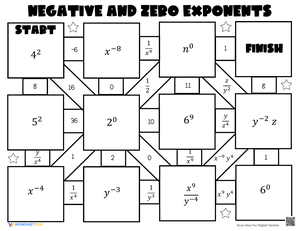
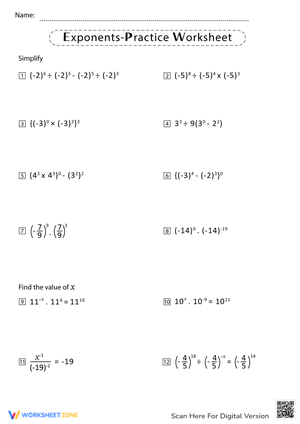
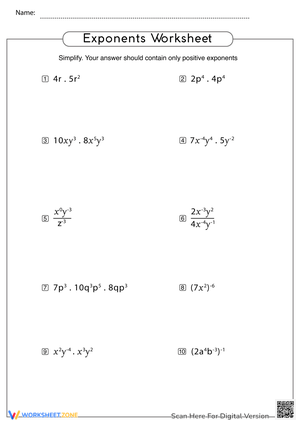
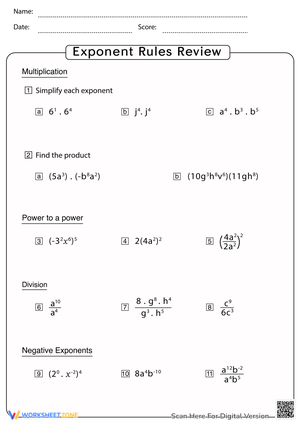
These 9th grade exponents printable worksheets resources give Algebra 1 teachers targeted, rule-specific practice sets covering every major property students need to master before moving into polynomial operations, quadratic functions, and scientific notation. The set includes both isolated-rule worksheets — where each worksheet focuses on a single property — and mixed-rule worksheets that require students to identify which rule applies before they can solve. That two-stage structure addresses a persistent teaching problem: students who can recite a rule in isolation but stall when a problem doesn't announce which rule to use.
The Exponent Rules Each Worksheet Targets
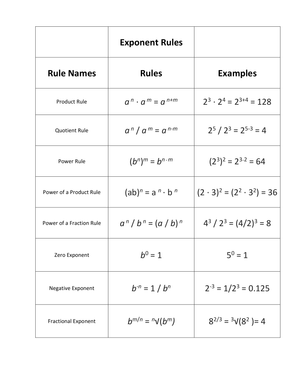
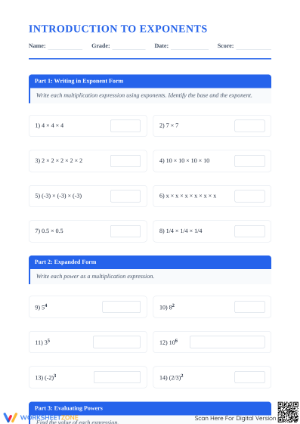
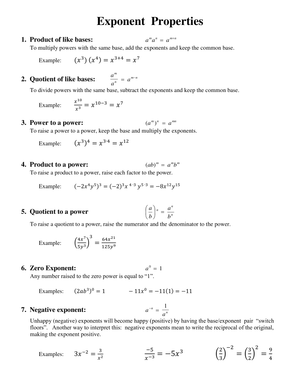
The worksheets move through the standard sequence of integer exponent rules before introducing the rational exponent extension that Algebra 1 students often find disorienting. Rules covered across the set:
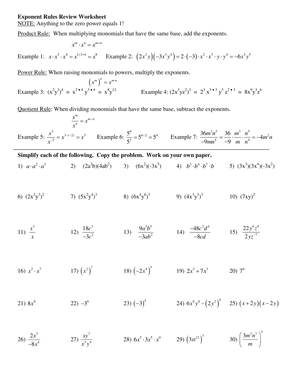
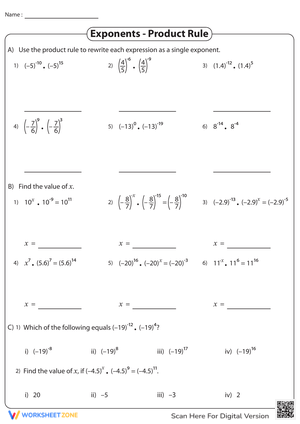
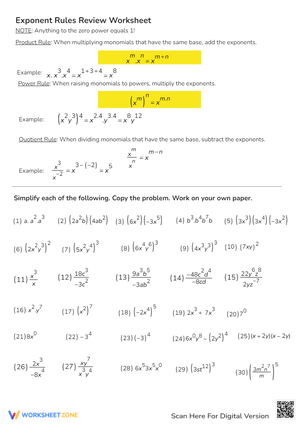
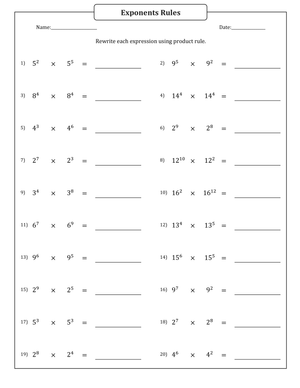
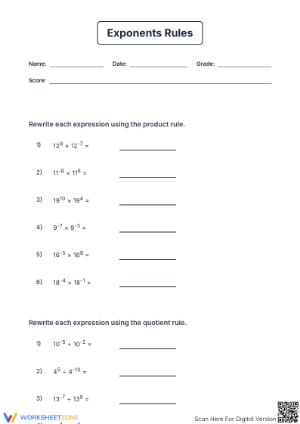
- Product Rule — multiplying powers with the same base by adding exponents
- Quotient Rule — dividing same-base powers by subtracting exponents, which introduces the possibility of negative results
- Power of a Power Rule — raising an existing power to another exponent by multiplying the exponents
- Power of a Product Rule — distributing an outside exponent to each factor inside parentheses
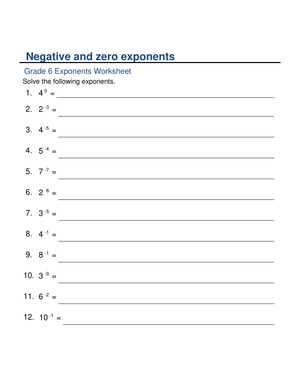
- Zero Exponent Rule — establishing that any nonzero base raised to the zero power equals one
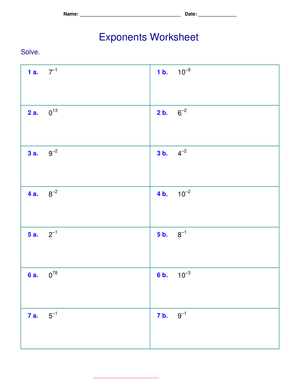
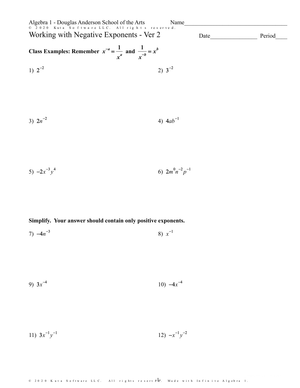
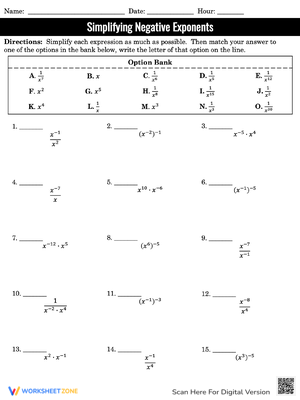
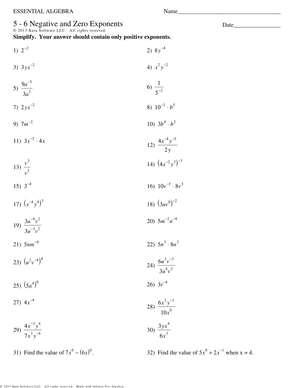
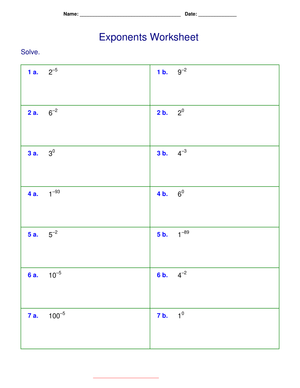
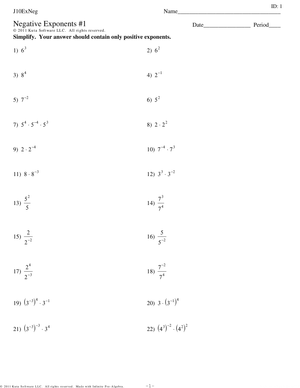
- Negative Exponent Rule — rewriting negative exponents as reciprocals
- Rational Exponents — connecting fractional exponents to radical notation, including cases where the numerator is not one
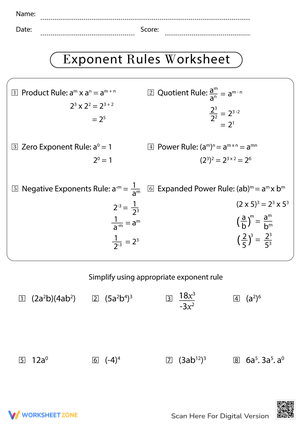
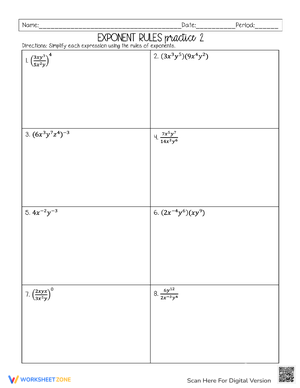
Mixed-rule worksheets appear later in the set. Each worksheet in that group presents expressions requiring students to sequence two or three properties correctly — for instance, an expression involving both a power of a product and a negative exponent where the final answer must be written as a simplified fraction. For the rule-discrimination work those problems demand, 9th grade exponents printable worksheets resources provide the volume of practice students actually need to stop second-guessing themselves.
Student Errors Worth Anticipating and Correcting
The product rule mistake happens almost universally in the first week: students see x² · x³ and write x⁶ because multiplying feels like the right operation when the word "multiply" appears in the problem. Catching that before it calcifies is one reason isolated-rule practice outperforms mixed-problem sets at the introduction stage — students need the rule to stabilize before they face decisions about when to apply it.
The more stubborn error is applying the power rule to addition. Students who correctly simplify (2x³)² into 4x⁶ will turn around and write (x + 3)² as x² + 9. These look structurally related to students, but they are not — and the conflation follows students into Algebra 2 if it goes unaddressed in 9th grade. Each worksheet targeting the power of a product rule pairs standard exercises with non-examples so students practice recognizing when the rule does and does not apply, not just how to execute it when prompted.
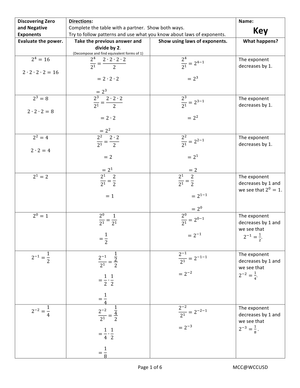
Negative exponents produce a third category of confusion. Students read the minus sign and conclude the result must be a negative number. Anchoring the concept to a descending pattern — 2³ = 8, 2² = 4, 2¹ = 2, 2⁰ = 1, 2⁻¹ = 1/2 — gives students something to check against rather than just a rule to recall. Worksheets in this set include that pattern table alongside standard problems so students have a visible reference as they build fluency, rather than relying on memory alone during the most error-prone stage.
Standard Alignment
The primary standards addressed are HSN.RN.A.1 and HSN.RN.A.2 from the Common Core High School: Number and Quantity domain. HSN.RN.A.1 asks students to explain why the properties of integer exponents extend logically to rational exponents — which means the worksheets need to do more than state the rule; they need problems that expose the reasoning behind it. HSN.RN.A.2 addresses rewriting expressions between radical and rational exponent notation in both directions. In practical terms, both standards appear in Algebra 1 during the exponential functions unit and resurface in Algebra 2 when students work with function transformations involving roots. Getting notation fluent at this stage prevents significant reteaching later and keeps the focus in subsequent courses where it belongs.
Building These Worksheets Into Your Algebra 1 Lesson Plans
Isolated-rule worksheets work well as bell ringers on the day after introducing a new rule — five to eight minutes of focused practice while attendance is taken, no additional instruction required. By the Friday of that same week, a mixed-rule worksheet functions as a low-stakes check on whether students can still distinguish Monday's rule from what came later. That spacing matters: retrieving information after a three- or four-day gap produces noticeably stronger retention than re-practicing immediately after instruction, and the format makes that spaced retrieval easy to build into a normal week without restructuring the lesson sequence.
Exit tickets drawn from this set give useful formative data at the end of a class period. After teaching the quotient rule, distributing three problems of increasing complexity — one straightforward same-variable expression, one with a numerical coefficient that needs separate handling, and one that produces a negative exponent students must rewrite — takes fewer than five minutes but tells you exactly where to start the next day. Teachers who use 9th grade exponents printable worksheets resources this way find the three-problem spread gives cleaner diagnostic information than a single multi-step problem, because it pinpoints where the breakdown occurs rather than just signaling that one exists.
Differentiating These Worksheets Across Your Class
Students who arrive in Algebra 1 with weak integer-arithmetic fluency need a different entry point than students who simply haven't learned exponent rules yet. Starting those students on the product and zero-exponent worksheets — where the numerical computation stays simple — keeps attention on the rule rather than on the arithmetic itself. Students who are ready for more can move directly into the rational exponent worksheets and the multi-step mixed-rule problems that involve three or more properties in a single expression.
For a class with a wide range in prior knowledge, 9th grade exponents printable worksheets materials make concurrent differentiation manageable — some students working on integer-rule practice while others move into rational exponents — without requiring three separate lesson plans. Students who catch on early benefit most from annotation tasks: writing out exactly which rule they applied and why, in words alongside their work. That written explanation surfaces procedural-versus-conceptual gaps that a correct final answer can hide.
Frequently Asked Questions
Do these worksheets directly address the confusion between the product rule and the power of a power rule?
Yes — that distinction gets explicit attention because it is one of the most reliable sources of error in the unit. Each rule has its own isolated worksheet before appearing in mixed practice. The mixed-rule worksheets include problems where both rules are structurally plausible, forcing students to read the expression carefully before applying anything. Students who skip the isolated worksheets and move straight to mixed problems almost always conflate the two rules when time pressure appears.
Can these be used with a class that hasn't reached rational exponents yet?
The integer-rule worksheets stand completely on their own. Teachers who won't reach HSN.RN.A.1 until later in the year can use those worksheets without touching the rational exponent materials. The fractional-exponent worksheets — which connect rational exponent notation to radical expressions — are sequenced at the end of the set and work best once students have solid fluency with the integer properties.
How does this set handle scientific notation?
Scientific notation is not the primary focus here. The product and quotient rule worksheets include some base-10 expressions that mirror the structure of scientific notation operations, but if scientific notation is a separate instructional unit in your course, these worksheets supplement rather than replace dedicated notation practice.
Are answer keys included?
Each worksheet comes with a corresponding answer key. For multi-step rational exponent problems, the key shows intermediate steps rather than just final answers — useful for identifying exactly where a student's work diverged from the correct reasoning, which saves time during feedback conferences and makes error conversations with students more specific.














 Interactive Worksheet Maker
 Quiz Maker
 Word Search Maker
 Crossword Puzzle Maker
 Word Scramble Generator
 Sentence Scramble Generator
 Handwriting Worksheet Generator
 Name Tracing Generator
 Fill In The Blank Generator




 BACK TOSCHOOL