Grid Drawing PDF Worksheets for 9th Grade Art Classes
These grid drawing pdf worksheets for 9th grade give art teachers a reliable method for addressing one of the most persistent problems in early high school studio work: students who draw what they think a subject looks like rather than what they actually see. An almond shape for an eye, a generic rounded silhouette for a tree, a V-form for a distant bird—these symbolic shortcuts are deeply ingrained by ninth grade, and the grid is one of the few techniques that interrupts them systematically.
The Specific Skills Targeted
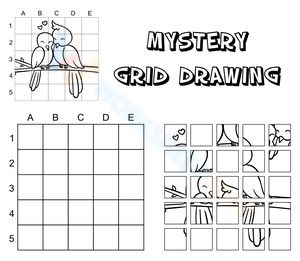
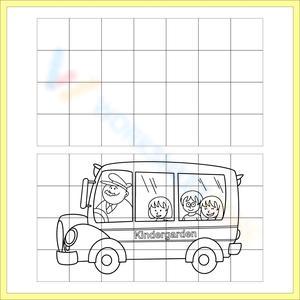
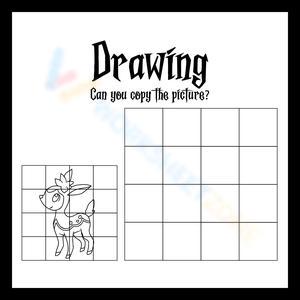
Each worksheet moves students through a sequence of technical decisions. They measure and lightly construct a corresponding grid on their drawing paper, then work square by square, identifying where lines enter and exit each cell and noting curvature and angle rather than subject identity. During the shading phase, they analyze the darkest and lightest values within individual squares before committing to broader tonal decisions. The more advanced worksheets introduce scaling: transferring the reference image at double or triple the grid square size, which requires students to extrapolate proportions rather than simply match them.
The observational discipline built here—reading a single square for intersecting lines and value gradients without interpreting the subject—carries directly into freehand work. Students who work through the full set move away from symbol-drawing habits even when no grid is present.
Why the PDF Format Matters for Grid Work
Grid drawing pdf worksheets for 9th grade depend on accurate print dimensions in a way that most other art resources simply do not. If a file stretches, reflows, or adjusts margins between file and printer, the correspondence between the reference grid and the drawing surface breaks down—and proportional accuracy becomes impossible regardless of how carefully a student works. The PDF format locks dimensions in place. A one-inch square on the reference prints as a one-inch square, or scales predictably when enlarged, regardless of printer settings. That print reliability is not a convenience feature; it is what makes the lesson structurally sound.
Smart Lesson-Planning Moves for a Grid Drawing Unit
Distribute each worksheet at the start of a studio block after students have labeled the rows and columns of both the reference and their drawing paper—letters across, numbers down. This cross-referencing step takes about three minutes and eliminates one of the most consistent sources of mid-session confusion: students losing track of which square they are currently drawing. Require the labels before pencils touch the drawing paper.
Demonstrate the isolation technique early. Have students cut a small rectangular window in a sticky note and place it over the reference grid so that only one square is visible at a time. When surrounding content is masked, the brain stops interpreting the subject and starts reading abstract lines, angles, and value shapes within the exposed cell. Students who resist this step typically reconsider after a single drawing period, when classmates using it produce noticeably more accurate results.
Reserve the final studio session of the unit for erasing grid lines and evaluating the full composition. Students who pressed too hard during grid construction discover that the pencil left permanent indentations in the paper—these catch graphite during shading and produce a visible ghost grid in the finished work. Catching heavy pressure in the first session, with a brief demo using a 2H pencil on scrap paper, prevents that problem before it compounds across the entire drawing.
Mistakes Students Make That These Worksheets Help You Catch
The most stubborn error is conceptual: students know they should focus on a single square, but they glance at the broader subject and slip back into symbolic drawing mode. A student copying a portrait will correctly trace an angled contour through square B-3, then round off the nostril in C-4 into the shape they believe a nostril should have rather than the irregular form it actually takes in that cell. This pattern needs intervention in the moment, not in a post-session critique—catching it while the student's pencil is still moving is far more effective than addressing it after the drawing is complete.
Heavy pencil pressure during grid construction is the second recurring problem. Students treat the gridding step as a chance to make clean, confident lines. A quick demonstration—drawing a 2H pencil line and showing how lightly it sits on the paper while still remaining legible—sets the right expectation. When it comes time to erase, a kneaded eraser handles light grid lines cleanly. Vinyl erasers work for precision cleanup but can abrade softer drawing papers if the original lines were pressed too deeply.
Standard Alignment
These worksheets address VA:Cr2.1.I, the high school Accomplished anchor standard that asks students to refine and complete artistic work through a sustained, process-focused approach to making. Grid drawing sits directly in this standard's territory: it is a technically rigorous, historically documented method—traceable at least to Dürer's perspective devices in the late fifteenth century—that students investigate through direct practice rather than passive instruction. The methodical precision demanded by working square by square also supports VA:Cr2.2.I, which focuses on craftsmanship and the acquisition of technical skill through practice and persistence. A completed grid drawing provides concrete, documentable portfolio evidence for both standards during formal review cycles.
Matching Worksheet Complexity to Where Students Actually Are
For students who struggle with spatial reasoning, select reference worksheets built around high-contrast, black-and-white images—a silhouetted architectural detail, a bold close-up of an animal's face—where value structure is unambiguous and lines are decisive. Ambiguous mid-tone photographs compound difficulty for students who are already uncertain about what they are reading in a single square. Simpler subject matter reduces one variable so students can concentrate on the grid process itself.
The range of subjects across the grid drawing pdf worksheets for 9th grade supports tiered work without requiring separate materials for different groups. Advanced students who move through line transfer quickly can work on scaling: constructing a grid with squares twice or three times the size of the reference and extrapolating proportions rather than copying them directly. Another extension for these students is removing the pre-printed grid from the reference entirely and having them construct their own grid on a clean photocopy, adding accurate measurement as part of the task from the start.
Frequently Asked Questions
How do I select reference images that will challenge 9th graders without causing frustration?
High-contrast portraits—animal faces, historical figures, close-up architectural details—work reliably at this level. Avoid images with large flat areas or repetitive fine textures like dense foliage; there is not enough visual variation per square to sustain attention, and sameness across cells causes students to rush. Images with a clear focal point surrounded by varied texture give each square a distinct problem to solve, which holds engagement through the slower middle phase of the drawing.
How do I assess grid drawings fairly when students chose different reference subjects?
Build the rubric around process evidence rather than subject difficulty. Evaluate grid construction accuracy—do the proportions in each cell correspond to the reference?—along with pencil control during shading (does the finished piece show a full range from darkest dark to lightest light?) and erasing quality (are grid lines removed without paper damage?). These criteria apply equally regardless of whether a student drew a portrait or a still life, and they reward technical discipline over the choice of an easier subject.
What specific materials do students need alongside the printed worksheets?
For grid construction: a 2H pencil, which marks lightly but stays visible. For shading: a range running from HB through 4B, depending on how deep the value structure of the reference runs. A kneaded eraser handles grid line removal on most drawing papers without abrading the surface. A clear plastic ruler is not optional—freehand grid construction introduces measurement error that accumulates across the entire worksheet and cannot be corrected mid-drawing.
Can these worksheets work with students who have no prior drawing experience?
Grid drawing pdf worksheets for 9th grade are well-suited to students with no drawing background specifically because the method does not depend on any existing observational skill—it builds that skill from the first session. A student who has never drawn formally can accurately copy a line that enters the lower-left corner of a cell and exits near the upper-right without knowing anything about proportion or technique. That early accuracy produces results that feel meaningful to beginners, and meaningful early results are what keep first-year high school art students engaged long enough to develop real observational habits.
Clear All