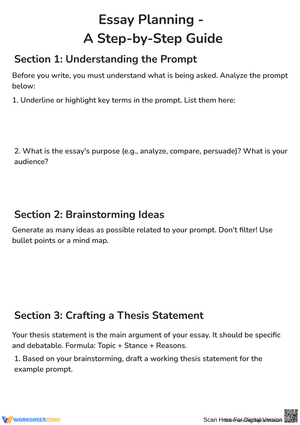
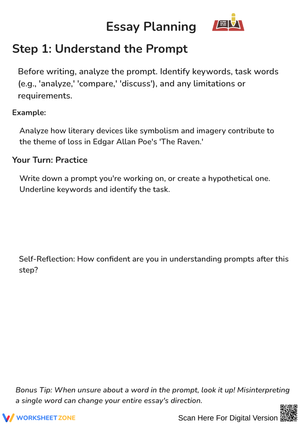
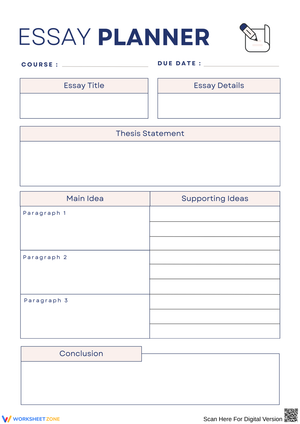
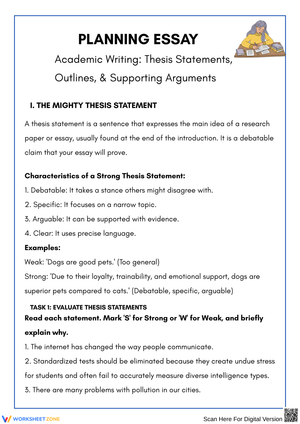
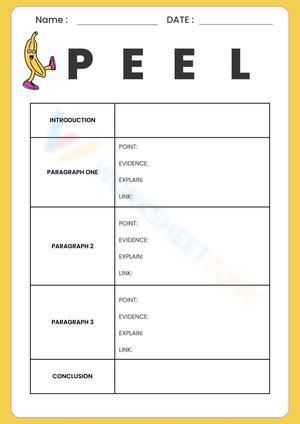
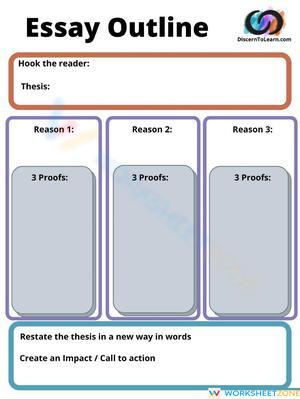
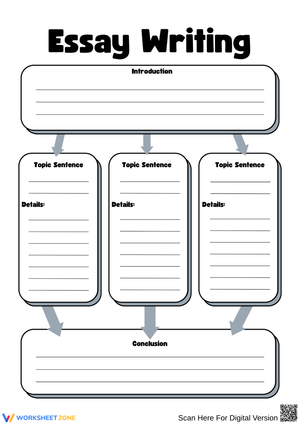
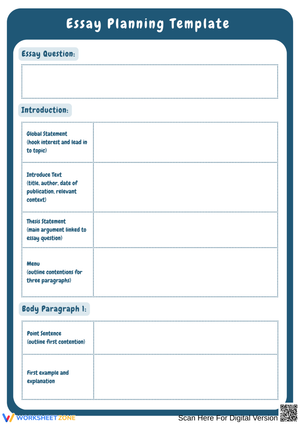
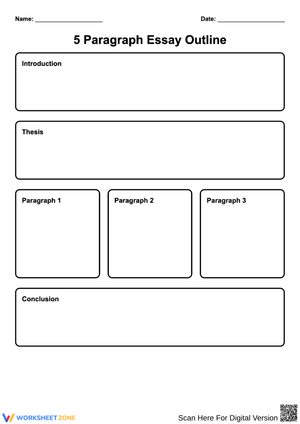
These essay outline printable worksheets for 9th grade solve a persistent classroom problem: students who discuss a text analytically in conversation but produce disorganized first drafts because they skipped planning entirely. The set includes four worksheet types — five-paragraph, argumentative, compare-contrast, and informational — each with labeled sections for thesis, topic sentences, evidence slots, and conclusion. They give teachers a consistent planning framework that holds up from the first essay unit in September through the last research paper in May.
Formats Included in the Set
Each worksheet targets the organizational challenge that ninth graders run into most often with that particular essay type. Moving from middle school to high school writing means shifting from summarizing to analyzing, from retelling to arguing — and these four formats address that transition directly.
- Five-Paragraph Outline: The foundational format. Students complete an introduction section — hook, brief context, thesis — three body sections with a topic sentence line and up to three evidence slots each, and a conclusion with separate lines for thesis restatement and closing thought. That distinction between restatement and closing thought is intentional; most students conflate them and end essays by simply repeating themselves.
- Argumentative Outline: Extends the five-paragraph structure with a dedicated counterargument and rebuttal section. Students name the opposing position, then write a rebuttal that acknowledges it while defending their own claim. This is the worksheet ninth graders need most for persuasive writing on school policy topics, current events, and literary debates.
- Compare-Contrast Outline: Offers a point-by-point version and a block-structure version as separate worksheets. Students select the format that suits their topic. Both include spaces for two subjects, at least three comparison criteria, and a synthesis conclusion that moves beyond simple summary.
- Informational Essay Outline: Built for explanatory writing. Sections prompt students to categorize information by subtopic, define terms where necessary, and support each category with objective evidence. There is no position or rebuttal section — the entire structure points toward clarity and factual organization rather than argument.
Each worksheet includes a brief reference note at the top explaining what that section of an essay accomplishes. Students working without a teacher nearby can answer the question "what am I supposed to put here" without hunting through their notes or flipping back to a handout from two weeks ago.
Outline Errors That Surface Early in 9th Grade
The most consistent outlining failure isn't structural — it's a thesis problem that makes everything downstream worse. Students write statements like "There are many reasons why school uniforms affect students" and then try to build body paragraphs from a claim that commits to nothing. That sentence names a topic; it doesn't make an argument. Body paragraphs end up loosely related rather than unified, and the essay tilts sideways by the second paragraph. Each worksheet includes a thesis line with a brief prompt — state a specific, arguable claim — which gives teachers a natural checkpoint before students fill in anything else.
A second consistent pattern: topic sentences that restate the thesis rather than develop it. A student with the thesis "social media harms teenagers' mental health" often writes as a first topic sentence "social media has negative effects on teenagers." That's the thesis slightly reworded, not a topic sentence. The body paragraph then has nowhere meaningful to go. Catching this on the outline worksheet — before the student has written 200 words in that direction — saves the kind of revision that comes back as "this whole paragraph doesn't do anything."
Conclusion sections get skimped too. Students write "restate thesis" in the conclusion space as if that's a complete plan. These worksheets separate the thesis restatement from the closing thought, with a prompt asking what the essay ultimately implies or what the reader should take away. That forced separation pushes students past the reflex move of copying their thesis back down at the end.
How to Fit These Worksheets Into Your Writing Units
The most reliable entry point is the first class day of a new essay unit, before any drafting happens. Distribute the appropriate worksheet, project a teacher-completed sample on the board — using a topic unrelated to the student assignment so they aren't simply copying the model — and walk through one section at a time while naming the decisions a writer makes at each step. That fifteen-minute guided opening typically prevents a full class period of structural revision comments a week later.
Peer outline review before drafting is worth the ten minutes it requires. Partners exchange worksheets and check three things: Is the thesis making a specific, arguable claim? Does each topic sentence clearly connect back to that claim rather than just restating it? Does the evidence listed in each body section actually support the topic sentence, or is it just generally about the same topic? Students find gaps in each other's outlines that they cannot see in their own, and fixing an organizational problem at the outline stage takes thirty seconds rather than thirty minutes of revision on a full draft.
For a low-stakes formative check mid-unit, the introduction section alone works during the first eight or ten minutes of class. Ask students to fill in only the hook, context, and thesis lines for a hypothetical prompt. A quick scan of the room before the lesson moves on tells the teacher almost everything worth knowing about where students are in their thinking that day — without adding a separate assignment or grade category.
Standard Alignment
The essay outline printable worksheets for 9th grade address CCSS ELA Writing Standards W.9-10.1 (argument writing), W.9-10.2 (informative and explanatory writing), and W.9-10.5, which explicitly calls for planning, revising, and editing as named stages of the writing process. W.9-10.5 is the anchor here. It makes a full class period spent on outline work defensible as genuine instructional time — not a preliminary activity students rush through before the "real" writing starts. When a department chair asks why today's lesson involved no drafting, W.9-10.5 is the direct answer.
Adjusting the Worksheets for a Range of Writers
Teachers who rotate through essay outline printable worksheets for 9th grade across multiple writing units find that the same worksheet works at different skill levels with minor adjustments — no need to print entirely separate materials for each tier.
For students who freeze at blank lines, the argumentative worksheet becomes approachable when the teacher pre-fills the thesis and first topic sentence before distributing copies. That removes the starting paralysis without removing the thinking — students still select evidence, build the rebuttal, and draft the conclusion. They have a concrete starting point at the moment they most often stop moving.
Advanced writers frequently rush outlining because they believe they already know what they want to argue. Requiring those students to add a citation placeholder next to every piece of listed evidence — just a quick author and page note — slows the process down in a productive way. It pushes them toward source integration habits that 11th and 12th grade writing will demand, rather than letting them treat the outline as a procedural box to check before drafting begins.
The compare-contrast worksheet naturally differentiates through its two format options. Students who handle abstraction easily tend to gravitate toward point-by-point structure; students who think more concretely often manage the block format better. Letting students choose between the two and write one sentence on the worksheet explaining why builds a small but deliberate moment of metacognitive awareness about how they organize information — worth naming explicitly at this grade level.
Frequently Asked Questions
What essay types do these worksheets cover?
The set includes worksheets for argumentative, informative/explanatory, five-paragraph, and compare-contrast essays. Those four formats cover most of what ninth graders encounter in ELA, social studies, and science writing assignments across a school year. The argumentative format handles both formal persuasive essays and literary analysis tasks that require students to defend an interpretation with textual evidence.
Can these be used as planning tools during timed in-class writing assessments?
The essay outline printable worksheets for 9th grade work well before timed assessments. Giving students five minutes with a blank outline worksheet before they begin an in-class essay improves first-draft organization noticeably. Students who have practiced filling out a physical outline repeatedly during instruction are better at producing a quick internal outline under timed pressure — the worksheet builds the habit, and the habit transfers to on-demand writing situations.
How should teachers approach grading completed outlines?
A completion check is usually sufficient. Did the student fill in the thesis, all topic sentence lines, at least one piece of evidence per body paragraph, and both conclusion fields? Reserve rubric-based grading for final drafts. That said, a quick teacher scan of just the thesis and topic sentence lines before students move to drafting catches most structural problems early. The outline is a planning tool, not a polished product — treating it that way keeps students willing to use it honestly rather than filling in placeholders just to satisfy the requirement.
How much class time does outlining typically require?
For most ninth graders, one full class period for introduction and guided practice, followed by fifteen minutes at the start of the next session for revisions before peer review, covers the process comfortably. Students who have used these worksheets across several units can complete an outline independently in thirty to forty minutes. The goal isn't speed — it's the consistent habit of planning before drafting, which develops gradually over the course of a semester.












 Interactive Worksheet Maker
 Quiz Maker
 Word Search Maker
 Crossword Puzzle Maker
 Word Scramble Generator
 Sentence Scramble Generator
 Handwriting Worksheet Generator
 Name Tracing Generator
 Fill In The Blank Generator