9th grade poetry analysis printable worksheets resources give English teachers a reliable starting point for one of the most resistant topics in freshman ELA — getting students to read beneath a poem's surface rather than summarize its literal content. This set covers figurative language, structural choices, tone, the TP-CASTT method, and unseen poem practice, with each worksheet targeting a specific analytical skill rather than asking students to do everything at once.
The Specific Skills These Worksheets Build
Freshman English asks students to make a significant cognitive leap — from retelling what happens in a text to explaining why an author made specific choices and what effect those choices create. These worksheets move through that progression deliberately.
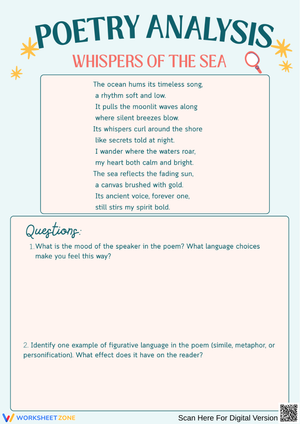
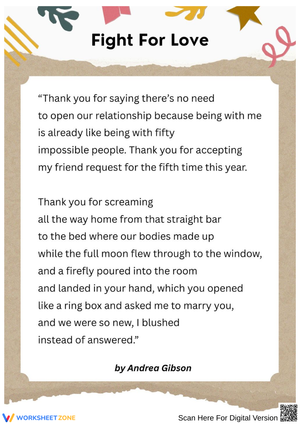
Figurative language worksheets push students past identification. At the Grade 9 level, labeling a metaphor earns partial credit on a rubric; explaining how that metaphor shifts the reader's understanding of the speaker's situation earns full credit. Each figurative language worksheet gives students a poem excerpt, asks them to mark the device, and then requires a sentence explaining its effect — a step most students skip when left to annotate on their own.
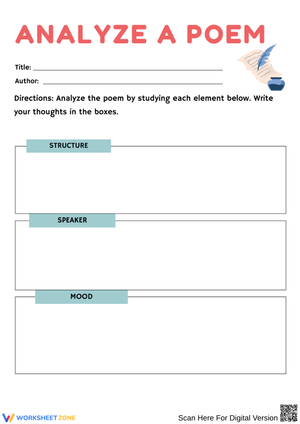
Structure worksheets address enjambment, caesura, rhyme scheme, and meter. Students often overlook the white space on a poem's page, treating every line break as an arbitrary visual choice. These worksheets make structural analysis concrete: students mark where syntax continues across line breaks, note where rhythm breaks mid-line, and write brief explanations of the pacing effect created by those choices.
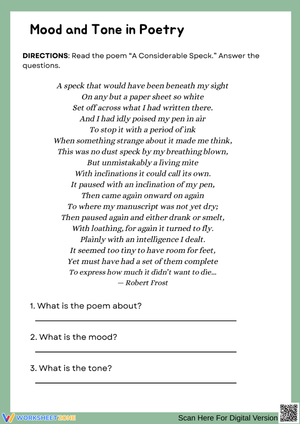
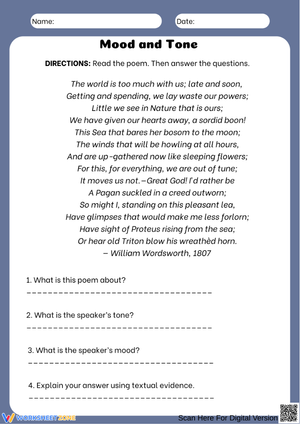
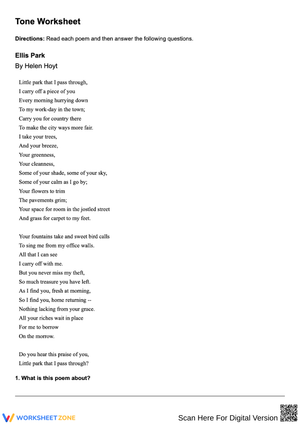
Tone-and-mood worksheets tackle a distinction that trips up freshmen every year. Students instinctively describe how a poem makes them feel — that's mood — but tone requires identifying the speaker's attitude and tracking how word choice signals it. Each worksheet requires students to underline specific diction, label its connotation, and build from that evidence to a tonal claim, in that order.
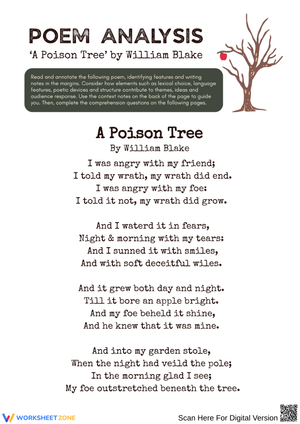
Unseen poem worksheets simulate assessment conditions. No prior class discussion, no teacher setup — just a short poem and a structured analysis prompt. Students annotate directly on each worksheet and then respond to targeted questions about structure and figurative language. These are the most useful worksheets for building the independent close-reading stamina that standardized exams actually test.
TP-CASTT Organizers in the Set
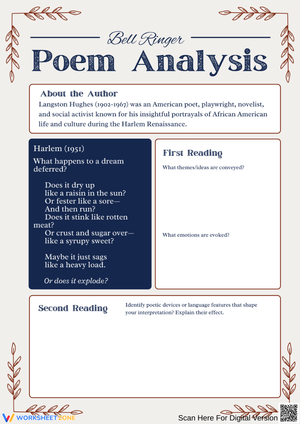
Several worksheets in the set are built around the TP-CASTT framework, which gives students a repeatable sequence for approaching any poem. The steps move from Title (an initial prediction before reading) through Paraphrase, Connotation, Attitude, Shift, a return to Title, and finally Theme. What makes these TP-CASTT worksheets especially useful is how the Shift step is handled — students are asked to circle transition words like "but" or "yet," note changes in stanza length or punctuation, and write a sentence explaining what the shift reveals about the poem's deeper meaning. Without that structured prompt, most freshmen either skip the volta entirely or confuse it with a change in rhyme scheme.
- Title (initial): Students record predictions based only on the poem's name, before reading a single line.
- Paraphrase: Students rewrite each stanza in plain language, confirming literal comprehension before moving to analysis.
- Connotation: Students mark figurative language, imagery, and sound devices, then explain what each adds to the poem's meaning — not just what it is.
- Attitude: Students cite specific words that establish the speaker's tone rather than naming tone without any textual grounding.
- Shift: Students locate the poem's turning point and explain how it reframes the material that came before it.
- Title (revisited): Students return to their initial prediction and revise it with the full poem in view.
- Theme: Students write a complete thematic statement — a sentence about what the poem says about human experience, not just what the poem is about.
Standard Alignment
These worksheets align most directly to RL.9-10.4, which asks students to determine the meaning of words and phrases as they are used in a text — including figurative and connotative meanings — and analyze the cumulative impact of specific word choices on tone and meaning. The tone-and-mood worksheets and figurative language worksheets both address this standard at the skill level, not just the surface level. RL.9-10.5 applies to the structure worksheets, covering how a poet's choices about form contribute to overall meaning. RL.9-10.1 runs underneath all of them: every analysis prompt requires students to cite specific textual evidence, which is a consistent expectation from the first week of freshman English through the end-of-year literary analysis essay. These aren't incidental standards touchpoints — they reflect the analytical moves freshmen need to execute independently by spring semester, without a teacher walking them through each step.
Mistakes Students Make That These Worksheets Help You Catch
The most common error isn't failing to find figurative language — it's stopping there. A student who writes "the poet uses a metaphor comparing grief to a stone" has done the minimum. The real work is explaining what that comparison does: whether it signals the speaker's heaviness, immobility, or emotional numbness. The figurative language worksheets include a follow-up prompt asking exactly that, which catches students who turn in identification dressed up as analysis.
Tone is another consistent trouble spot. Students default to feeling words — "sad," "angry," "hopeful" — without grounding those labels in actual diction. In real student work, you'll see "the tone is depressing" written next to a poem where no specific word choices have been examined. The tone-and-mood worksheets require students to annotate the poem first, highlight three or four specific words, and only then name the tone. That sequence catches students who label before they read.
On the TP-CASTT worksheets, the Paraphrase step reveals something teachers don't always anticipate: students who understand a poem's emotional register but not its literal meaning. A student can correctly identify grief or defiance in a poem while misreading half the sentences. Paraphrase makes that gap visible before it surfaces in an essay.
Working These Worksheets Into Your Weekly Plans
Unseen poem worksheets work particularly well as Monday warm-ups. Ten minutes at the start of class, students annotate independently, and the discussion that follows gives the teacher a clean read on where the class stands before the week's formal instruction begins. It's a low-stakes formative check that doesn't need to be collected or graded to be useful — the conversation is the data.
The jigsaw approach is worth trying with more involved TP-CASTT worksheets. Divide the class into small groups and assign each group only one section of the framework — one group handles Connotation, another handles Shift — then reshuffle into mixed groups where each student brings their section's findings. Students work more slowly and carefully when they know they're the only person in their new group who tracked that element. The quality of discussion in those mixed groups is noticeably higher than when everyone completes the same steps in parallel.
For formal assessment, 9th grade poetry analysis printable worksheets resources pair naturally with a short literary analysis essay. Students complete the worksheet first, use it as an evidence bank, then draft an essay pulling from their annotations. Teachers who build this two-step sequence into their unit find that essays show stronger textual support — because the close reading happened on the worksheet rather than being attempted simultaneously with the writing.
Adjusting These Worksheets for Mixed-Ability Classes
Students who need additional support benefit from beginning with shorter lyric poems — twelve to sixteen lines — before working with longer poems on the same worksheet format. The analysis structure stays identical; only the text changes. This keeps the instructional target consistent while reducing the cognitive load of processing an unfamiliar lengthy poem while simultaneously learning the analytical framework.
Advanced students can take the unseen poem worksheets further by completing two passes: the first annotating surface-level observations, the second tracking how structural choices reinforce or complicate the poem's literal content. Asking them to write a paragraph about the relationship between form and theme — using their worksheet annotations as the evidence base — moves them toward the kind of writing expected in AP Literary Analysis in later years. For these students, each worksheet functions as a first draft, not a finished product.
Students who freeze when confronted with archaic or syntactically dense language respond better to the tone-and-mood worksheets used first with contemporary poetry. Once they have the analytical habit — identify the diction, assess the connotation, name the tone — they transfer it to harder texts more readily. Starting with a 16th-century poem before that habit is established tends to produce surface-level annotation rather than genuine analysis, no matter how capable the student.
Frequently Asked Questions
Which poems work well for a first use with these worksheets?
Poems with a clear narrative arc and a strong emotional core give students the most productive first experience. Pieces organized around identity, loss, or conflict give students something concrete to track as they move through the TP-CASTT steps. Accessible contemporary poets — those whose syntax reads close to conversational speech — lower the barrier to entry before students have built confidence with more compressed or archaic texts.
How do I use completed worksheets as formative assessment tools?
Collecting worksheets at the end of a class period gives more diagnostic information than a quiz would. Look specifically at the Connotation and Shift sections of the TP-CASTT worksheets — those two steps reveal whether students are reading analytically or summarizing. Students who write single-word labels in the Connotation box rather than explanatory phrases need a reteaching cycle on figurative language function before they move to essay writing.
What is the difference between theme and subject on these worksheets?
Subject is what the poem is about at the literal level — a storm, a parent, a city street at night. Theme is what the poem argues about human experience through that subject. The theme prompt on each worksheet asks students to write a complete sentence, not a word or a phrase, because a full sentence forces them to articulate the poet's claim rather than just the topic. "Loss" is not a theme statement. "Loss reshapes a person's sense of time" is closer to what the prompt requires.
Do these worksheets work with student-selected poems?
They do, and student-selected poems often produce the most thorough responses — students are more willing to sit with a difficult figurative moment in a poem they chose than in one assigned to them. The 9th grade poetry analysis printable worksheets format works with any short-to-medium poem that carries enough structural and figurative complexity to sustain the analysis prompts. Song lyrics, for instance, rarely support the Connotation or Shift steps in a way that meaningfully advances the skill — the analysis runs out of material before the worksheet does.












 Interactive Worksheet Maker
 Quiz Maker
 Word Search Maker
 Crossword Puzzle Maker
 Word Scramble Generator
 Sentence Scramble Generator
 Handwriting Worksheet Generator
 Name Tracing Generator
 Fill In The Blank Generator