9th Grade Poetry Annotation PDF Worksheets for ELA Class
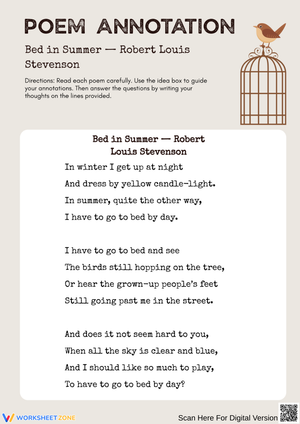
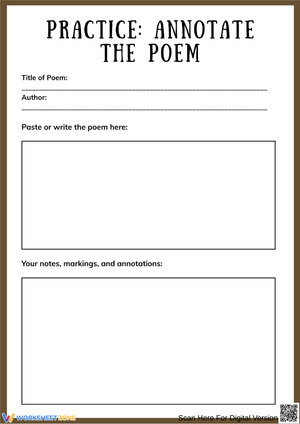
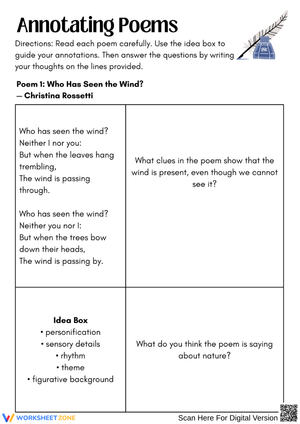
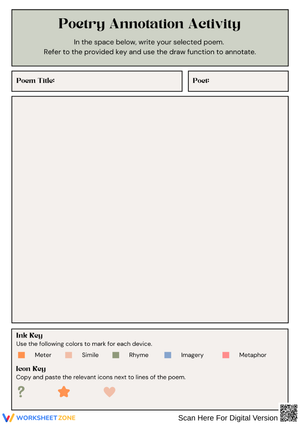
9th grade poetry annotation pdf worksheets give English teachers a close reading routine that students carry across poems all year — same marks, same habits, different texts each time. A well-built worksheet prints the poem with enough margin space to write, includes a short annotation key, and ends with questions that push students toward explanation rather than simple labeling. That combination turns a passive reading experience into visible thinking on the page.
The Reading Moves Each Worksheet Builds
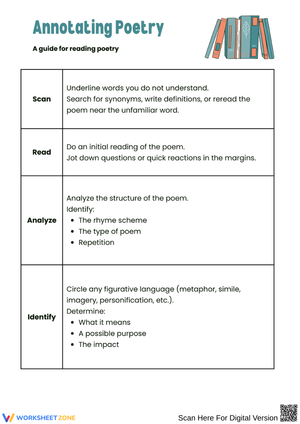
Annotation at this level should do more than get students to notice poetic devices — it should get them to explain effects. Each worksheet in this set targets a cluster of skills that build directly toward literary analysis:
- Diction: Students underline specific word choices and write brief notes about why those choices matter — not just that they "sound good" or "stand out."
- Imagery: Students circle sensory details, label the sense they appeal to, and note the mood those images create in context.
- Figurative language: Students identify metaphor, simile, personification, and symbolism, then connect each device to the poem's central concern rather than just naming it.
- Sound devices: Students mark alliteration, repetition, and rhythm when those features reinforce tone or emphasis — not as a separate inventory but as part of meaning-making.
- Tone shifts: Students track changes in speaker attitude across stanzas and note the specific lines where something changes.
- Theme evidence: Students gather textual evidence before writing a claim, which makes analytical paragraphs more grounded and less reliant on vague assertion.
The sequence matters. Students who skip straight to theme tend to make unsupported generalizations. Annotation forces them to slow down and collect evidence before they interpret.
Errors That Show Up in Annotated Poems — and What to Do About Them
The most common problem in 9th grade annotation isn't missing devices — it's labeling without explaining. A student marks "metaphor" next to a line and considers the job done. The annotation says nothing about what the metaphor does: what feeling it creates, what idea it reinforces, why the poet chose a figurative comparison rather than a literal description. This is exactly the surface-level habit annotation practice is meant to break.
A second pattern: students annotate the first stanza carefully and then trail off. The last half of the poem gets underlines with no notes. By the time they reach the final image or a closing tone shift, they're reading for plot rather than meaning. Building in a mid-poem pause — stopping as a class after the second stanza and having each student share one annotation — disrupts that fade consistently.
A third issue appears specifically with sound devices. Students who identify rhyme tend to stop there, writing "ABAB rhyme scheme" without asking what the rhyme accomplishes. In a poem where the rhyme breaks down in the final couplet, that breakdown often signals emotional fracture — and students miss it entirely because they catalogued the pattern instead of reading its effect. Pushing back on that habit with one direct question ("What does this sound device do to the feeling of the line?") redirects students faster than reteaching the device itself.
Smart Ways to Work These Worksheets Into Your Week
The most efficient use of this set is a two-day sequence. On day one, students read the poem once for general understanding and then again with a narrow annotation focus — diction and imagery only, for example. Class discussion draws from those marks before moving to broader interpretation. On day two, students return to the same worksheet and add a second layer of annotation focused on tone or theme evidence, then write a short response using lines they've already marked. Returning to the same poem builds the kind of rereading habit that carries into independent reading and timed writing tasks.
For warm-up use, a focused annotation task on a short poem runs cleanly in 10 to 12 minutes before a writing lesson. Students annotate for one element, share a mark with a partner, and the teacher surfaces two or three observations to open discussion. That narrow focus keeps the task from sprawling and models the precision students need in analytical writing. Each worksheet also works as a sub plan — the poem, key, and questions are all in one place, so there's nothing for a substitute to interpret beyond the written instructions.
One small technique that raises annotation quality quickly: require two kinds of marks on every poem, a notice and a because. The notice mark identifies a feature — repeated syntax, a stark image, a shift in register — and the because note explains its effect in a phrase. That rule, enforced consistently for a few weeks, pushes students beyond labeling and into the reasoning that literary analysis actually requires.
Choosing Poems That Reward Close Reading at This Level
Short poems with at least one noticeable shift work best for annotation practice in Grade 9. Students need enough happening on the page to annotate meaningfully, but not so much density that decoding takes over from analysis. A poem that can be read aloud in two minutes and then reread three times during class is usually in the right range. Poetry Foundation, ReadWriteThink, and CommonLit all maintain teacher-accessible collections where texts are tagged by grade band and reading level.
Match the poem to the lesson objective before selecting the worksheet. If the goal is tone analysis, choose a poem where the speaker's attitude changes across stanzas — something students can track with marks. If the goal is figurative language, choose a poem where the central metaphor carries the meaning and students can trace how it develops from stanza to stanza. A poem that only rewards one kind of annotation isn't a problem, but the worksheet prompts should reflect that narrower focus rather than asking about devices the poem doesn't actually use.
Standard Alignment
These worksheets address CCSS.ELA-LITERACY.RL.9-10.4, which requires students to determine the meaning of words and phrases as used in a text and analyze the cumulative impact of specific word choices on meaning and tone. That standard is the instructional core of poetry annotation — naming a device is not enough; students have to explain what it does. CCSS.ELA-LITERACY.RL.9-10.1, requiring students to cite strong and thorough textual evidence, is built into the annotation-to-response structure of each worksheet. The two standards together cover what annotation practice is trying to develop in Grade 9 ELA, and the collected worksheets give teachers a paper trail of that development over time.
Adapting Each Worksheet Across Ability Levels
For students who are still building stamina with close reading, narrow the annotation task to two elements instead of the full key. Marking imagery and tone only — then responding to one text-dependent question — reduces how much students have to track at once without removing the analytical thinking. They're still making meaning from the poem; they're just doing it with a smaller task load.
English learners benefit from a short glossary of difficult words attached to the worksheet, along with a few sentence-level prompts in the margin: The word __ suggests __ or This image makes me think of __ because __. Those frames don't do the thinking — they give students a structure to hang their thinking on, which is a different thing.
Advanced students can annotate for pattern and contradiction. After marking imagery and figurative language, they look for places where the poem resists its own apparent meaning — an image that doesn't fit the dominant tone, a line that complicates an earlier claim, a speaker whose stated feeling and word choices pull in different directions. That analytical move goes beyond what any worksheet explicitly asks and prepares students for the evidence-based writing that higher-level courses require. Teachers who want to extend those students can add a second response prompt directly to the worksheet with a pen: "Where does the poem work against itself? Cite two lines."
Across all levels, 9th grade poetry annotation pdf worksheets give teachers something that oral discussion alone can't — a physical record of how each student reads. That record makes differentiation more precise because teachers aren't guessing where the breakdown is; they can see it in the margins.
Frequently Asked Questions
What should 9th graders annotate in a poem?
Students should annotate for diction, imagery, figurative language, sound devices, tone shifts, and theme evidence. The goal isn't to mark every line — it's to mark what helps explain how the poem creates meaning. Quantity of marks doesn't indicate quality of thinking, and students who cover a poem in highlighter without any written notes haven't actually annotated.
How do I introduce annotation to students who have never done it before?
Start with one element, not six. Give students a short poem and ask them to underline every word that connects to mood, then share one observation. Add elements across several lessons as the habit builds. The first time students work through a complete annotation key, at least two or three of those marks should already feel familiar from earlier practice.
Can I use these worksheets as formative assessment?
Yes — and they give more information than many teachers expect. Collecting an annotated worksheet lets you see not just whether a student answered a question correctly but whether they can identify relevant textual evidence in the first place. A student who writes a reasonable theme statement but marks nothing useful in the poem margins has a different problem than a student who marks strong evidence but can't form a claim. Each worksheet surfaces both.
Do I need a specific symbol key, or can I create my own?
Consistency across the class matters more than which symbols you choose. When everyone marks tone the same way, whole-class discussion runs faster because students can reference each other's annotations without confusion. Keep the key to five or six symbols — more than that and students spend class time managing the key rather than reading the poem. The set works well alongside whatever key your department already uses.
How often should students annotate poetry in 9th grade?
Frequent short practice beats occasional long sessions. One annotated poem per week — even 15 minutes — builds the habit faster than a single annotation unit done once a semester. Using 9th grade poetry annotation pdf worksheets as a Monday warm-up or a brief Friday close reading gives students the repetition they need without displacing the main unit work. By mid-year, students annotate more automatically and discussion requires less prompting to reach textual evidence.
Clear All