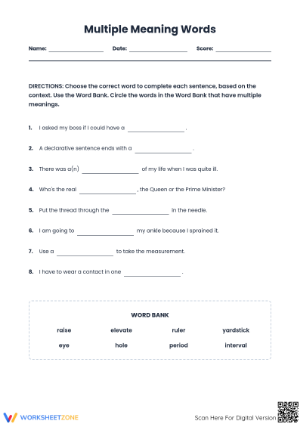
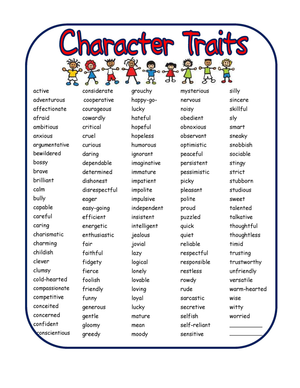
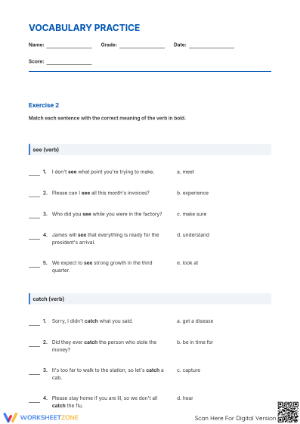
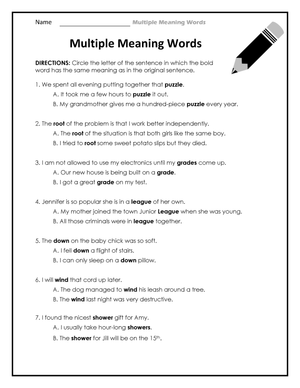
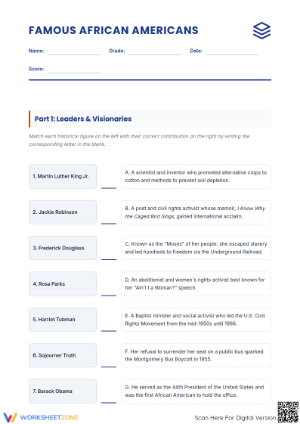
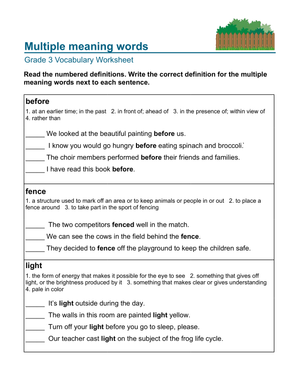
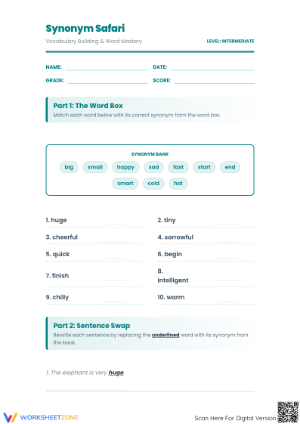
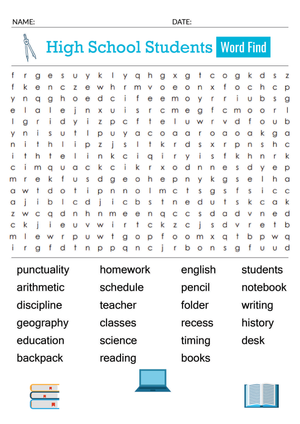
These 9th grade vocabulary printable worksheets give freshman English teachers a focused, skill-specific set covering Greek and Latin roots, context clue strategies, and Tier 2 academic vocabulary — the three areas where 9th graders most commonly hit a wall in both reading and analytical writing. Each worksheet targets one skill so teachers can pull exactly what fits a given lesson rather than working through the full set in a fixed sequence.
The Specific Skills in Each Worksheet
Root word worksheets ask students to break apart multisyllabic words — identifying the prefix, root, and suffix separately — and then generate two or three additional words using the same base. That generative step separates real morphological understanding from the kind of memorization that evaporates by the following Monday. A student who can write that contradict, edict, and dictate all share dict (to say, to declare) has internalized a pattern, not a definition.
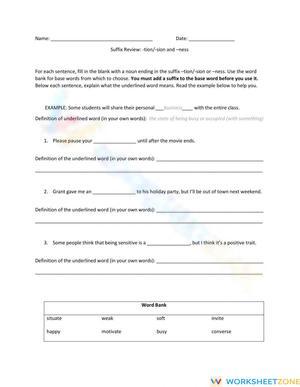
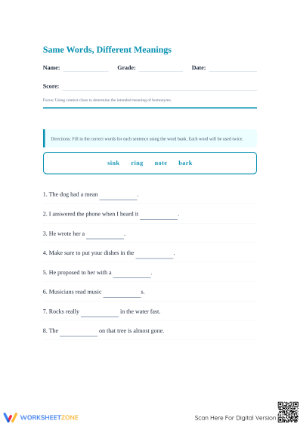
Context clue worksheets present sentences with an underlined target word and ask students to identify the clue type — synonym restatement, antonym contrast, example, or inferential — before writing a working definition in their own words. Requiring that label first forces interpretation rather than guessing.
The Tier 2 academic vocabulary exercises pair words like corroborate, implicit, and diverge with three task types:
- Sentence completion that requires choosing between two semantically close options
- Word-relationship analysis connecting the target word to a synonym, antonym, or related term
- A short constructed response asking students to explain when they would use the word — and when they wouldn't
That last task tends to surface gaps that sentence completion alone misses entirely.
Where Students Go Wrong — and How These Worksheets Surface It
The most persistent root word error appears when students learn a root correctly but ignore the prefix that modifies it. A student who knows chron means time will label anachronism as "related to time" and consider the job done — the ana- (backward, against) goes entirely unexamined. On the worksheet, putting the prefix in its own column and asking students to define it independently forces that second look. Until the prefix column is there staring at them, many students genuinely don't notice it exists.
In context clue exercises, students almost universally default to synonym-based reasoning even when the sentence signals a contrast. A sentence like "She was never loquacious; a single afternoon with her and you'd learn that silence was her preferred state" contains obvious contrast signals, but students will write "talkative" without identifying how they got there. These worksheets require students to mark the clue type before writing the definition — that sequence disrupts the automatic skip to the answer and makes the reasoning visible to the teacher.
With Tier 2 academic vocabulary, the common problem is definitional flattening: students learn that infer means "to figure something out" and treat that as complete knowledge. When a writing prompt asks them to draw an inference and evaluate its validity, they collapse both operations into one. The constructed-response tasks on these worksheets separate those steps explicitly, and teachers can use the student responses to identify who is actually applying the distinction versus who is still treating the two as synonymous.
Building These Worksheets Into a Weekly Vocabulary Routine
Monday bell ringers with a new root word worksheet get the week started without eating into lesson time — ten minutes, no mid-lesson distribution, students working before attendance is even finished. By Wednesday, a quick oral review of that same root in three or four words encountered in the day's reading turns the worksheet into retrieval practice. That spacing — initial exposure Monday, retrieval Wednesday — moves vocabulary into longer-term memory more reliably than a review crammed the night before a Friday quiz.
These 9th grade vocabulary printable worksheets also fit naturally into small-group instruction. Assigning each group a different root family — one group on -spec-, another on -port-, a third on -dict- — and then having each group spend five minutes teaching their words to the class turns peer instruction into genuine vocabulary work. The group that learned dict explaining contradict and edict to students who only worked with spec is reinforcing the pattern through production, not just recognition.
One honest limitation: the context clue worksheets work best with students reading at or near grade level. Students reading significantly below grade level often struggle with the target sentences themselves, which means the exercise ends up measuring reading fluency more than vocabulary strategy. A brief partner read-aloud before students work independently addresses that problem without modifying the task itself.
Standard Alignment
These worksheets address CCSS.ELA-LITERACY.L.9-10.4, which requires students to determine or clarify the meaning of unknown and multiple-meaning words and phrases in grades 9–10 texts. Substandard L.9-10.4a targets context clue use directly; L.9-10.4b requires students to identify and correctly use patterns of word changes that indicate different meanings or parts of speech — the skill the root word exercises practice explicitly. L.9-10.4c extends into consulting reference materials for pronunciation and usage, which teachers can layer in as a follow-up once students have already attempted a target word independently.
In classroom terms, L.9-10.4 sits in the Language strand but carries real weight across all four ELA domains. Students who can determine meaning from context read the literary and informational texts in the Reading standards more fluently and write with more precise word choice in the Writing strand — both of which show up in end-of-year assessment performance at this grade band.
Using the Set Across the Full Range of Your Class
For students who need more support, the root word worksheets respond well to a partially completed chart: fill in the root and two example words before distributing, and ask those students only to generate the third word and write the shared meaning. That reduced production demand lets them concentrate on pattern recognition rather than decoding and generating at the same time.
Advanced students who finish the core exercises quickly benefit from an extension that keeps them in the same vocabulary territory rather than sending them off to unrelated work. Ask them to locate a sentence from the current class reading where a word containing the day's root appears, then explain in two or three sentences how recognizing the root affected — or would have affected — their interpretation of the passage. That task keeps the vocabulary work anchored to actual reading rather than becoming an isolated exercise in word trivia.
These 9th grade vocabulary printable worksheets also transfer well across departments. A science or history teacher who assigns independent reading can take the context clue format and substitute domain-specific sentences, keeping the task structure students already know while applying it to new content. The root word exercises work especially well in science, where Greek and Latin roots account for the majority of technical terminology students encounter.
Frequently Asked Questions
How many words does each worksheet cover?
Root word worksheets introduce one root with four to six derived words — a number small enough for genuine depth but large enough to demonstrate a real pattern. Context clue worksheets use eight to ten target sentences, each featuring a different word. The point in both cases is repeated meaningful contact with a manageable set, not surface coverage of a long list.
Are the context clue worksheets suitable to send home as homework?
The root word and Tier 2 academic vocabulary worksheets work well as homework because the task structure is self-explanatory once students have seen the format in class. Context clue worksheets are better kept in class the first time students encounter a new clue type — students who misread the instructions tend to complete the entire worksheet incorrectly without realizing it. One modeled example at the board before students take the worksheet home eliminates most of that problem.
Do these work for English language learners?
The root word exercises work particularly well for students whose first language has Latin or Romance roots, since port, dict, and spec appear in Spanish, French, and Italian cognates many of these students already know. The 9th grade vocabulary printable worksheets in this set make those connections explicit by including a step where students list words they already know that share the root — a task that validates prior knowledge while building academic vocabulary at the same time.












 Interactive Worksheet Maker
 Quiz Maker
 Word Search Maker
 Crossword Puzzle Maker
 Word Scramble Generator
 Sentence Scramble Generator
 Handwriting Worksheet Generator
 Name Tracing Generator
 Fill In The Blank Generator