Semicolon worksheets for 9th Grade
These semicolon worksheets for 9th grade cut through the rote-memorization approach that rarely transfers and replace it with clause-level decision-making: students mark subjects and verbs on both sides of a potential semicolon, compare punctuation options against each other, edit real errors in context, and write original sentences that use the mark deliberately. The set targets the two uses that matter most at this level — joining closely related independent clauses and sorting out complex list items that already carry internal commas.
The Specific Skills Targeted
Each worksheet focuses on one or two skills rather than cycling through everything simultaneously. The progression moves from clause recognition to editing to original production, because most students can identify a semicolon before they can deploy one correctly in their own sentences.
- Clause-level identification: Before marking any punctuation, students underline the subject and verb on each side of a potential semicolon. This structural check turns punctuation work into grammar analysis, which makes corrections more durable than pattern-matching alone.
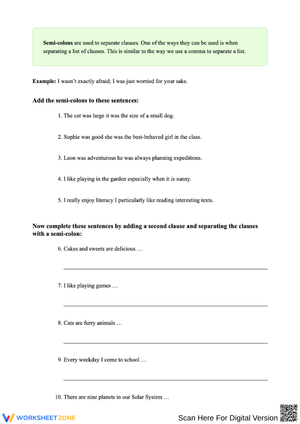
- Sentence combining: Students take two related independent clauses and write them as one, then justify their choice between a semicolon, a comma-plus-conjunction, and a period. The justification step separates applying the rule from guessing it.
- Error correction: Students locate and fix comma splices and run-ons, choosing a semicolon only when both sides are complete and the ideas are closely related. Not every error calls for a semicolon, and the worksheets make that distinction explicit.
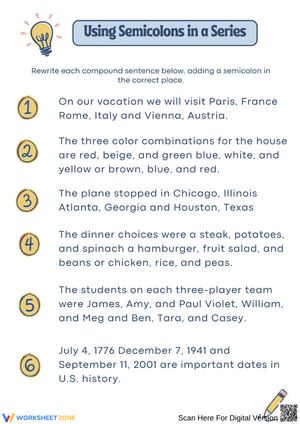
- Complex series punctuation: Students separate list items that already carry internal commas — a use most students haven't encountered before 9th grade and one that takes longer to internalize than the clause-joining rule.
- Writing application: Students write original sentences or revise a paragraph excerpt, producing the punctuation mark in context rather than just recognizing it in pre-written examples.
Errors That Surface Predictably in Student Drafts
The most consistent error at this level isn't ignorance of the definition — students have heard it. The failure point is overgeneralization. A student will correctly join two complete sentences (The lab results were back; the hypothesis held) and then apply the same move to a clause and a fragment (She grabbed her bag; running toward the door). The rule feels simple enough to extend everywhere, and that extension is precisely where accuracy collapses. Editing worksheets that include fragment examples alongside correct models force students to test completeness on both sides before committing to any punctuation choice.
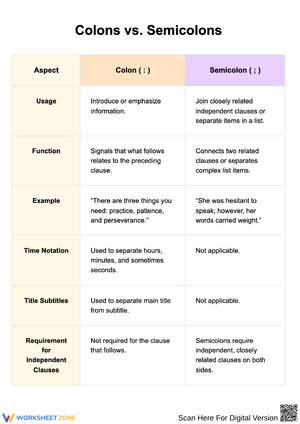
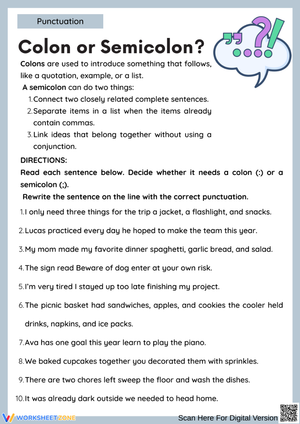
The colon-semicolon swap is a second persistent confusion. Both marks tend to appear in the same unit, and students conflate their functions for weeks afterward. A colon introduces or expands; a semicolon joins two complete thoughts on equal terms. When students encounter both marks in the same editing section and have to decide which one each sentence requires, they build a working distinction — not just a memorized definition they can recite and immediately misapply.
Comma splices produce a third specific problem during editing tasks. When students fix a comma splice, many remove the comma and drop in a semicolon without asking whether the ideas actually belong together. The result is a correctly punctuated sentence that still doesn't cohere as a unit. Worksheets that ask students to explain why a semicolon fits — rather than simply where it goes — catch this pattern before it reappears in the next formal essay.
Building These Worksheets Into Your Weekly ELA Routine
The most productive use of a semicolon editing worksheet in a 50-minute class follows a tight sequence: five minutes on a projected model where you read both sides of a semicolon aloud and ask what changes if you replace it with a period; 12 to 15 minutes of independent practice on the editing and combining sections; then a writing transfer task in the last 10 minutes. For that transfer task, ask students to find one place in a current draft where two short sentences could be joined with a semicolon and one place where the mark would be incorrect. The contrast is where the rule becomes functional rather than theoretical.
Semicolon worksheets for 9th grade also fit well as Monday bell ringers after a weekend gap, when punctuation recall needs a quick reset before writing instruction continues. Three or four sentence-combining items take fewer than eight minutes and give you a readable snapshot of who retained the rule and who needs a small-group reteach before the next writing assignment. For homework, a two-part worksheet — correct five sentences, then write two originals — gives students low-stakes independent practice they can complete without in-class guidance. A worksheet with a short rule box at the top and an answer key works cleanly for a substitute period too, without needing additional explanation left in the plans.
Standard Alignment
These worksheets align to CCSS.ELA-LITERACY.L.9-10.2a, which requires students to use a semicolon to link two or more closely related independent clauses. In classroom terms, this standard becomes most relevant during the writing-intensive stretches of the year — literary analysis, argument essays, research papers — when teachers want students to produce varied sentence structures rather than stacking the same short independent clauses repeatedly. The complex series application falls under L.9-10.2 more broadly, which covers conventions of standard English punctuation across all writing contexts. Both uses appear in most district grammar pacing guides at the 9th grade level and show up in state assessments that include sentence-revision tasks.
Differentiating the Worksheets Across Student Readiness Levels
The entry point for the task shifts without requiring a different handout. For students who are still working through clause structure, the first step is always the structural check: mark the subject once and the verb twice on each side of the semicolon before touching punctuation. That requirement removes guessing and makes grammar visible before the mechanics decision happens.
- Students who need additional support: They complete the clause-marking step before editing anything, then reference a brief guide showing correct and incorrect models side by side. This keeps the cognitive load at a manageable level while still requiring genuine decision-making rather than copying a pattern.
- On-level students: They work through editing, combining, and short-answer items without the clause-marking structure. They write a one-sentence explanation for at least two answers, naming the structural reason the semicolon works or doesn't work in that sentence.
- Students ready for extended challenge: They locate every semicolon in a published nonfiction excerpt from the current unit, identify which use each one represents, and write an original sentence modeled on each example. The imitation task moves from recognition straight into stylistic control.
When semicolon worksheets for 9th grade are assigned this way, the same resource covers three readiness levels without separate preparation or different handouts for each group.
Frequently Asked Questions
What background knowledge do students need before the first worksheet makes sense?
Students need to identify an independent clause — a subject, a verb, and a complete thought that can stand alone. If they can't test whether a sentence is complete, semicolon rules won't settle into place. A five-minute clause-identification check before the first worksheet saves significant confusion mid-task and tells you quickly whether students are ready for punctuation decisions or need another day on sentence completeness.
Are these worksheets more useful as formative checks or as graded assignments?
They produce the most useful information as formative tools. A grade on an editing drill tells you less than a look at whether the same student uses the mark correctly in the next essay. The more productive move is to sort student responses into three rough groups — understands and can explain it, correct by instinct, still making errors — and use that sort to decide who needs a reteach conversation before the next major writing task.
What do I do when a student starts placing semicolons into every sentence after this lesson?
This happens reliably once students feel they've acquired a new skill. The fastest correction is a read-aloud check: the student reads each side of every semicolon in their draft as a standalone sentence. If one side doesn't hold up alone, the mark goes. Students usually find the overcorrection themselves within three or four sentences, which is more lasting than re-explaining the rule from the front of the room.
Where does semicolon instruction fit in a typical 9th grade grammar sequence?
Most teachers introduce semicolons after students have solid practice with compound sentences — after comma-plus-conjunction work and before the conjunctive adverb unit. At that position in the sequence, semicolon worksheets for 9th grade require minimal reteaching because students already understand that two related independent clauses can be joined; they're adding a new tool rather than learning the underlying clause concept from scratch.
Clear All