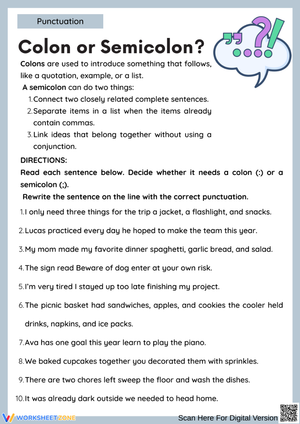
Colon printable worksheets for 9th Grade
These colon printable worksheets for 9th grade give ELA teachers what they actually need: short, focused practice that fits the narrow windows where grammar instruction happens — the nine-minute bell ringer, the editing block before a draft returns, the reteaching session on Friday afternoon. The set covers the full range of colon conventions at the high school level, from list introductions and explanation clauses to title-subtitle formatting and formal quotation setup. Students do not just mark colons — they test sentence structure, revise errors, and put their reasoning into words.
The Specific Skills Each Worksheet Builds
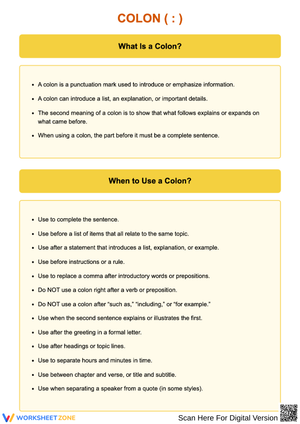
Ninth graders typically arrive with one colon rule: it introduces a list. That partial knowledge is exactly what causes most of the errors teachers see in drafts and timed writes. These worksheets push past that starting point and require students to work with four distinct colon functions.
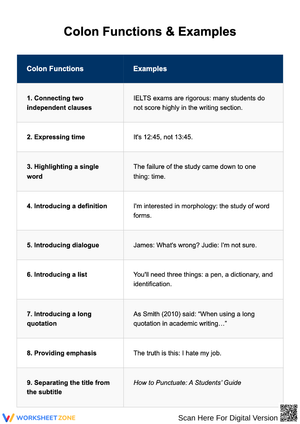
- List introduction after a complete clause: Students practice identifying that The expedition required three supplies: a compass, a water filter, and a signal mirror works because the clause before the colon stands alone — and that changing the structure to "the expedition had" followed by a colon would break it entirely.
- Explanation or restatement: Sentences like She had one regret: she never revised the thesis teach students that a colon can introduce a single completing idea, not only a series of items.
- Formal quotation setup: Students format sentences where the speaker's attribution is a complete statement, making the colon — not a comma — the correct choice before the quotation.
- Title and subtitle punctuation: Academic papers, annotated bibliographies, and research presentations all require this convention, and it is consistently undertaught before students begin formal research writing in 9th grade.
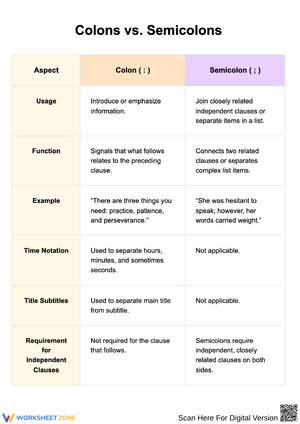
Each worksheet also includes items that ask students to distinguish colons from semicolons and em dashes. Those side-by-side comparisons surface a confusion that does not resolve on its own without direct, repeated practice.
Errors Worth Catching Before They Calcify in Student Writing
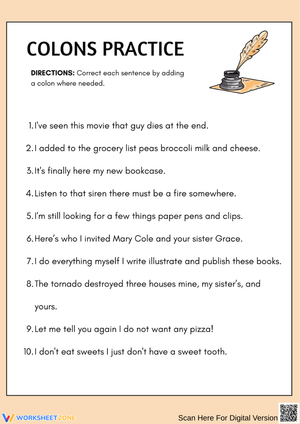
The most persistent error at this level is the colon placed after an incomplete clause — specifically after a verb or preposition. Students write The backpack contained: a calculator, two pens, and a folder and hear nothing wrong because the pause sounds right when spoken aloud. The problem is structural: "the backpack contained" does not stand alone as a sentence, so the colon that follows is incorrect. These worksheets include sentence-repair tasks built around exactly this pattern, because identifying the error is not enough — students need practice rewriting it until the correction becomes automatic.
A second predictable confusion involves colons and semicolons. Students who have just learned that semicolons connect two independent clauses sometimes reach for a colon when they mean to link rather than introduce. The correction requires students to ask what the second part actually does: if it explains or illustrates the first clause, a colon may belong; if both parts carry equal weight as statements, a semicolon is the stronger choice. Worksheets that put both options in the same exercise make that distinction visible in a way a rule card on the wall cannot.
Where These Worksheets Belong in a Real ELA Week
The most effective use of any colon practice worksheet is pairing it with something students are currently writing. Assign a worksheet the same week students are drafting analytical paragraphs, then ask them to return to their own writing and find one place where a colon either belongs or has been misused. That transfer step — scanning their own paragraph immediately after finishing the worksheet — is where the rule consolidates. Without it, students often complete the practice correctly and then continue punctuating their essays the same way they always have.
Beyond that core pairing, the resources fit several other spots in the week. A three-item bell ringer — one correct colon, one missing colon, one incorrect colon — takes roughly eight minutes and generates enough brief class discussion to check understanding before moving into independent work. For reteaching, one group can work on sentence correction while another edits a short passage, then both groups debrief with the same answer key. Sending a worksheet home the night before a writing revision focuses students on punctuation decisions at the exact moment they need them.
Standard Alignment
These colon printable worksheets for 9th grade address CCSS L.9-10.2 (Demonstrate command of the conventions of standard English capitalization, punctuation, and spelling when writing), and more specifically L.9-10.2.b, which calls for students to use a colon to introduce a list or quotation. In classroom terms, that standard surfaces during editing instruction, formal writing assignments, and revision workshops — not as a stand-alone grammar unit. The worksheet format reflects that placement: the tasks are short enough to pair with other work and specific enough to surface whether a student has internalized the rule or is still punctuating by ear.
Adjusting the Set for a Range of Learners
Students who are still shaky on independent clauses work through the colon printable worksheets for 9th grade most effectively when they have a visible decision process in front of them — something like: "Can the words before the colon stand alone as a sentence? If yes, a colon may work. If no, the colon is likely wrong." That step-by-step test is not a workaround; it is the actual reasoning skilled editors use, and making it explicit reduces the guessing that produces random punctuation placement. These students benefit from sentence-level correction tasks before attempting passage editing.
Students who already place colons correctly in simple sentences need tasks that push toward complexity: introducing block-style quotations in analytical writing, formatting titles for research papers, and editing passages where several punctuation options are defensible and they must choose and explain. Mixed punctuation review items — colons alongside semicolons, em dashes, and commas in appositive phrases — challenge students who have moved past the foundational rule and need to make finer distinctions at the sentence level.
Frequently Asked Questions
Can a colon come after a verb or preposition?
No. If the words before the colon do not form a complete sentence, the colon is incorrect regardless of how natural the pause sounds when read aloud. Her goals included: better time management and consistent revision is wrong because "her goals included" is not an independent clause. Students catch this most reliably when they physically cover the colon and test whether the left side stands alone — and that habit is worth teaching explicitly as a self-editing strategy.
How is a colon different from a semicolon in practice?
A colon introduces — it signals that what follows will explain, complete, or list from the first clause. A semicolon connects — it joins two independent clauses of roughly equal weight. If removing the second part leaves the first clause genuinely incomplete in meaning, a colon likely fits. If both sides could stand as their own sentences with no loss of clarity, a semicolon is the stronger choice. Students who mix these up usually improve quickly once they see several contrasting examples worked through side by side.
When in the school year should colon instruction happen?
Introduce colon use in context the first time students write a formal analytical essay or research-based response — typically early fall in 9th grade. Return to it during revision cycles rather than teaching it once and moving on. Colon conventions reappear in citation formatting, title styling, and formal quotation setup across the year, so brief repeated exposure across several units does considerably more than a single isolated lesson.
Do these worksheets work for reteaching and intervention?
The colon printable worksheets for 9th grade work well for intervention when teachers select specific task types rather than assigning the full set at once. Sentence correction targets the most common error pattern — the colon after an incomplete clause. Passage editing reveals whether a student can apply the rule under context pressure. Starting with sentence correction, then moving to passage-level work after a session or two, gives struggling students a clear progression without pushing them into complexity before they are ready.
Clear All