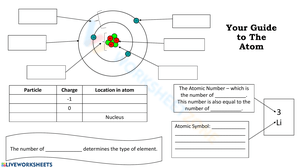
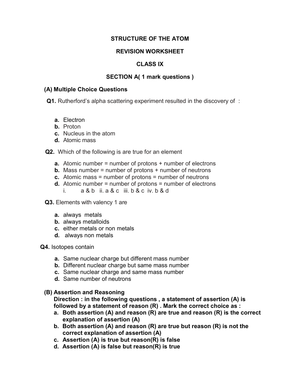
These 8th grade structure of the atom printable worksheets resources fill a gap that most middle school science teachers run into by October: students can name a proton but can't explain what changes when an atom gains an electron. Each worksheet moves past simple identification toward the particle relationships that appear in class discussions, unit models, and assessment questions. The set covers the sequence physical science demands at this level — from identifying subatomic particles to comparing simple atom diagrams that include charge and mass information.
What Each Worksheet Targets
Grade 8 atomic structure instruction has a narrower target than high school chemistry, and the best worksheets stay inside that boundary. Students at this level work with protons, neutrons, and electrons in the context of a simple nuclear model — not electron configuration notation, not quantum numbers. The skills that matter here are particle identification, using atomic number and mass number to find missing counts, and reading diagrams well enough to determine whether an atom is neutral, ionized, or an isotope variant of a known element.
Each worksheet in the set builds one or more of these skills:
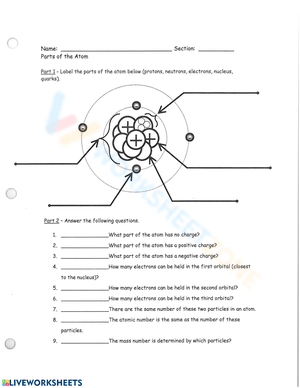
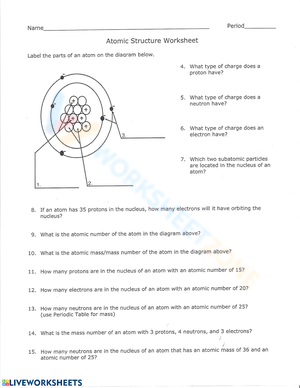
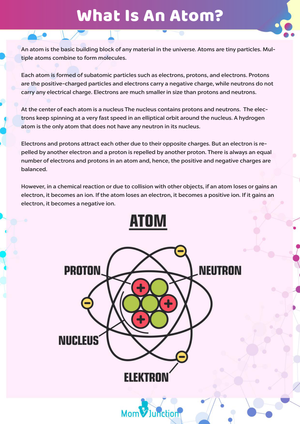
- Label the nucleus, electron region, and each particle type in a simple atom diagram.
- Identify the charge of each subatomic particle and explain why a neutral atom has equal proton and electron counts.
- Use atomic number to name an element and locate it on the periodic table.
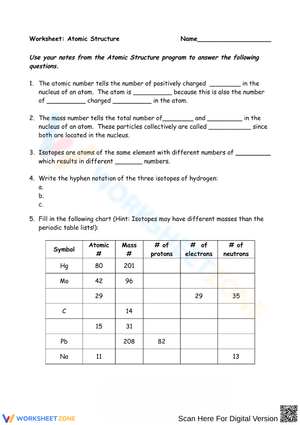
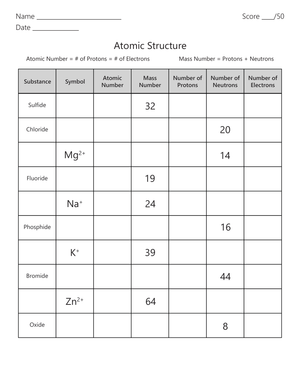
- Apply the relationship between mass number, protons, and neutrons to find missing particle counts.
- Explain what changes — and what stays the same — when electrons are added or removed to form an ion.
- Distinguish isotopes from ions using particle counts rather than memorized definitions.
That last skill is harder than it sounds. Students who handle neutral atom problems confidently often freeze when asked to compare two carbon atoms with different neutron counts. Having a separate worksheet for isotopes — rather than combining them into a general review before students are ready — makes a real difference in how many students actually get there.
Mistakes Students Make That Are Worth Catching Early
The most reliable error in eighth-grade atomic structure work is the conflation of atomic number and mass number. Both involve counting particles, and both appear as whole numbers on the periodic table or in a diagram caption, which means students treat them as interchangeable until something goes wrong. A student might correctly identify that carbon has 6 protons, then turn around and write that a carbon-14 atom has 14 electrons — pulling the mass number into the electron count because "that number must mean something about electrons" feels internally consistent to a twelve-year-old. The fix is rarely more explanation; it's deliberate practice where students must name the rule before they compute.
A second pattern shows up in ion problems. Students learn that a neutral atom has equal protons and electrons, then assume that gaining a proton is what creates a positive ion. The confusion is understandable — "positive" connects to protons in their mental model — but it inverts the actual mechanism. Ion worksheets that require students to annotate which particle count changed, and by how much, surface this error faster than any diagnostic question alone.
There is also a sequencing mistake that teachers sometimes make inadvertently: presenting neutral atoms, ions, and isotopes in the same lesson before students have a stable rule for any of them. A better instructional order is neutral atoms first, ions second, isotopes third. Each step changes only one variable at a time — identity, then charge, then neutron count within the same element — which keeps the cognitive load manageable and makes errors easier to trace back to a specific gap.
Standard Alignment
NGSS MS-PS1-1 asks middle school students to develop and use models to describe the atomic composition of simple molecules and extended structures. In classroom practice, that means students should spend time reading, drawing, and reasoning from particle models — not just labeling diagrams and moving on. The 8th grade structure of the atom printable worksheets set supports this expectation by asking students to use particle information to make claims about identity, charge, and mass rather than simply recall definitions. The distinction matters for formative assessment: a worksheet that only asks students to fill in a particle name gives you recall data, while one that asks them to determine whether two atoms are isotopes gives you model-use data.
NGSS performance expectations at the middle school level deliberately avoid advanced orbital notation and quantum mechanics — those belong in high school chemistry. Each worksheet here stays within the MS-PS1 boundary, which means you can assign them without cutting questions or adding caveats about content students aren't expected to know yet.
How to Fit These Worksheets Into Your Science Block
The 8th grade structure of the atom printable worksheets set works most cleanly when you match each worksheet to a specific lesson moment rather than assigning the whole set as a block. Early in the unit, a particle-labeling worksheet is a strong choice for guided practice immediately after direct instruction — students annotate the diagram while the model is still visible on the board, which keeps attention on the reasoning rather than the recall. In the middle of the unit, atomic number and mass number worksheets run well as partner work at stations; the back-and-forth of partner explanation tends to surface the proton-versus-electron confusion faster than silent independent work.
Near the end of the unit, mixed review worksheets that include neutral atoms, ions, and isotopes give students a chance to apply all three rules in one sitting. That kind of review works best in the last ten or twelve minutes of class — not the five minutes before pickup, when students are already half out the door — because it takes a moment for students to re-engage with the decision logic of which rule applies to each problem.
- Labeling worksheet as guided practice on day one of the unit, with the diagram still displayed on the board.
- Particle-count problems as bell work the morning after the atomic number mini-lesson.
- Ion or isotope worksheet during a small-group reteach session mid-unit.
- Mixed review worksheet as a Friday check before the unit quiz.
- Any focused worksheet as a self-contained substitute plan, with the answer key left at the desk.
Connecting Printable Practice to Simulation Work
The PhET Build an Atom simulation lets students add or remove protons, neutrons, and electrons and watch what changes in real time — element name, charge indicator, and mass number all update immediately. That kind of direct manipulation builds a mental model faster than a diagram alone, but it doesn't automatically transfer to written reasoning. A worksheet that follows a simulation session asks students to commit their observations to paper: record the element, the particle counts, the charge, and the mass number for several atoms they built. That written record is what makes the learning retrievable later when the simulation is no longer in front of them.
The pairing is especially useful for students who can manipulate the simulation confidently but still write vague explanations on a quiz. After building a sodium ion in the simulation, a student who must then complete a worksheet asking them to explain what changed from the neutral atom — and why the charge is now positive — has to move from clicking to thinking in language. After students work through the simulation, a worksheet can ask them to apply the same reasoning independently, without the real-time feedback the simulation provides for every move. That transition is where a well-designed worksheet does its actual work.
Adjusting the Work for Different Student Readiness Levels
For students who are still getting their footing with atomic structure, the most useful adjustment is narrowing the task. Choose worksheets with clear, labeled diagrams and questions that direct attention to one number at a time — "how many protons does this atom have?" rather than "determine the identity and charge of this atom." A reference box showing that atomic number equals proton count and mass number equals protons plus neutrons removes a decoding step and keeps the work focused on science reasoning rather than direction-reading.
For students who move through the basic problems quickly, extension doesn't require a different worksheet. Ask them to write one original problem for a classmate — specifying a particle count, an element, and a charge — and verify their own answer. Or ask them to sort a mixed list of atom descriptions into neutral atoms, ions, and isotopes and justify each placement in a sentence. Both tasks stay inside the same content without introducing high school concepts that don't belong at this level.
There is also a middle tier worth thinking about: students who solve neutral atom problems correctly but make consistent errors on ions and isotopes. Those students benefit from a worksheet that places a neutral atom directly beside its ion or isotope variant so the change in exactly one particle count is visible. That side-by-side format makes the underlying rule feel concrete rather than abstract, which tends to move students past a common sticking point faster than re-explanation does.
Frequently Asked Questions
What should 8th graders be able to do with atomic structure concepts?
At grade 8, students should identify protons, neutrons, and electrons; use atomic number and mass number to find particle counts in a neutral atom; and read simple atom diagrams well enough to determine element identity. Basic ions and isotopes are also grade-appropriate when introduced sequentially — ions before isotopes — so students handle one new variable at a time rather than all three at once.
Do these worksheets align with NGSS middle school matter standards?
The set fits NGSS MS-PS1-1 when students use and interpret particle models to make claims about identity, mass, and charge. Each worksheet stays at the middle school level — no electron configuration notation, no orbital diagrams — which matches the scope NGSS sets for grade 6 through 8 physical science and makes the resources usable without modification for most state-aligned curricula.
Can a teacher use these worksheets for bell work, exit tickets, and homework within the same unit?
Yes. Because each worksheet focuses on a defined skill, you can pull a short particle-count worksheet for bell work, use a mixed review worksheet as an exit ticket later in the unit, and send a focused ion or isotope practice worksheet home before a quiz. The 8th grade structure of the atom printable worksheets resources work in those short-cycle roles because each one carries a single instructional purpose rather than asking students to address five different concepts at once.
What supports work best for students who are struggling to tell ions and isotopes apart?
Side-by-side comparison problems help most. When a worksheet shows a neutral carbon atom next to a carbon-14 isotope, or a neutral sodium atom next to a sodium ion, students can see exactly which particle count changed and by how much. That visual comparison is more effective than re-reading a definition, and it gives students a self-checking strategy — "which number is different, and does that number tell me about charge or mass?" — that they can apply independently on the next problem.












 Interactive Worksheet Maker
 Quiz Maker
 Word Search Maker
 Crossword Puzzle Maker
 Word Scramble Generator
 Sentence Scramble Generator
 Handwriting Worksheet Generator
 Name Tracing Generator
 Fill In The Blank Generator