Matter and Change Practice That Helps 8th Grade Students Explain What They Observe
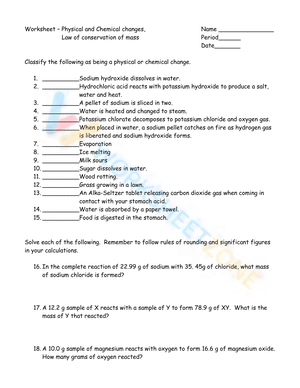
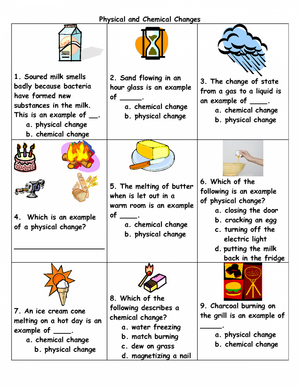
These matter and change worksheets for 8th grade give teachers practice tasks that go beyond labeling — students read observation-based scenarios, analyze what happened to a substance before and after an interaction, and explain their classification in writing. The set covers physical properties, phase changes, and the observable evidence that separates a chemical reaction from a simple change of form.
What Students Practice Across the Set
The core demand at this grade level is not recall — it's reasoning. Students have usually encountered the terms physical change and chemical change before eighth grade, but they tend to remember examples rather than understand why a classification holds. Each worksheet targets the step between knowing a vocabulary term and applying it accurately to an unfamiliar situation.
- Identify physical properties — color, mass, texture, state of matter — and determine whether those properties shift after an interaction.
- Classify a described event as physical or chemical and cite specific observable evidence to support the decision.
- Distinguish between evidence types: gas production, precipitate formation, unexpected color change, and energy release.
- Compare properties before and after an interaction using data-table formats and short-answer prompts.
- Recognize that some changes look more dramatic than they are — a solid dissolving in water disappears visually but has not become a different substance.
That last point rarely gets addressed directly in vocabulary-focused drills. When students mark "dissolving" as a chemical change, the error almost always traces to the fact that the solid is no longer visible. Students confuse a change in appearance with a change in identity. Worksheets that include short observation descriptions — not just event names — push students to ask whether the dissolved material could be recovered, which is the actual diagnostic question.
Where Student Reasoning Breaks Down in This Unit
The most persistent error is treating a single observation as sufficient proof. A student who sees "the liquid turned blue" and immediately marks chemical change is pattern-matching rather than analyzing. That shortcut fails when the blue color came from a dye mixing into water — a physical process — rather than a reaction producing a new substance. Worksheets that present two or three simultaneous observations for each scenario push students to build a case rather than react to one detail.
Temperature change is a second reliable trap. Students learn that energy release signals a chemical reaction, and then they label every warming or cooling event as chemical — including melting ice. The reasoning is understandable: combustion releases heat, so heat feels like proof. It is not sufficient on its own, and a worksheet that requires students to name at least one additional piece of supporting evidence catches those who are treating energy change as a shortcut. In actual student work, this pattern shows up as correct labels paired with explanations that read: "It was chemical because it got hot." No further reasoning follows.
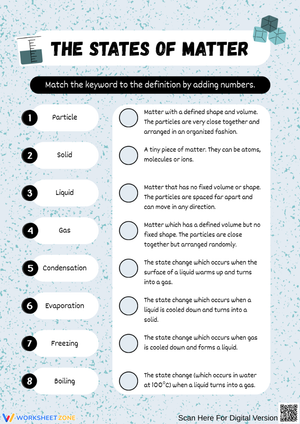
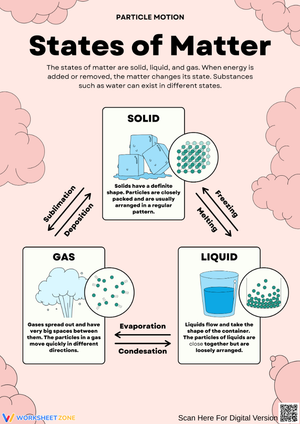
Phase changes produce a third consistent error. Many students classify the shift from liquid to gas as a chemical change because the substance looks so different afterward. A worksheet that places condensation and rusting side by side — and asks students to explain the difference — forces that comparison explicitly rather than leaving students to sort it out from memory alone.
Standard Alignment
Next Generation Science Standards MS-PS1-2 asks students to analyze and interpret data on the properties of substances before and after they interact in order to determine whether a chemical reaction has occurred. The key phrase in that standard is "before and after" — classification follows evidence, not intuition. Worksheets that include data tables with before-and-after property columns, or short scenarios with specific observation details, match that expectation at the task level.
Matter and change worksheets for 8th grade built around written explanation prompts give teachers a formative tool that multiple-choice quizzes cannot replicate. When a student writes "I know it was chemical because something new formed and gas was released," that response shows whether the reasoning behind the label is intact. A student who marks the right answer but writes "it just changed" has not yet met the MS-PS1-2 performance expectation — and the written response surfaces that gap before a unit test does.
Where to Place These Worksheets in Your Teaching Week
The most productive placement connects each worksheet to something students have already observed. After a steel wool demonstration, a burning-candle observation, or a baking soda and vinegar reaction, students carry a fresh sensory memory of what the evidence actually looks like. A worksheet used the next class period — asking students to classify similar scenarios — gives spaced retrieval a practical entry point. Students are recalling and applying at the same time, not just drilling on the day of the lesson and moving on.
For bell ringers, a worksheet with two or three focused items works better than pulling from a longer set. Present one physical and one chemical change, ask students to write one sentence of evidence for each, and use those sentences to open class discussion. That routine, running three to five minutes before the lesson begins, surfaces misconceptions while there is still time to address them. Matter and change worksheets for 8th grade with short-scenario formats fit this slot particularly well because students can read, reason, and produce a written justification without needing the full period to do it.
Sub-plan use is another reliable application. Choose worksheets with self-contained directions and familiar everyday contexts — rust, fire, melting, mixing baking soda with vinegar. Students do not need prior introduction for those scenarios, which means a substitute can distribute the worksheet without a content briefing. Save worksheets tied to specific lab data for days when you are in the room to connect them back to what the class observed firsthand.
Using These Worksheets With Students at Different Levels
For students still building fluency with the underlying vocabulary, narrow the starting task. Instead of asking them to classify six scenarios independently, give them a reference card listing the four standard chemical change indicators, then have them check each scenario against the card before writing. Students who shut down when a prompt is open-ended often know more than they can demonstrate without some entry structure. The card does not eliminate the thinking — it gives them a process to follow while they build confidence with the terminology.
For students who have the basic classification solid, raise the demand at the explanation level. Ask them to include in every response both what changed and what stayed the same — a dissolved salt retains its chemical properties, a burned piece of paper does not. That "what stayed the same" requirement is harder than it sounds and catches students who can apply the label correctly but have not fully worked out the underlying principle. Matter and change worksheets for 8th grade that include open-ended written response sections give you room to add that requirement verbally without creating a separate extension task.
English learners often find worksheets anchored in everyday examples most accessible. Tearing paper, melting butter, and watching a nail rust translate across language backgrounds more reliably than technical lab-report language does. Pairing each scenario with a quick teacher-drawn sketch on the board, or a short video clip shown before independent work, reduces the vocabulary barrier without simplifying the scientific reasoning the worksheet demands.
Frequently Asked Questions
What do 8th graders learn about matter and change that is different from earlier grades?
In earlier grades, students typically identify familiar examples of physical and chemical changes. At grade 8, the expectation shifts: students analyze observable data and use evidence to defend a classification rather than recall examples from memory. That shift in reasoning demand is what makes MS-PS1-2 a grade 8 standard — the science is the same content, but the cognitive demand is fundamentally different.
Can these worksheets replace a lab activity?
No, and they should not try to. Labs give students direct sensory data — the smell of a reaction, the feel of heat released, the appearance of a precipitate forming in solution. Each worksheet in this set works best as a follow-up that asks students to transfer firsthand reasoning to new examples. The two formats reinforce each other; neither substitutes for the other.
How do I push students who already have the basic classification down?
Add a "what stayed the same" requirement to their written responses, and introduce borderline cases — sugar caramelizing, a gas dissolving into liquid — where students must argue a position with evidence rather than apply a memorized rule. That kind of task exposes whether a student understands the underlying chemistry or is still relying on categories they have seen before. Worksheets with open-ended response sections let you raise that bar verbally without modifying the printed resource.
Are these worksheets useful for standardized test preparation?
For science assessments that include constructed-response items, yes. Students who have practiced writing one-to-two sentence explanations grounded in specific observational evidence are better prepared than those who have only completed multiple-choice identification tasks. Using a mix of classification items and short-answer prompts in the same set builds both skills across the same content.
Clear All