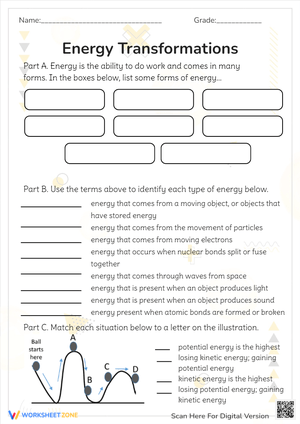
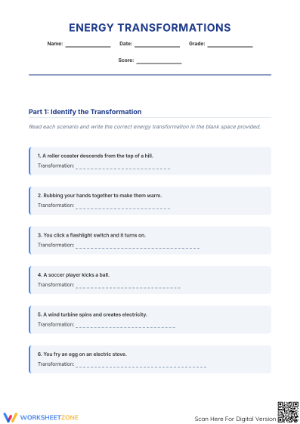
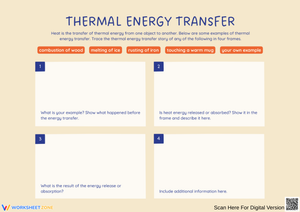
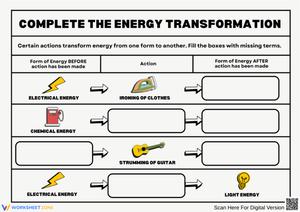
These energy worksheets for 8th grade ask students to explain what is happening inside a system — not just circle the right term from a word bank. Each worksheet centers on a familiar scenario, a diagram of a common device, or a short physical event, and students decide what form of energy is present, how it moves or changes, and what observable evidence supports their answer. That structure of identification followed by justification is what separates grade-level practice from simple recall.
The Specific Skills Each Worksheet Targets
The three concepts at the center of this set are kinetic and potential energy, energy transfer, and energy conversion. Those ideas look tidy on a unit plan but get messy fast once students start working. A student who can define potential energy will still describe a ball resting at the top of a ramp as "ready to move" without connecting that description to stored energy — the vocabulary is there, but the concept isn't fully attached yet. Each worksheet targets that gap by asking students to annotate a diagram, trace a conversion step by step, or write a one-sentence justification anchored in what they can observe about the system.
The energy worksheets for 8th grade in this set draw on everyday examples — a toaster heating bread, a phone charger transferring energy to a battery, a pendulum at different points in its swing, a simple circuit with a light bulb — so students always have a mental image to reason from before they move into abstract explanation.
- Identify kinetic and potential energy in moving objects, elevated positions, and compressed or stretched materials.
- Trace energy transfer between two or more parts of a system.
- Describe energy conversions in short written responses paired with diagrams.
- Distinguish between an energy source and an energy form — a line most 8th graders find blurry at first.
- Apply observational vocabulary — stored, released, transferred, transformed — to real physical events and devices.
Frequent Student Errors Worth Watching For
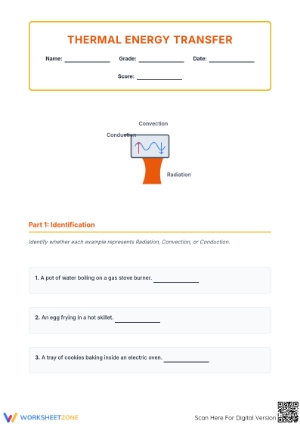
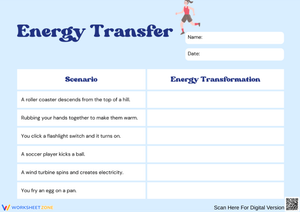
The most consistent pattern in 8th grade energy work is students naming the object instead of the energy. The prompt asks for an energy form; the student writes "the ball" or "the spring." The second-most common problem is conflating energy transfer with energy transformation. Transfer moves energy between objects — a moving cart striking a stationary one. Transformation changes the form — the chemical energy stored in a battery becoming electrical energy, which then becomes light and heat in a bulb. Students who blur that distinction answer quiz questions incorrectly and rarely know why.
A subtler misconception surfaces when students treat electrical energy as something that originates in an outlet or switch, as if it appears there rather than arriving from somewhere else. The U.S. Energy Information Administration classifies electricity as a secondary energy source because it must be generated from a primary source — the kinetic energy in moving water, the chemical energy stored in fuel, or the radiant energy from the sun. Worksheets that ask students to trace the full chain from original source through generation to end use in a device address this gap before it becomes a persistent misunderstanding.
How to Build These Worksheets Into Your Lesson Sequence
Placement depends on what the class has just done. A short worksheet with three to five diagram questions works well as a Monday bell ringer after morning meeting — students settle in while attendance is taken, and they have something concrete to do before direct instruction begins. Longer worksheets with a diagram section and a short written response fit guided practice blocks or station rotations where students work independently for 12 to 15 minutes. After a lab with ramps, pendulums, or simple circuits, a follow-up worksheet that asks students to name the energy forms they observed and explain what evidence supports each claim turns a hands-on experience into a written scientific argument — which is almost always the harder step for this grade level.
One reuse strategy worth building into the week: introduce a worksheet during class on day one by modeling two or three items aloud, assign the remaining energy worksheets for 8th grade items as an exit ticket the next day, and return the same worksheet on day three for peer comparison before a quiz. Students get three passes at the same material — initial introduction, individual practice, and review — without any additional preparation on your end.
Standard Alignment
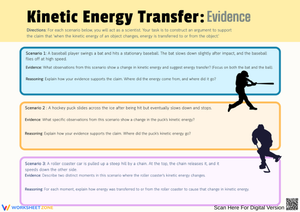
These worksheets connect to NGSS MS-PS3, the middle school energy performance expectations. MS-PS3-1 asks students to construct and interpret graphical displays showing how kinetic energy relates to mass and speed — the analysis that diagram interpretation items across the set put into written practice. MS-PS3-2 focuses on modeling how the arrangement of objects changes the potential energy stored in a system, which maps directly to elevated-object and compressed-spring scenarios. MS-PS3-5 calls for evidence-based arguments about how kinetic energy changes when energy transfers to or from an object, which is the reasoning that short written-response items target directly.
In a typical 8th grade physical science course, those three standards appear in roughly that order across a four- to six-week energy unit. Worksheets organized to follow the same progression — kinetic energy first, potential energy second, transfer and evidence-based reasoning third — let students build on what they already understand rather than treating each new lesson as a disconnected concept.
Adjusting These Worksheets Across Ability Levels
Grade 8 classes rarely move as one. Some students can describe a complete multi-step energy chain in writing at the start of the unit; others are still sorting out what makes something kinetic versus potential when the unit ends. The item variety inside each worksheet makes that spread workable. Diagram labeling and sentence completion give students who need structure a concrete entry point — they can mark what they see before they explain it. Open-ended prompts at the end of the same worksheet ask students who are ready to describe how energy changes at each stage, what evidence shows the change, and why the total energy in a closed system stays constant even as the form shifts.
For students still building vocabulary, a small reference strip with five key terms and a one-line definition each keeps the focus on reasoning rather than retrieval. For students who finish quickly, any identification item becomes a richer task with one added prompt: "Write one sentence explaining why that energy form is present at that point in the system." No extra printing needed — the same worksheet handles both without pulling the class apart.
Frequently Asked Questions
What concepts should 8th grade energy worksheets cover?
At minimum: kinetic energy, potential energy, energy transfer, and energy conversion. Strong worksheets include diagram interpretation and short written responses so students explain how energy changes rather than only name the form. Everyday examples — roller coasters, batteries, light bulbs, falling objects — give students familiar systems to reason about before applying the concepts more abstractly.
How can I use these for exit tickets or bell ringers?
For a bell ringer, pull three to four identification items and one short explanation prompt. For an exit ticket, use a diagram item paired with a one-sentence justification — a student who can explain why a roller coaster at the bottom of a hill has more kinetic energy than at the top tells you far more than a correct multiple-choice answer. Longer worksheets split naturally across two days for pre-quiz review.
What makes a worksheet appropriate for 8th grade rather than for an earlier grade?
The energy worksheets for 8th grade collected here ask students to interpret physical systems and construct written explanations — not just match terms. The scenarios involve a phone charging, a pendulum mid-swing, or a roller coaster at different heights, and students use energy vocabulary as a reasoning tool rather than retrieve it for its own sake. That claim-and-evidence demand aligns with the cognitive expectations in the NGSS MS-PS3 performance expectations for this grade band.
How do these worksheets support post-lab reflection?
Labs generate experience; follow-up worksheets build explanation. After a ramp and ball investigation, a worksheet that connects height, speed, and energy form to what students actually observed turns their data into a scientific argument. Students who missed the lab can read the written setup, work through the scenario, and answer the same conceptual questions without being shut out of the thinking work.












 Interactive Worksheet Maker
 Quiz Maker
 Word Search Maker
 Crossword Puzzle Maker
 Word Scramble Generator
 Sentence Scramble Generator
 Handwriting Worksheet Generator
 Name Tracing Generator
 Fill In The Blank Generator