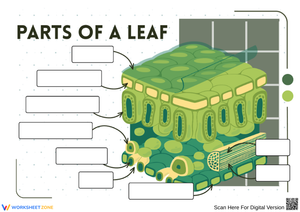
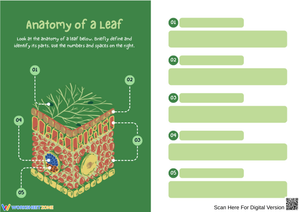
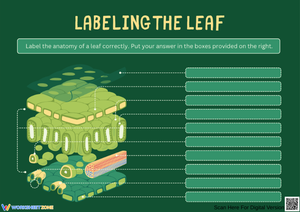
These 8th grade plant cells printable worksheets give science teachers targeted, low-prep resources for the part of the cell unit where students need to stop naming organelles and start explaining what each one does. The set covers diagram labeling, function matching, and plant-versus-animal comparison — the three task types that carry the most weight when cells appear on end-of-unit tests and NGSS-aligned assessments.
The Specific Skills Each Worksheet Targets
At eighth grade, plant cell instruction sits at the intersection of two demands: students have to know which organelles exist, and they have to explain why those structures matter to the organism. The progression across this set moves from recognition toward explanation — labeling tasks come first, function connections come next, and comparison work requires students to integrate both kinds of knowledge at once.
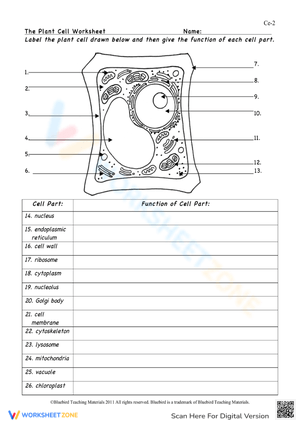
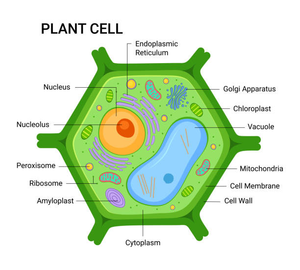
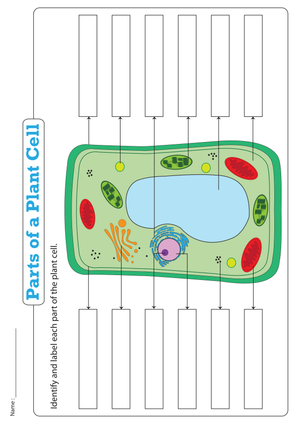
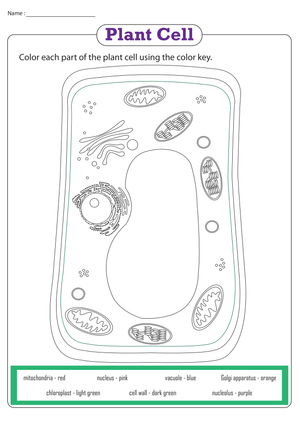
- Locating and labeling major organelles in a plant cell diagram, including the chloroplast, cell wall, large central vacuole, nucleus, mitochondria, and cell membrane
- Matching each structure to a function description written at a grade-appropriate reading level
- Sorting eukaryotic features into two categories: shared with animal cells versus plant-only
- Writing one or two sentences explaining how a specific structure supports the plant organism — the task that separates vocabulary recall from genuine biological reasoning
The plant-specific structures receive the most instructional weight. Chloroplasts, the cell wall, and the large central vacuole are the three organelles students are expected to explain — not just identify — by the end of a middle school cell unit. Each worksheet keeps those three in focus while still situating them inside the broader eukaryotic vocabulary students need for comparison questions.
Errors Students Make That These Worksheets Help You Catch
The most revealing error in grade 8 plant cell work is not mislabeling — it is correct labeling paired with a wrong function. A student will place "chloroplast" on the diagram without hesitation, then write "helps the cell maintain its shape" in the matching column. That specific mistake tells you the student has memorized the term but has not connected it to photosynthesis. Function-matching sections surface that gap right away, before it shows up as a lost point on a test.
Cell wall versus cell membrane confusion is a close second, and it is entirely predictable. On diagrams, students see the cell wall as the outer boundary, so they conclude it must be the structure that "controls what enters and exits the cell" — the job that belongs to the membrane. The reversal happens because students are relying on visual position rather than functional knowledge. A two-minute scan of matching answers during a partner work rotation will catch it in almost every class.
The large central vacuole causes a different problem. Most students know it stores water. Fewer understand that the hydrostatic pressure inside the vacuole is what keeps the plant cell rigid — the same mechanism that explains wilting when the plant is dry. Short-answer prompts in this set ask students to connect the vacuole to cell shape specifically, not just label it as a storage compartment, which forces that reasoning out into the open.
Building These Worksheets Into Your Teaching Week
The labeling worksheet works well as a unit opener before any instruction, with notes put away. Used that way, it functions as a retrieval check that also tells you what students carried forward from 7th-grade life science. If most students can locate the nucleus and cell membrane but blank on chloroplasts, that signals exactly where the first lesson needs to spend its time — which is more useful than guessing.
Function-matching and comparison worksheets fit best in the middle of the unit, after initial instruction but before the quiz. Assigning one as homework the night before a class discussion gives students a chance to sort their thinking on paper first. The conversation the next day tends to be sharper because students arrive with language already organized rather than trying to build it in real time.
For teachers working in shorter blocks or split schedules, the last eight minutes of a period is enough time for a quick labeling check. Asking students to circle one plant-only organelle and write a single sentence about why it matters produces usable formative data without the prep a full exit slip requires. These 8th grade plant cells printable worksheets also hold up well as sub-plan materials because every worksheet is self-contained — directions are clear, and the tasks do not depend on special equipment or a class discussion that happened earlier in the day.
Standard Alignment
These resources align with NGSS MS-LS1-2, which asks students to develop and use a model to describe the function of a cell as a whole and to explain how its parts contribute to that function. In classroom terms, that standard means students need to do more than identify structures on a diagram — they need to connect each organelle to the biological role it performs. The labeling-to-function progression built into this set directly supports that performance expectation. Using 8th grade plant cells printable worksheets as a unit-long review sequence rather than a single one-off activity aligns with the standard's emphasis on building and applying a model rather than reciting isolated facts.
Many state frameworks carry language closely aligned to NGSS LS1, so these worksheets serve teachers in states that have adopted the standards directly and those working within state-specific frameworks that prioritize the same structure-function reasoning at the middle school level.
Tiering the Set to Fit Your Range of Learners
For students who need more support, reducing the number of blank labels on a diagram — leaving two or three already filled in — removes enough retrieval pressure to make the task workable without changing what the student is practicing. Adding a word bank to a matching section gives a similar kind of guided support for vocabulary without giving away the function connections. The goal is for the student to practice the reasoning; the adjustment reduces the load so that reasoning can actually happen.
Students who move through labeling and matching quickly can be pushed further with a targeted extension: describe what would happen to a plant cell if its chloroplasts stopped functioning, then explain how that would affect the whole organism over time. That prompt pulls the same worksheet into higher-order analysis without requiring a separate resource. The 8th grade plant cells printable worksheets in this set are built so extensions like that feel like a natural continuation of the task — not busywork added after the fact.
Frequently Asked Questions
What organelles should 8th graders be able to identify and explain?
At minimum, students should locate and explain the roles of the nucleus, cell membrane, mitochondria, chloroplasts, cell wall, and large central vacuole. The first three are shared with animal cells; the last three are the plant-specific structures that carry the most instructional weight at this level and appear most frequently on assessment items.
How do I decide which worksheet to assign first?
Start with the labeling worksheet before instruction to see what prior knowledge students bring from 7th grade. Move to function matching after the initial lesson, and assign the comparison worksheet once students have covered both plant and animal cell content. That sequence supports retention better than repeating the same task type two or three times in a row.
Can these worksheets work for both homework and in-class practice?
Yes. Each worksheet is self-contained — directions are plain, diagrams are clearly drawn, and no special materials or prior class notes are required to complete any task. That makes them equally usable as homework, station work, early-finisher assignments, or sub-plan materials without any modification.












 Interactive Worksheet Maker
 Quiz Maker
 Word Search Maker
 Crossword Puzzle Maker
 Word Scramble Generator
 Sentence Scramble Generator
 Handwriting Worksheet Generator
 Name Tracing Generator
 Fill In The Blank Generator