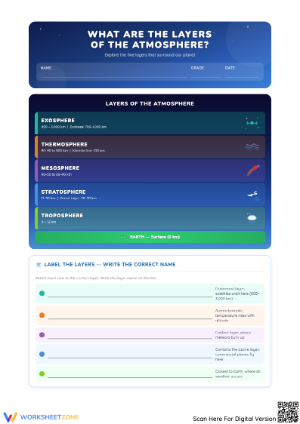
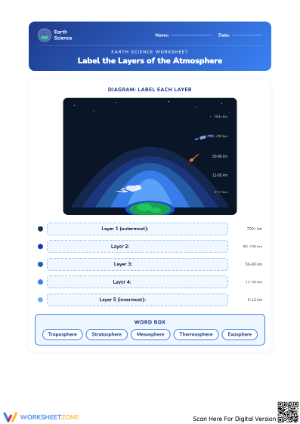
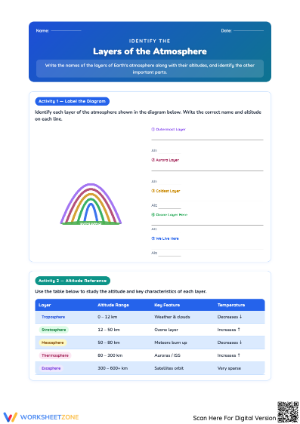
These 8th grade atmospheric layers printable worksheets give Earth science teachers a set of standalone resources that move students past layer naming toward functional understanding — connecting each altitude zone to the observable phenomena that make it concrete. The set combines diagram labeling, phenomena matching, and short constructed responses so teachers can assess not just whether students recall the order of the five layers, but whether they can explain what each one does.
The Specific Skills Each Worksheet Targets
At 8th grade, atmospheric layers instruction asks students to do more than memorize five names. They need to sequence the layers by altitude, attach defining features to each one, and connect those features to real-world events — weather, ozone protection, meteor burnup, auroras. Each worksheet in this 8th grade atmospheric layers printable worksheets set targets one stage of that progression rather than collapsing everything into a single task type.
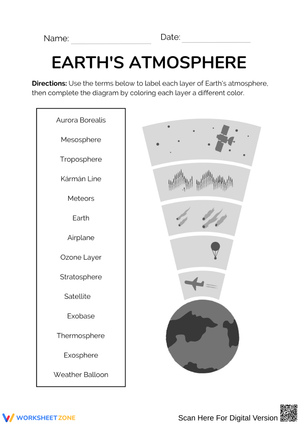
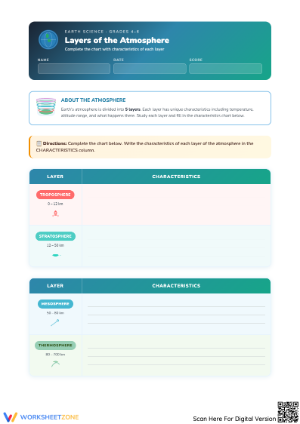
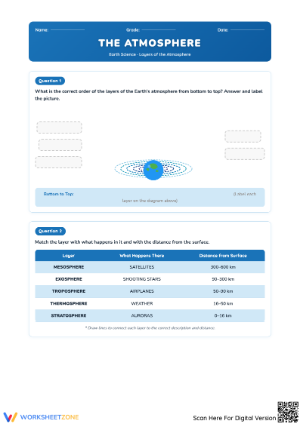
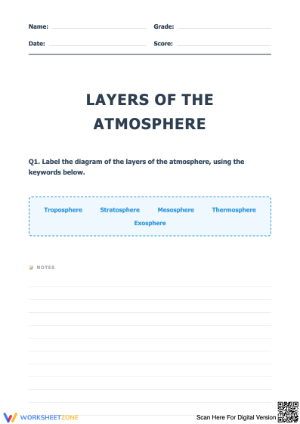
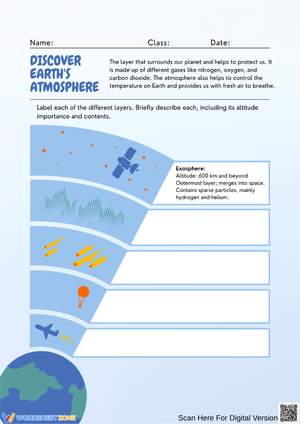
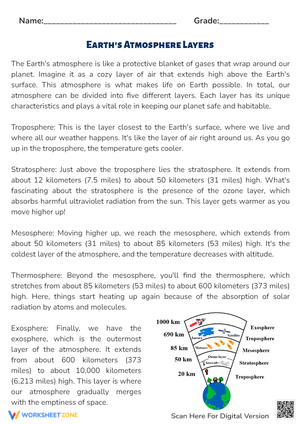
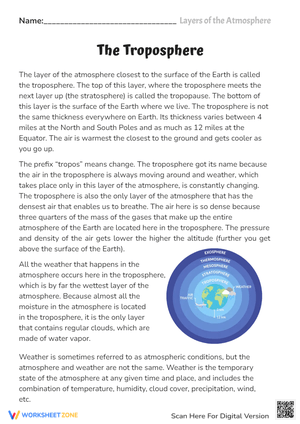
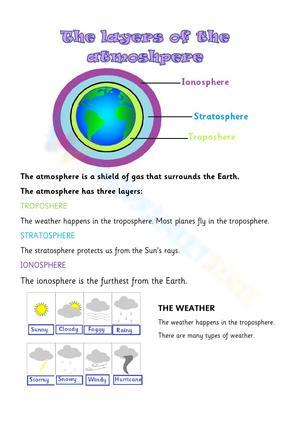
- A diagram worksheet presents a cross-section of the atmosphere with blank callout lines and altitude markers; students label all five layers and annotate each with one defining characteristic
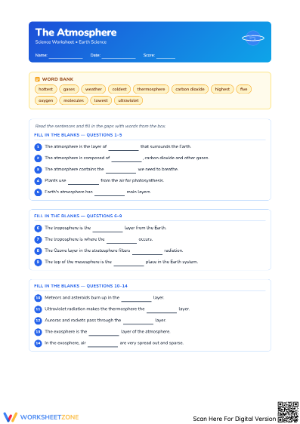
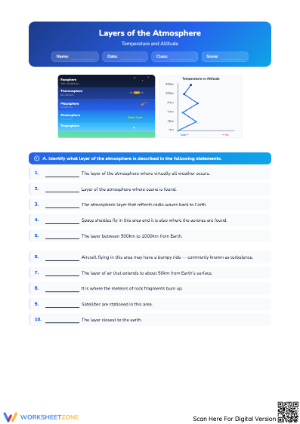
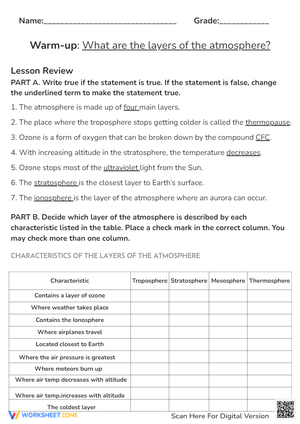
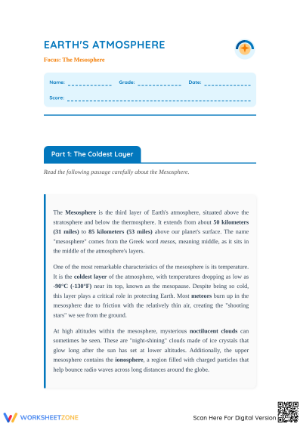
- A phenomena-matching worksheet asks students to assign real-world events — weather, ozone absorption of ultraviolet radiation, meteor burnup, auroras, and radio wave reflection — to the correct altitude zone
- A characteristics sort requires students to categorize properties such as temperature gradients, gas composition, and human activity by layer before writing one justifying sentence per category
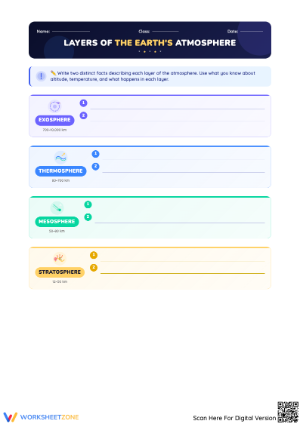
- A compare-and-contrast worksheet pairs two non-adjacent layers — troposphere and thermosphere, or stratosphere and mesosphere — and prompts students to identify a functional difference and explain one way both layers affect life on Earth
That range of task types matters because a student can label the layers in order and still be unaware that the stratosphere blocks ultraviolet radiation or that the mesosphere is where most space rock burns up. The diagram reveals whether students know the sequence; the matching reveals whether they connect layers to function; the written items reveal whether they can reason about why phenomena occur at specific altitudes.
Mistakes Students Make That These Worksheets Help You Catch
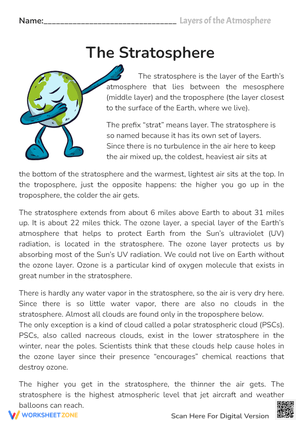
The most predictable error in this unit is the stratosphere-mesosphere swap. Students know two things matter — the ozone layer and meteors burning up — but they cannot reliably place each one in the correct layer. In student work, it is common to find "meteors burn up in the stratosphere" on the same worksheet as "the ozone layer is in the mesosphere." That combination tells you the student memorized two facts but never anchored them to two distinct altitude zones. The phenomena-matching worksheet exposes this immediately because students cannot assign both events to the same layer — the format forces the distinction in a way that reading notes never quite does.
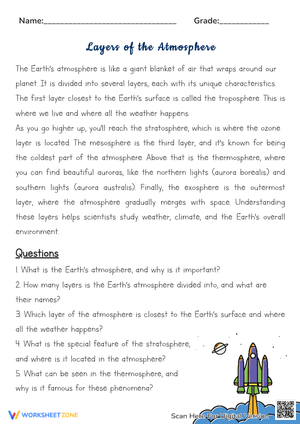
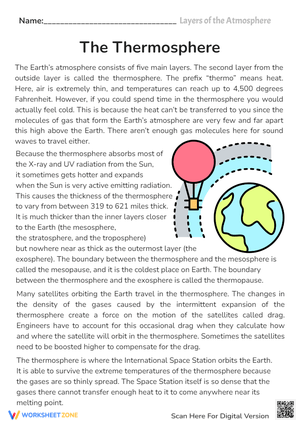
A second consistent pattern involves the thermosphere. The prefix "thermo-" leads many students to associate this layer with something vaguely warm and terrestrial rather than with auroras and the ionosphere. They frequently skip it on diagram labels or conflate it with the exosphere, treating the upper atmosphere as one undifferentiated region. Short-answer prompts that ask students to name one observable event associated with the thermosphere — not just its position in the sequence — catch this gap before it costs them on a unit test.
Strong students sometimes stumble on the exosphere for a different reason: they assume the outermost layer must host dramatic phenomena and mention satellites or the International Space Station, not realizing those orbit at altitudes that span multiple layers. Prompts asking students to contrast the exosphere and thermosphere in terms of particle density pull that reasoning into the open so teachers can address it before it hardens into a misconception.
How to Work These Worksheets Into Your Instructional Week
The diagram worksheet works best the day after initial instruction. Students have already heard the layer names and seen a visual during class; using the diagram as a 10-minute opener the next morning forces retrieval while the content is recent but no longer immediate. Spaced retrieval — returning to material after a short gap rather than reviewing it in the same session — is the principle at work, and a printable diagram is one of the simplest ways to build it into a daily routine without writing new material each time.
The phenomena-matching worksheet fits naturally mid-unit, once students have encountered weather, ozone, meteors, and auroras in context. Running it as a station activity keeps all students working on the same content while moving through different task types: one group sorts phenomena cards, another completes the diagram, a third writes compare-and-contrast responses. Short-answer items from the compare-and-contrast worksheet double as exit tickets — three questions in three minutes at the end of a period tells teachers whether students can identify layer function or only layer order, which shapes the following day's opening review.
The full 8th grade atmospheric layers printable worksheets set also works well for substitute plans. The diagram and matching worksheets require no teacher facilitation; each includes clear student-facing directions. For reteach groups, teachers can keep some students on the compare-and-contrast worksheet while others redo the matching task with a word bank added as a reference.
Standard Alignment
These worksheets align to NGSS Disciplinary Core Idea ESS2.D: Weather and Climate, which describes the role of the atmosphere in Earth's systems and underlies the MS-ESS2 performance expectations. In classroom practice, atmospheric layers instruction most often sits inside the same unit as weather systems and climate patterns, where students must understand what happens in the troposphere before they can reason about how energy and moisture move through the atmosphere. The diagram and matching worksheets support the conceptual knowledge required for MS-ESS2-5, which asks students to collect data and explain how air mass interactions produce weather — an explanation that assumes students already know which layer those interactions occur in.
The 8th grade atmospheric layers printable worksheets set also fits naturally into units that extend toward Earth's place in space, where the thermosphere's connection to auroras and radio communication links atmospheric science to solar radiation and space weather. The compare-and-contrast worksheet supports that extension without requiring teachers to build a separate resource.
Differentiating the Set Across a Range of Student Readiness Levels
Students who need more support on the diagram worksheet benefit from having the troposphere pre-labeled and the altitude scale already filled in. Removing those two cognitive demands keeps the focus on layer names and characteristics instead of requiring students to manage sequencing and scale-reading at the same time. For the matching worksheet, narrowing the answer pool from eight choices to five keeps the task from becoming a process of elimination for students still building vocabulary fluency with atmospheric terminology.
On-level students can work through each worksheet as written. The compare-and-contrast prompts are calibrated for 8th graders who have completed initial instruction and can produce two- to three-sentence responses with specific supporting details from the lesson.
For enrichment, the compare-and-contrast worksheet becomes more demanding when students consider what life on Earth would look like if the stratosphere's ozone layer were absent — a task that applies cause-and-effect reasoning across Earth systems rather than just recalling layer functions. A second extension: students annotate the diagram worksheet in a second color to mark where human activity has a measurable effect on each layer. That task requires synthesizing content from across the unit, not retrieving individual facts in sequence.
Frequently Asked Questions
What prior knowledge do students need before using these worksheets?
Students need at least one lesson introducing the five atmospheric layers before the phenomena-matching or compare-and-contrast worksheets will be productive. The diagram worksheet can come earlier — even before the unit begins — because the altitude markers give students enough structure to make reasonable guesses and identify their own gaps. Some teachers use it as a pre-assessment specifically to surface what students already know coming into the unit.
Can these worksheets replace direct instruction, or do they work alongside it?
These worksheets work alongside instruction, not in place of it. The diagram and matching worksheets help students organize and apply content from lessons, textbook readings, or video resources. The compare-and-contrast worksheet fits best after students have had time to process the material — using it as a first exposure to atmospheric layers content will frustrate students who have nothing to draw on yet.
Are the worksheets accessible for students who struggle with reading?
The diagram and matching worksheets have minimal reading demands and work well for students who find text-heavy materials challenging. The compare-and-contrast worksheet requires more reading and writing, but the prompts are written without unnecessary complexity. Teachers have successfully paired the worksheets with a labeled diagram from the class textbook as a visual reference for English learners and students who benefit from having core content visible while they work.
Do these worksheets include answer keys?
Yes. Each worksheet comes with a teacher answer key. The short-answer and compare-and-contrast keys provide sample responses rather than single correct answers, which gives teachers language to use during discussion and a consistent benchmark for scoring written responses across multiple class sections.












 Interactive Worksheet Maker
 Quiz Maker
 Word Search Maker
 Crossword Puzzle Maker
 Word Scramble Generator
 Sentence Scramble Generator
 Handwriting Worksheet Generator
 Name Tracing Generator
 Fill In The Blank Generator