Sea Floor Spreading Worksheets That Make Plate Tectonics Click in Grade 8
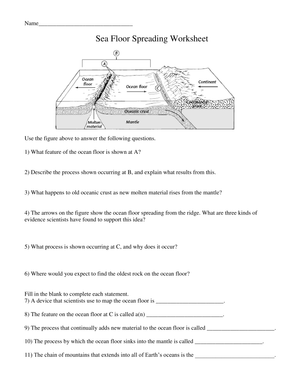
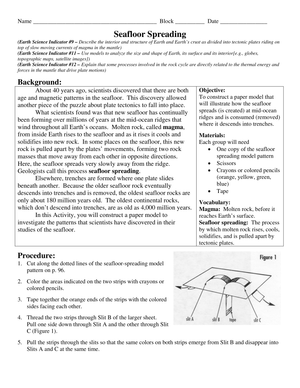
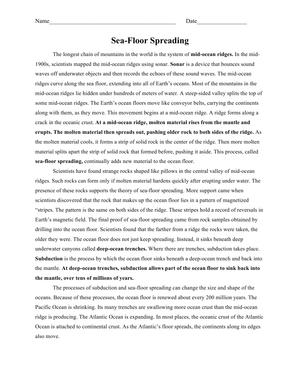
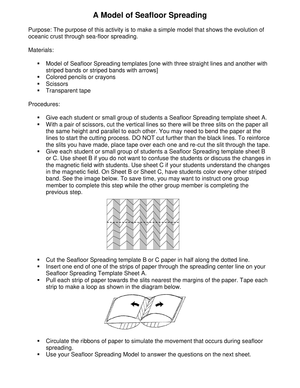
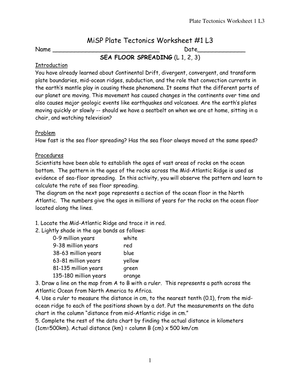
8th grade sea floor spreading worksheets give Earth science teachers structured, visual practice for one of the trickiest conceptual leaps in a plate tectonics unit — connecting an ocean-floor pattern to the larger mechanism of plate motion. The set includes diagram-labeling tasks, crust-age comparisons, magnetic striping questions, and short written explanations that ask students to support evidence-based conclusions.
The Specific Skills Each Worksheet Targets
The core task across the 8th grade sea floor spreading worksheets is reading patterns, not memorizing definitions. Each worksheet moves students from recognizing where a mid-ocean ridge sits on a diagram to explaining what the surrounding evidence actually means. That distinction — between identifying a feature and interpreting its significance — is exactly where 8th graders tend to stall on this topic.
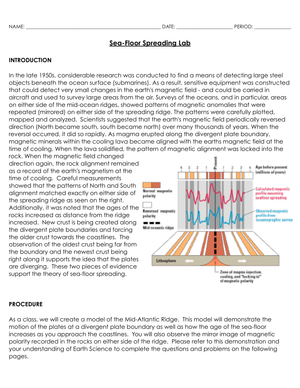
- Diagram labeling: students mark the ridge, identify the direction of plate movement, locate where magma rises, and label new versus older crust.
- Crust-age comparison: students look across both sides of a spreading center and explain why rock age increases with distance from the ridge.
- Magnetic striping: students trace the mirrored pattern on each side of the ridge and connect it to Earth's past magnetic reversals.
- Short evidence-based writing: students write one or two sentences explaining how a specific piece of evidence — age distribution or magnetic banding — supports the conclusion that crust moves outward from the spreading center.
The writing tasks are kept deliberately short. One or two targeted sentences reveal reasoning more clearly than a full paragraph where students can hide behind restated vocabulary. If a student writes "the rock near the ridge is younger because seafloor spreading happens there," that sentence shows what they know and exactly where the thinking stops — which is far more diagnostic than a correct answer on a multiple-choice item.
Mistakes Students Make That These Worksheets Help You Catch
The most widespread error is assuming that because new crust forms at mid-ocean ridges, all oceanic crust must be relatively new. Students will label the ridge correctly, then answer an age-distribution question as if the entire seafloor has uniform age. The worksheets that show labeled distances from the ridge — with students ranking relative ages across several positions — catch this error before it hardens into a unit-long misconception.
Magnetic striping trips up a different group of students. Some learn the phrase and move on without noticing what makes the pattern significant. The mirrored symmetry on both sides of the ridge is the actual evidence — it shows that crust formed at the center and moved outward in two directions, recording the same sequence of magnetic reversals on each side. A worksheet item that asks students to predict what the magnetic pattern should look like on the opposite side of a ridge is a fast diagnostic: students who understand the mechanism answer without hesitation, while students who memorized a phrase have to stop and think.
A third confusion comes from mixing up plate processes. Grade 8 students often treat seafloor spreading, subduction, and continental drift as happening in the same location — or blur them into one vague idea of plates moving. Anchoring each question to a specific location (at the ridge, away from the ridge, at a convergent boundary) keeps the processes distinct rather than letting them collapse into each other in student thinking.
Lesson-Planning Ideas to Get the Most From These Worksheets
Where you place these worksheets in the unit cycle matters. Early on, a diagram-labeling task works well as a bell ringer before students have vocabulary to lean on — it forces observation first, which is actually the better cognitive sequence for a topic built on visual evidence. During direct instruction, projecting one worksheet and working through the first item as a think-aloud gives students a repeatable routine: find the ridge, locate the youngest crust, then explain what that distribution means for plate movement.
- Assign a crust-age comparison worksheet as guided practice the day after introducing mid-ocean ridges, so students apply the concept immediately rather than encountering it again only at review.
- Run magnetic stripe questions as a station activity in groups of three or four, where students read the pattern aloud before writing answers — hearing the description often catches errors that silent individual work misses.
- Keep a mixed-review worksheet available as a sub plan or formative check before moving into convergent and transform boundaries, so you know whether students have the seafloor spreading evidence sorted before the full plate boundary comparison begins.
For intervention groups, fewer items with stronger feedback outperforms additional worksheets. A student who labels the ridge diagram correctly but freezes on the age comparison usually needs one anchor question — "Which side of the ridge did this rock form on first?" — before the broader comparison item makes sense.
Standard Alignment
These 8th grade sea floor spreading worksheets connect directly to NGSS MS-ESS2-3, which asks students to analyze and interpret data on the distribution of fossils, rocks, continental shapes, and seafloor age and structures to provide evidence of past plate motions. That standard positions seafloor spreading as an evidence-interpretation task, not a vocabulary lesson. Worksheets that stop at defining the term fall short of that expectation; worksheets that ask students to read an age distribution, explain a magnetic pattern, or argue from data fit the standard as written. Within the NGSS framework, these resources belong inside the Earth's Systems disciplinary core idea at the middle school band, where the instructional emphasis is on building explanations from data rather than reproducing facts.
A useful formative signal at this point in the unit: watch whether students treat crust age and magnetic striping as two separate facts or as linked evidence from the same process. When students can explain that both the youngest rock near the ridge and the mirrored magnetic bands point to outward movement from a single spreading center, they're ready to take on stronger plate tectonics explanations across the rest of the unit.
Differentiating the Set Across Student Readiness Levels
Students who are ahead of the unit can go further with the evidence-connection tasks. Instead of writing one sentence explaining what a crust-age pattern shows, ask them to write two — one for the age evidence, one for the magnetic striping — and then explain why both point to the same conclusion. That synthesis task is harder than it looks and mirrors how scientists actually reason when multiple independent lines of evidence converge on the same explanation.
Students still building their understanding do better when they complete the labeling section before encountering the written-response prompt. The act of marking the ridge and the crust positions activates the vocabulary they need for the explanation. Working through the diagram first reduces the cognitive load of the writing task without changing what students are ultimately expected to explain.
For multilingual learners or students who struggle with text-heavy prompts, the diagram-labeling items serve as the strongest entry point regardless of language proficiency. A completed, labeled diagram gives these students a concrete reference when they draft their short explanation — turning the writing step from a blank-slate task into a translation task, which is meaningfully less demanding.
Frequently Asked Questions
What is seafloor spreading in terms students can actually use?
Magma rises at a mid-ocean ridge, cools, and becomes new oceanic crust. As more material pushes up at the center, the older crust moves away from the ridge on both sides. Over time, that outward movement is recorded in the age and magnetic properties of the rock itself.
How does seafloor spreading serve as evidence for plate tectonics?
It gives scientists a measurable, observable record of plate motion. Oceanic crust near the ridge is younger than crust farther away, and the magnetic stripe pattern mirrors itself on both sides of the spreading center. Both patterns point to the same conclusion: crust forms at the ridge and moves outward continuously over geologic time.
Which three pieces of evidence should 8th graders be able to explain?
Students should explain that new crust forms at mid-ocean ridges, that crust age increases with distance from the ridge on both sides, and that mirrored magnetic bands record the same sequence of Earth's magnetic reversals on each side of the spreading center. Those three ideas taken together make the case for continuous outward movement — and students who can explain all three in their own words are ready for the broader plate tectonics unit.
Can these worksheets work for homework, review, or formal assessment?
Each worksheet holds up independently, so the answer is yes to all three. Teachers can assign one as homework after a class discussion, use another during guided practice, or pull a mixed-review worksheet as a short formative check. The 8th grade sea floor spreading worksheets in this set combine labeling and written-response items, so a single worksheet gives teachers a clear picture of both content recall and evidence-based reasoning — which is more diagnostic than a multiple-choice quiz when it comes to this topic.
Clear All