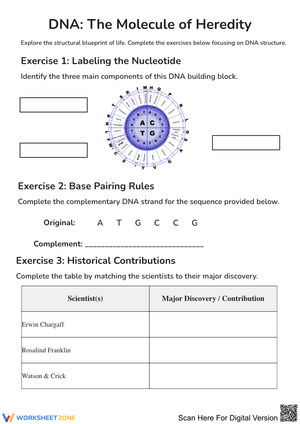
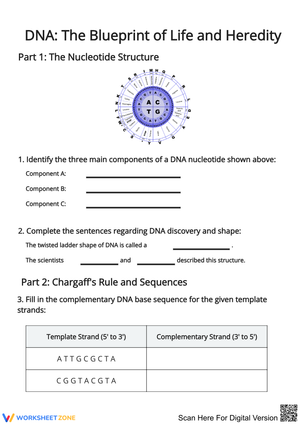
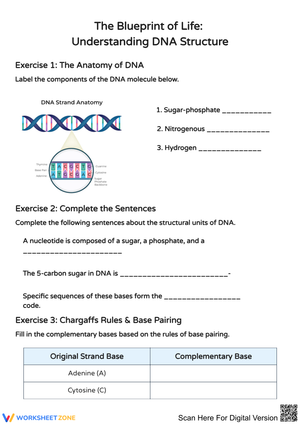
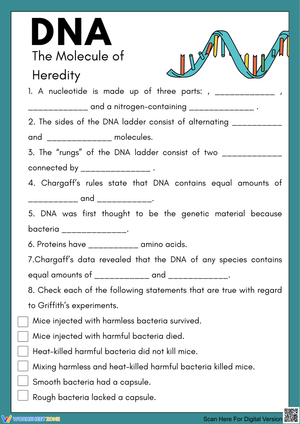
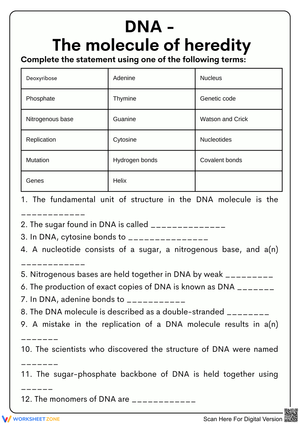
These heredity worksheets for 8th grade cover the full arc of a genetics unit — from vocabulary and allele relationships through Punnett square analysis, pedigree interpretation, and genetic variation — giving teachers ready-to-use practice that holds up as instruction progresses. Each worksheet is a standalone activity built around a specific skill, so you can drop individual pieces into warm-ups, independent practice blocks, or review rotations without rearranging a whole unit plan.
The Specific Skills Targeted
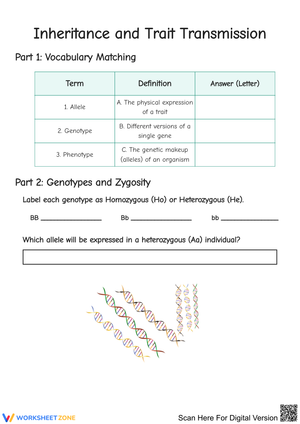
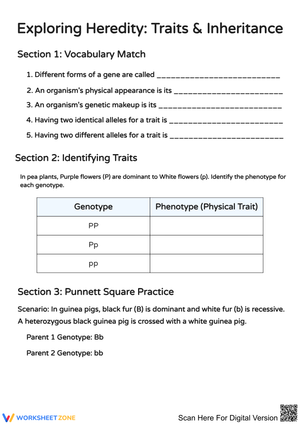
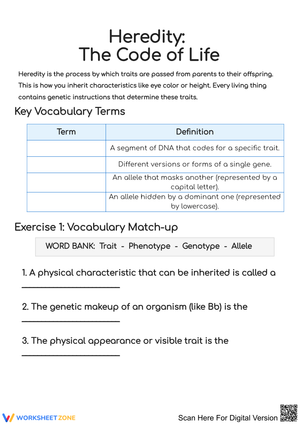
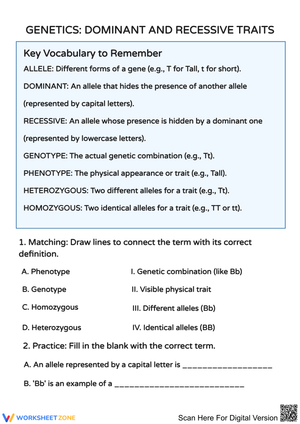
The set moves through genetics concepts in a deliberate sequence. Early worksheets anchor the vocabulary — students sort and define terms like allele, homozygous, and heterozygous, then immediately apply those terms by labeling genotype-phenotype pairs for simple organisms. This application-alongside-definition structure matters because students who memorize definitions in isolation tend to blank on them three days later when Punnett squares arrive.
From there, worksheets step into monohybrid crosses. Students set up 2×2 grids, fill in parental alleles, and calculate both genotypic and phenotypic ratios. Scenario-based problems — coat color in rabbits, seed texture in pea plants — give the math a referent so ratios feel like predictions rather than arithmetic exercises. Later worksheets push into pedigree analysis, asking students to trace a trait across multiple generations, determine whether it follows dominant or recessive inheritance, and assign probable genotypes to family members whose status isn't stated. That last task — reasoning backward from a phenotype to a genotype — is where the analytical work gets genuinely hard, and where repeated structured practice pays off.
The set also includes comparative work on sexual versus asexual reproduction. Students explain why meiosis generates offspring with novel allele combinations while mitosis produces genetically identical cells — a distinction that connects directly to the broader question of where variation in a population comes from.
Standard Alignment
These worksheets align to NGSS MS-LS3: Inheritance and Variation of Traits, specifically performance expectations MS-LS3-1 and MS-LS3-2. MS-LS3-1 asks students to develop and use models to describe why structural changes to genes may affect proteins and may result in harmful, beneficial, or neutral effects to the structure and function of the organism — a standard that the vocabulary and genotype-phenotype worksheets address directly. MS-LS3-2 asks students to develop and use a model to describe why asexual reproduction results in offspring with identical genetic information while sexual reproduction results in offspring with genetic variation — the target of the comparative reproduction worksheets. Punnett square and pedigree activities support the science and engineering practice of developing and using models throughout the unit.
Mistakes Students Make That These Worksheets Help You Catch
The most persistent error in Punnett square work is conflating genotypic and phenotypic ratios. A student who correctly fills in a grid showing one AA, two Aa, and one aa will sometimes write "the ratio is 1:2:1" and stop there, treating that as the answer to a phenotype question. These worksheets ask for both ratios explicitly and in separate answer lines, which forces students to make the distinction rather than guess which one was wanted.
Pedigree charts surface a different error pattern. Students who understand dominant and recessive alleles in isolation often default to calling every trait in a pedigree dominant because the affected individuals appear more prominently on the page. Worksheets here present pedigrees where a recessive trait skips a generation — where two unaffected carriers produce an affected child — because that scenario directly challenges the assumption. Seeing it once on a worksheet, with space to work through the logic, tends to break the habit in a way that lecture alone doesn't.
A subtler issue appears in vocabulary work: students who correctly define phenotype as "observable traits" still write genotypes when asked to state someone's phenotype. They write Bb when the answer is "brown eyes." Worksheets with mixed-format questions — some asking for the genotype, some for the phenotype, without labeling which is which — surface that confusion quickly.
Fitting These Worksheets Into Your Planning
Vocabulary worksheets work well in the first five minutes of class, particularly at the start of a new concept week. Asking students to define three terms and write one sentence using each in context takes about six minutes and gives you a quick read on who retained the previous day's instruction before you move forward. That's more useful than a quiz because students who are fuzzy on a term can correct themselves in real time.
Punnett square worksheets earn their place as guided practice right after initial modeling. Work one cross on the board using gradual release — the teacher completes the setup, students fill in the grid, everyone calculates the ratios together — then send them into the remaining problems independently or in pairs. Circulate during that independent phase; the errors that surface in the first ten minutes tell you exactly what needs re-teaching before the next day.
Pedigree worksheets land best mid-unit, after students have a firm grip on dominant and recessive logic. Introducing them too early adds cognitive load at the wrong moment — students are simultaneously managing a new diagram format and still shaky on the underlying genetics. Held until the Punnett square work is solid, pedigree analysis becomes an extension rather than a source of confusion.
Single-problem exit tickets drawn from this set give you formative data in the last three minutes of class. A monohybrid cross or a genotype-identification question takes students about two minutes to complete and tells you, before the period ends, whether the day's instruction landed.
Why This Format Works for This Topic at This Grade
Eighth graders are at a specific developmental moment with abstract reasoning: most can handle symbolic representation — alleles as letters, grids as models — but only when the symbols stay anchored to something concrete. The scenario-based problems in these worksheets do exactly that. A rabbit's coat color or a dragon's wing pattern gives the letters B and b a referent, which reduces the cognitive load of the symbolic manipulation itself and leaves more working memory available for the actual genetics reasoning.
Spaced retrieval also shapes how the set is structured. Terms introduced in early vocabulary worksheets reappear in later Punnett square and pedigree activities — students encounter heterozygous in a definition context, then again when describing a carrier parent in a pedigree, then again when interpreting a cross result. That spacing, across different task types, builds retention more reliably than a single vocabulary quiz followed by nothing.
Frequently Asked Questions
What grade level are these worksheets written for?
These are written for 8th grade, aligned to the reading level and reasoning demands typical of middle school science at that grade. The vocabulary and problem complexity assume students have had some exposure to cell biology — they've encountered DNA and chromosomes — but no prior formal genetics instruction.
Can these worksheets be used for review before a genetics unit test?
Yes, and they work particularly well as a structured review rotation. Group students by the skill each one needs most work on — vocabulary, Punnett squares, or pedigrees — and assign the corresponding worksheet during a review block. Students who are solid across all three can work on the pedigree extension tasks described in the differentiation section above.
Are these worksheets usable in a hybrid or remote setting?
The PDF format works for print distribution in class or digital distribution for at-home completion. Students working digitally can annotate most PDFs directly using free tools, or they can print and return scanned copies. The standalone structure of each worksheet — no cross-referencing between activities — makes them easy to assign individually rather than as a packet.












 Interactive Worksheet Maker
 Quiz Maker
 Word Search Maker
 Crossword Puzzle Maker
 Word Scramble Generator
 Sentence Scramble Generator
 Handwriting Worksheet Generator
 Name Tracing Generator
 Fill In The Blank Generator