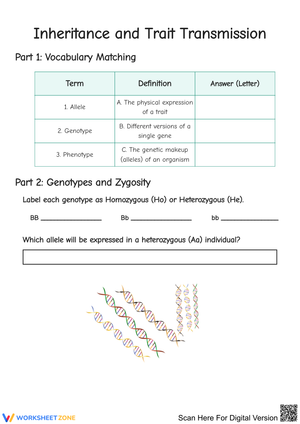
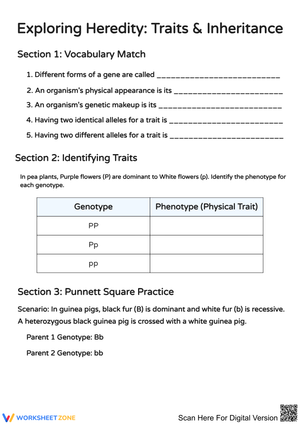
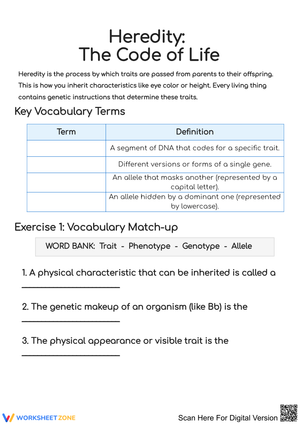
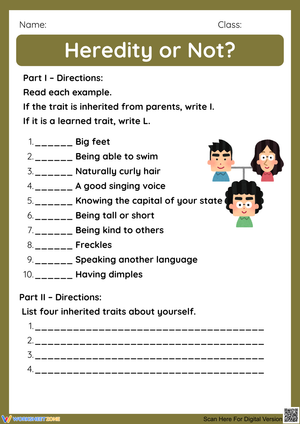
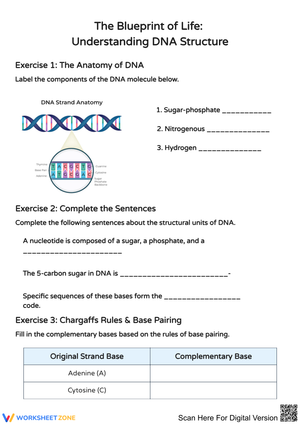
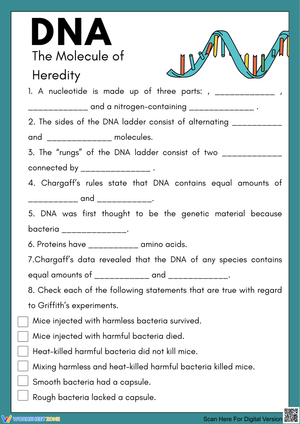
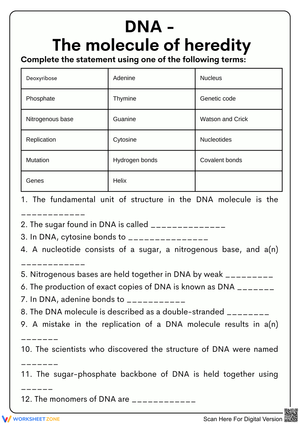
These genetics and heredity worksheets for 8th grade give science teachers structured, classroom-ready practice covering the full arc of a middle school heredity unit — from Mendel's foundational experiments through Punnett square probability, genotype-phenotype translation, and the genetic consequences of sexual versus asexual reproduction. Each worksheet targets a distinct skill set so teachers can sequence them across a unit or pull individual ones for targeted review.
What's Inside the Set
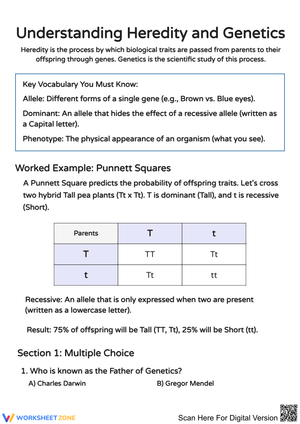
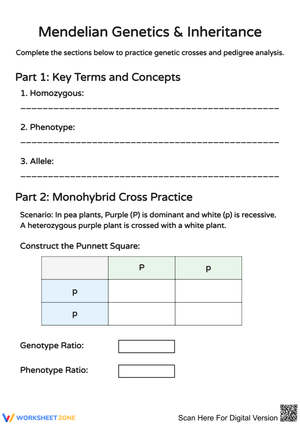
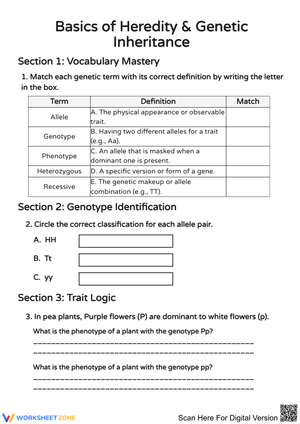
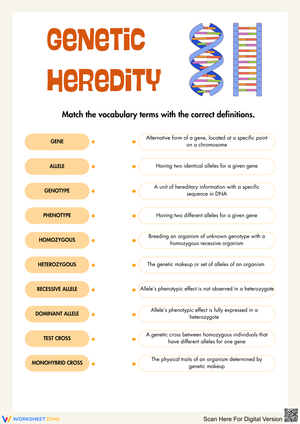
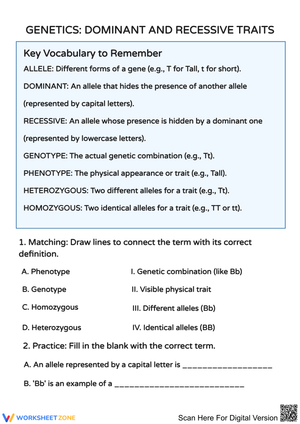
The worksheets move students through inheritance concepts in a deliberate progression. Early worksheets establish vocabulary in context — students label diagrams connecting genes to chromosomes to alleles, rather than copying definitions. Later worksheets introduce monohybrid crosses and require students to set up Punnett squares from written scenario descriptions, not pre-drawn grids. That distinction matters: students who only fill in grids handed to them often freeze when an exam presents a cross as a word problem.
Specific skills across the set include:
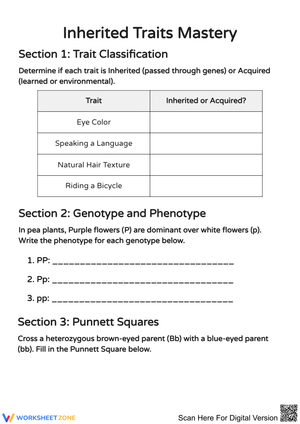
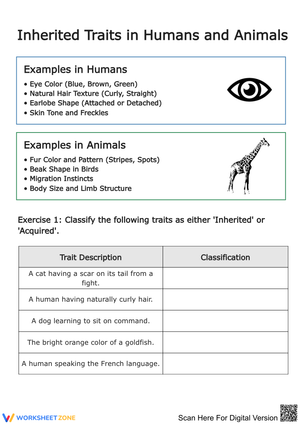
- Distinguishing homozygous dominant, homozygous recessive, and heterozygous genotypes and predicting corresponding phenotypes — including cases where the genotype uses unfamiliar organisms like guinea pigs or pea plants rather than human traits.
- Completing monohybrid crosses and converting Punnett square ratios into percentages and simplified fractions, which reinforces the 7th-grade math standard on proportional reasoning in a science context.
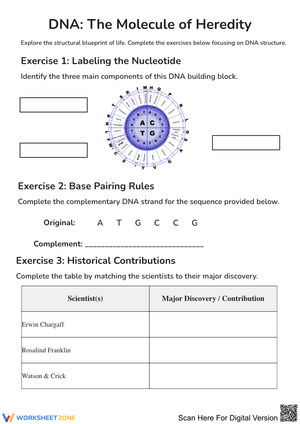
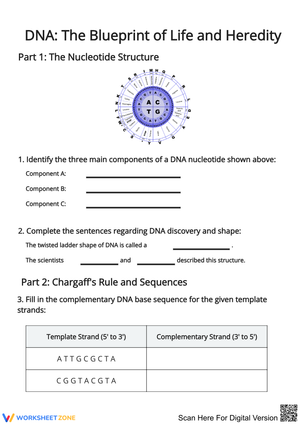
- Interpreting mutation scenarios — reading a description of a base-pair change and identifying how the resulting protein alteration might affect an observable trait.
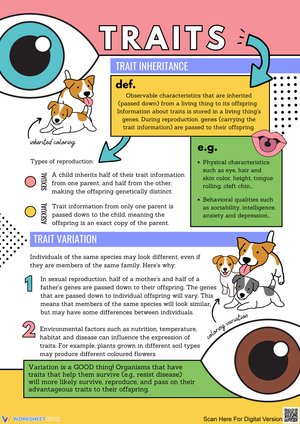
- Comparing sexual and asexual reproduction through structured data tables, analyzing genetic variation outcomes rather than simply defining the terms.
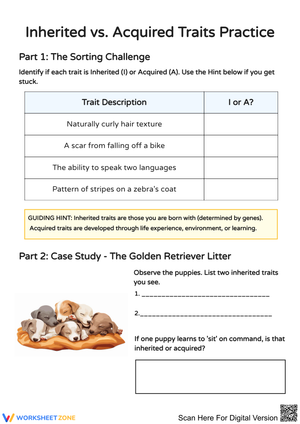
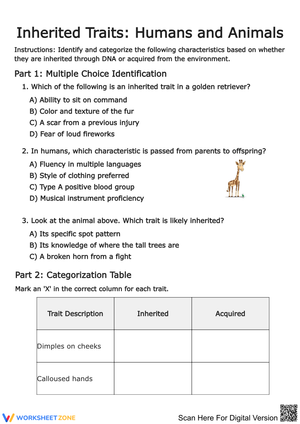
- Identifying environmental influences on gene expression through short case studies (a plant with genes for tall growth kept in low light, or a sibling pair with identical genotypes who develop differently due to diet).
Standard Alignment
These worksheets address MS-LS3-1 and MS-LS3-2 from the NGSS Heredity: Inheritance and Variation of Traits standard cluster. MS-LS3-1 asks students to develop and use a model to describe how the structure of genes determines the structure of proteins — the mutation case studies in this set directly support that, requiring students to trace a DNA-level change through to a phenotypic outcome. MS-LS3-2 addresses why sexual reproduction produces variation while asexual reproduction does not, which the comparison and scenario worksheets handle through evidence-based argumentation rather than recall.
Instructionally, these standards sit at the intersection of life science and information processing — students are expected to treat DNA as coded information, not just biological material. That framing supports the crosscutting concept of Cause and Effect and the disciplinary core idea that genetic variation drives natural selection. Teachers working in states that have adopted NGSS frameworks can use these worksheets as formative evidence that students are progressing toward the performance expectations in the LS3 band before any summative assessment.
Frequent Student Errors Worth Watching For
The most persistent error in 8th grade genetics work is treating genotype and phenotype as interchangeable — students will write "Bb" in the phenotype column without hesitation. This is not a vocabulary slip; it reflects a conceptual gap. Students often understand that "B stands for brown" but haven't internalized that the letter is a code for an instruction, and the instruction produces something physical. Worksheets that ask students to rewrite a genotype as a complete sentence — "An organism with genotype Bb has brown coloring because the dominant allele is expressed" — close that gap more reliably than fill-in blanks.
A second error pattern appears during probability work. Students routinely conflate the ratio shown in a Punnett square with a guarantee about a specific litter or family. They'll write "the second offspring will be recessive" after seeing 3:1 odds, applying the ratio as a sequence rather than a probability. Worksheets that include the coin-flip framing — where students calculate expected outcomes from 20 coin tosses and then compare to actual results — make the independence of each reproductive event concrete in a way that lecture alone doesn't.
Watch also for letter-case errors in genotype notation. Students who are careful with uppercase and lowercase letters in English class routinely write "bB" or "BB" and "bb" interchangeably. A quick normalization exercise at the start of Punnett square work — where students sort a list of ten genotypes and mark which are homozygous dominant, homozygous recessive, or heterozygous — prevents this from corrupting their later cross work.
How to Build These Worksheets Into Your Lesson Plans
The vocabulary and diagram worksheets work well as structured note-taking companions on the day you introduce a new concept — students have something to annotate while you model, which reduces the cognitive load of simultaneously listening, processing, and recording. Reserve the Punnett square worksheets for the following class period, after students have slept on the initial instruction. Spacing even by one day produces noticeably more independent work than assigning practice the same hour as the lesson.
The probability and ratio worksheets are particularly effective in the 10-to-15-minute block after a lab or activity, when students are still in a thinking frame but energy is winding down. Pairing students for these — one building the Punnett square while the other writes the probability statement — generates the kind of low-stakes verbal explanation that surfaces misconceptions faster than solo work. You'll hear students self-correct each other on the dominant-recessive distinction in real time.
For the sexual vs. asexual reproduction comparison worksheets, use them as the anchor for a Socratic discussion rather than silent seat work. The questions about evolutionary advantage invite genuine disagreement — students who initially believe asexual reproduction is "better" because it produces more offspring more quickly often revise that view when they work through a disease-resistance scenario on the worksheet. That productive discomfort is exactly where the NGSS science-and-engineering practice of constructing explanations from evidence becomes real.
Frequently Asked Questions
Are these worksheets designed for use alongside a specific textbook?
No — the worksheets are written to stand independently of any single textbook series. The conceptual sequence follows the standard MS-LS3 unit arc used by most 8th grade life science programs, so they slot into existing pacing guides without requiring reorganization. Teachers using CK-12, McGraw-Hill, or district-developed curricula have all found the worksheets compatible with their current sequence.
How many worksheets cover Punnett squares specifically?
Several worksheets focus on Punnett square construction and interpretation — some introduce the setup process step by step, and others present complete crosses and ask students to analyze ratios and write probability statements. Because the skill has multiple layers (constructing the grid, reading genotype outcomes, converting to phenotype, expressing as probability), the worksheets address each layer before combining them.
Do the worksheets address incomplete dominance or codominance?
The core set focuses on complete dominance, which is the MS-LS3 standard as written for 8th grade. Incomplete dominance and codominance are typically introduced in high school biology (HS-LS3). If your district's pacing guide extends into those concepts at 8th grade, the Punnett square worksheets provide the foundational fluency students need before those more complex inheritance patterns make sense.












 Interactive Worksheet Maker
 Quiz Maker
 Word Search Maker
 Crossword Puzzle Maker
 Word Scramble Generator
 Sentence Scramble Generator
 Handwriting Worksheet Generator
 Name Tracing Generator
 Fill In The Blank Generator