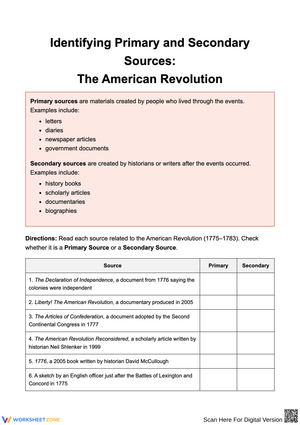
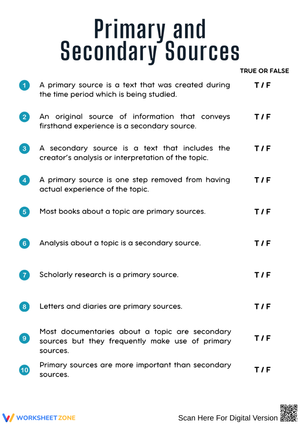
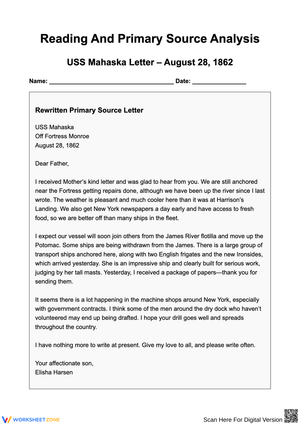
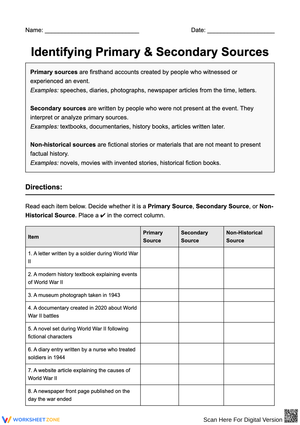
These primary and secondary sources worksheets for 8th grade give teachers structured, printable practice that moves students from basic definition recall into source reasoning and written justification. Each worksheet targets a specific layer of source analysis — identifying type, explaining the reasoning, and evaluating usefulness for a research task. The set works across a full research or informational reading unit and holds up as both independent practice and guided work during a mini-lesson.
What These Worksheets Ask Students to Do
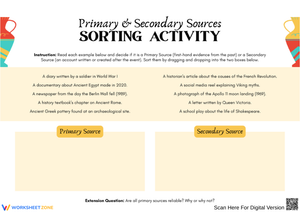
Recognition is the entry point, not the goal. Students sort items — diary entries, textbook excerpts, interview transcripts, encyclopedia summaries, photographs, documentary descriptions — and then write justifications rather than just marking a box. The reasoning prompts require them to identify three things: who created the source, when it was created relative to the event being studied, and whether the source presents original material or later interpretation of that material.
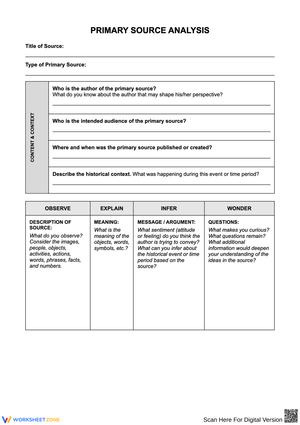
Across the set, students also analyze point of view, authorship purpose, and audience. Several worksheets ask students to compare a primary and a secondary source covering the same event and decide which would be more useful for a specific research question. That comparison task is where the real analytical work happens — students can no longer rely on category labels alone; they have to weigh evidence and explain their thinking in complete sentences.
Mistakes Students Make That These Worksheets Help You Catch
The most consistent error in student work is confusing age with source type. Students assume that anything old is primary and anything recent is secondary. A 2015 biography of Frederick Douglass is still secondary, and students who understand the definition can usually say so — until they encounter a handwritten reproduction of an 1845 letter, which reads old and formal. The format triggers the wrong category. Worksheets that include both types from the same general era surface this confusion early, before it migrates into research papers.
A second pattern worth addressing directly: students classify documentaries as primary because the film includes footage or photographs. They don't yet separate original footage — which could be primary material — from the documentary's narration, selection, and framing, which make the documentary itself secondary. Getting that distinction in front of students during the first or second worksheet prevents it from compounding later, when they start citing sources in research writing.
Third, and most relevant to writing: students stop one step too early in their justifications. They write because it was created during the event and consider that a complete answer. A strong worksheet prompt forces them to add what that means for source use — that it gives direct evidence of a speaker's actual words, or an eyewitness's unmediated account, rather than a later analyst's summary. That additional step is the difference between a label and an argument.
Standard Alignment
These worksheets most directly address CCSS.ELA-LITERACY.RH.6-8.9, which asks students to analyze the relationship between a primary and secondary source on the same topic. In practical classroom terms, this standard appears whenever students are reading two accounts of the same event and need to explain how one source built on or interpreted the other. The worksheets place that standard in an accessible context — students work with familiar examples like speeches, textbook passages, and interview transcripts — before teachers move them toward full document analysis. CCSS.ELA-LITERACY.W.8.8, which addresses gathering and evaluating source credibility in research writing, connects naturally to the worksheets that ask students to assess usefulness and reliability alongside source type.
How to Build These Worksheets Into Your Lesson Plans
The lightest lift is using one worksheet as a warm-up to open a research unit — five to eight minutes of individual work followed by two minutes of partner discussion before whole-class sharing. That sequence surfaces misconceptions before they get embedded, and it gives the teacher a quick read on where the class actually is. Worksheets with written justification prompts also work well as exit tickets: collect them at the door, sort them into three piles — solid reasoning, partial, needs reteaching — and you have your grouping data for the next day without any additional assessment prep.
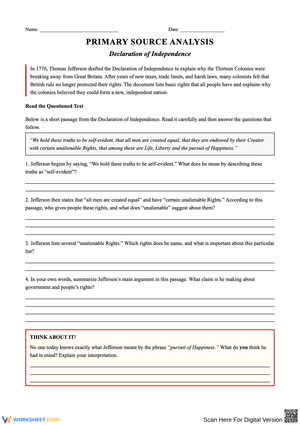
For a two-day sequence, pair a definition-and-sorting worksheet on day one with a passage-based worksheet on day two. On day two, students analyze a real excerpt — an interview or textbook paragraph — and write a short explanation of its type, purpose, and usefulness for a named research question. The written response is what separates surface labeling from the kind of source thinking that transfers to actual research papers.
Primary and secondary sources worksheets for 8th grade also fit naturally into sub plans. The format is clear enough that students work through directions independently, and the written justification component gives the returning teacher a genuine record of what was completed and where reasoning broke down.
Differentiating the Set Across Your Classroom
For students who are still building vocabulary around source types, narrow the task to sorting only and add a word bank that includes terms like firsthand, original, interprets, and summarizes. The word bank removes the retrieval burden and keeps attention on classification logic. Once students sort consistently, pull the word bank and introduce the justification prompt.
For students ready for more complexity, add a credibility column. After labeling the source and explaining the type, they assess whether it is reliable, whether it reflects a clear perspective or bias, and whether it has limitations that matter for research. That extension requires no new materials — it's an added column on an existing worksheet. It also pairs well with document analysis in social studies, making the skill explicitly cross-curricular.
The most demanding version of any worksheet in the set: give students an unlabeled excerpt stripped of contextual clues and ask them to determine source type from internal evidence only — verb tense, whether the author references other sources, whether the text presents original observation or draws conclusions from prior accounts. That task reflects what students actually do when they encounter sources during independent research, and it is where primary and secondary sources worksheets for 8th grade move from practice into genuine analytical transfer.
Frequently Asked Questions
Can a source be primary in one research context and secondary in another?
Yes, and this is one of the most productive teaching points in the unit. A newspaper article written the day after a historical event is primary when students are studying how people responded to that event in real time. The same article becomes secondary when a researcher uses it to establish facts about the event itself. Helping students understand that classification depends on how a source is being used — not just what the source is — deepens source thinking considerably and prevents oversimplification during research projects.
What if a student insists a documentary is primary because it contains real footage?
This is the right argument to have in class. The footage embedded in a documentary may be primary material. The documentary as a whole — its selection, narration, structure, and framing — is secondary. Ask students who made the decision about what to include and how to present it. That question usually lands. It also builds the broader habit of separating raw evidence from curated presentation, which matters every time students evaluate a source during research writing.
Do these worksheets work outside of ELA?
They transfer easily to any class that involves document analysis or research. History and social studies teachers will recognize the source types immediately, and the analytical language on the worksheets — authorship, purpose, point of view — maps directly to historical thinking frameworks. The ELA emphasis shows up most in the written justification tasks, which ask students to construct explanations in complete sentences using evidence from the source itself. That writing demand is what makes the resources especially productive within the primary and secondary sources worksheets for 8th grade context, where source evaluation and evidence-based writing appear in the same standards cluster.
How many worksheets support a typical research unit?
Three to five worksheets covers a full instructional sequence: one for initial definition and recognition, one for sorting mixed examples with written justification, one for passage-based analysis, one for comparison tasks using a primary and secondary source on the same topic, and an optional review worksheet before students begin their research project. Teachers who work through the full sequence report that by the third or fourth worksheet, students are labeling and evaluating sources during independent research time without prompting — which is the actual instructional goal.












 Interactive Worksheet Maker
 Quiz Maker
 Word Search Maker
 Crossword Puzzle Maker
 Word Scramble Generator
 Sentence Scramble Generator
 Handwriting Worksheet Generator
 Name Tracing Generator
 Fill In The Blank Generator