


























1 / 2
0
Views
0
Downloads


0.0
0
Save
0 Likes
Share
Identifying Primary and Secondary Sources Worksheet
0 Views
0 Downloads
Paste this activity's link or code into your existing LMS (Google Classroom, Canvas, Teams, Schoology, Moodle, etc.).
Students can open and work on the activity right away, with no student login required.
You'll still be able to track student progress and results from your teacher account.
Information
Description
What It Is:
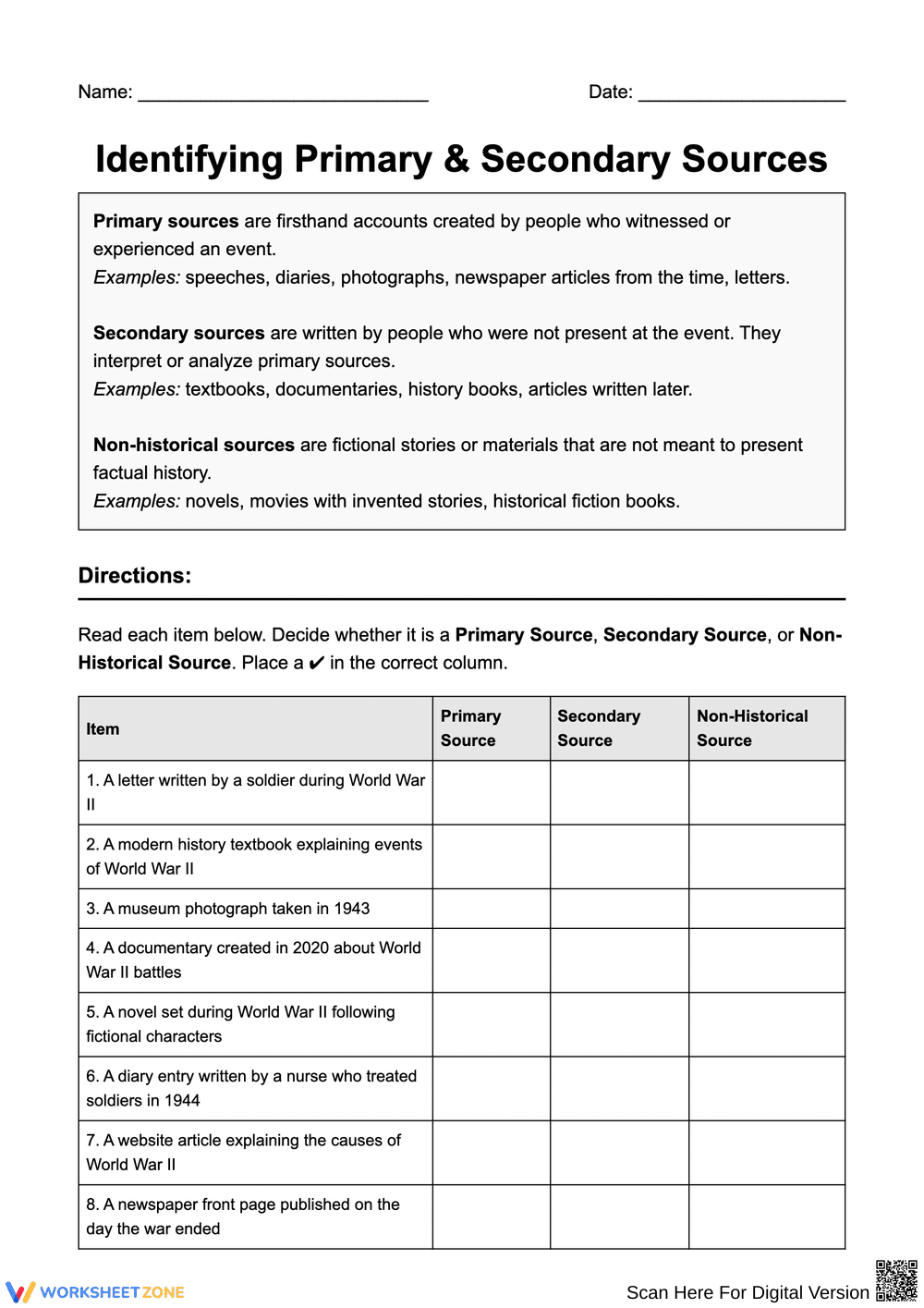
A social studies and history skills worksheet that teaches students how to identify primary sources, secondary sources, and non-historical sources. The worksheet includes clear definitions and examples at the top, followed by an 8-item classification activity where students determine the type of source and place a checkmark in the correct column.
Why Use It:
Understanding the difference between primary and secondary sources is an essential research and historical thinking skill. This worksheet helps students interpret evidence, recognize firsthand accounts, and distinguish between factual historical analysis and fictional or non-historical materials. It builds critical thinking skills needed for research projects, document analysis, and academic writing.
How to Use It:
• Review the definitions and examples of primary, secondary, and non-historical sources with students before beginning the activity.
• Have students read each item carefully and decide which category it belongs to.
• Use as a warm-up, independent practice, social studies center activity, or assessment tool.
• Extend learning by having students bring in examples of sources or create their own primary/secondary source examples.
Grade Suitability:
Best suited for Grades 4–8.
• Ideal for history, social studies, and research skills lessons.
• Helpful for ELL/ESL learners needing explicit examples and clear categorization practice.
Target Users:
Social studies teachers, history instructors, librarians, research skills coaches, tutors, and homeschool educators teaching historical source evaluation and evidence-based thinking.
A social studies and history skills worksheet that teaches students how to identify primary sources, secondary sources, and non-historical sources. The worksheet includes clear definitions and examples at the top, followed by an 8-item classification activity where students determine the type of source and place a checkmark in the correct column.
Why Use It:
Understanding the difference between primary and secondary sources is an essential research and historical thinking skill. This worksheet helps students interpret evidence, recognize firsthand accounts, and distinguish between factual historical analysis and fictional or non-historical materials. It builds critical thinking skills needed for research projects, document analysis, and academic writing.
How to Use It:
• Review the definitions and examples of primary, secondary, and non-historical sources with students before beginning the activity.
• Have students read each item carefully and decide which category it belongs to.
• Use as a warm-up, independent practice, social studies center activity, or assessment tool.
• Extend learning by having students bring in examples of sources or create their own primary/secondary source examples.
Grade Suitability:
Best suited for Grades 4–8.
• Ideal for history, social studies, and research skills lessons.
• Helpful for ELL/ESL learners needing explicit examples and clear categorization practice.
Target Users:
Social studies teachers, history instructors, librarians, research skills coaches, tutors, and homeschool educators teaching historical source evaluation and evidence-based thinking.


