8th Grade Primary Source worksheets for Source Analysis
These 8th grade primary source worksheets resources give teachers print-ready, structured analysis tasks that move students well past simple "label it and move on" exercises — into the kind of close, evidence-based reading that feeds directly into argumentative writing and research-unit work. Each worksheet asks students to read a source, reason about its context, and explain their thinking in writing.
The Specific Skills Each Worksheet Builds
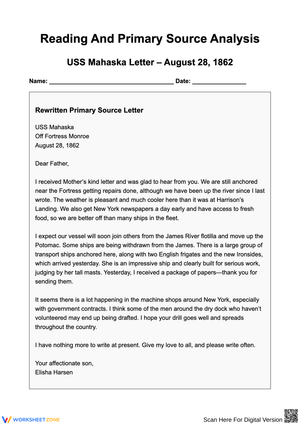
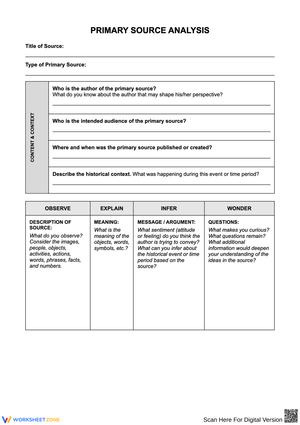
Source analysis at Grade 8 goes well past identification. Students annotate documents to mark creator, date, audience, and purpose. They pull specific evidence to support a claim, compare a firsthand account with a later summary of the same event, and evaluate what a source leaves out — not just what it contains. That combination of reading and writing in one task makes the set useful for more than a vocabulary lesson on source types.
Across the worksheets, students practice:
- Distinguishing primary from secondary sources using mixed, sometimes deliberately ambiguous examples
- Identifying creator, original context, and intended audience for a given document
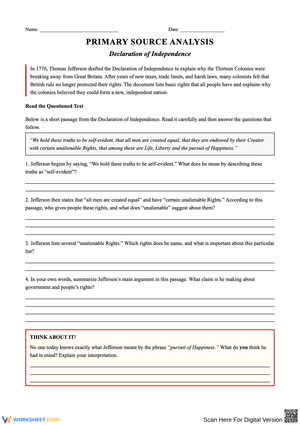
- Writing evidence-based claims drawn directly from source excerpts
- Evaluating source reliability and noting where a document may be incomplete or partial
- Comparing two accounts of the same event and deciding which offers stronger support for a specific claim
- Sorting sources by usefulness for a given research question — then explaining the reasoning
Common Misconceptions to Watch For and Correct
The most persistent error at this grade level is age-based classification. Students routinely mark a 2015 textbook chapter as a primary source "because it's about something old" and flag a 1945 firsthand letter as secondary because they assume the war preceded the writer. That's not a careless mistake — it reflects a genuine gap in understanding that classification depends on the research question, not on the calendar. The same memoir can be a primary source when a student is researching the author's lived experience and a secondary source when a student is analyzing the accuracy of a historical event. This context-dependence is the hardest concept in the set, and it takes repeated exposure across multiple documents before most students internalize it.
A second pattern worth anticipating: false trust in original sources. Grade 8 students frequently treat primary documents as automatically correct because they're "from the actual time." A government wartime poster from 1943, for instance, was created with a deliberate persuasive purpose — and students who label it "reliable because it's old" are missing the more interesting analytical move. Worksheets that prompt students to ask "What might the creator have emphasized or omitted, and why?" are the ones that push thinking past the label.
Fitting These Worksheets Into the Week Without Disrupting Your Flow
The format is flexible enough to land in several spots without awkward transitions. A single worksheet works well as a Monday opener — students are returning from the weekend and need a structured reading task to re-engage before a longer drafting session. It also fits the fifteen minutes before a research project work period, where the goal is activating source-evaluation thinking before students go find their own materials.
A useful sequence: model the analysis process with one short excerpt as a class, walking through creator, date, audience, and purpose aloud. Then give students a second source to annotate independently before comparing notes with a partner. Release the full worksheet for independent work once that structure is in their heads. End with two or three students sharing their reasoning about a difficult case — not just the answer, but the logic behind it. That discussion surfaces whether the class is applying the concept or pattern-matching on surface features.
For research units, the real instructional payoff comes when students move from analysis to selection. After completing several worksheets, hand them a research question and three or four sources — some primary, some secondary — and ask them to rank by usefulness and explain the ranking. That task shows whether source analysis has become a genuine thinking tool or stayed a worksheet exercise. Using the same annotation routine across every worksheet in the unit accelerates that transfer: if students always circle the creator, box the date, and underline their strongest piece of evidence, the habit becomes automatic on new documents.
Standard Alignment
These worksheets address CCSS RI.8.6 — determining an author's point of view and analyzing how it shapes content and style — and CCSS RI.8.9, which asks students to analyze how two or more texts address the same topic, including comparing a primary and secondary account. The written response tasks connect to CCSS W.8.8, which requires students to gather relevant information, assess source credibility, and integrate evidence while avoiding plagiarism. In practical planning terms, that means these worksheets belong inside the same unit window as argumentative writing, not in a separate "research skills" block that students forget by the time they're drafting.
Adapting the Set for Mixed-Ability Classrooms
For students who struggle with dense written texts, a photograph, political cartoon, or wartime poster carries the same analytical framework with lower decoding demand. The questions transfer cleanly — Who made this? For whom? For what purpose? What's missing? — and students can practice the reasoning before tackling a written excerpt later in the unit. This isn't about lowering expectations; it's about giving students a way into the intellectual work without getting stuck on unfamiliar vocabulary in the source itself.
Students who work quickly benefit from a comparison task: two primary sources on the same event written by people with different stakes in the outcome. Ask them to write a paragraph explaining which source gives stronger evidence for a specific claim, and why. That task requires exactly the kind of evaluative reasoning that stronger readers need to stay challenged — and it produces writing teachers can use to assess whether students are thinking about source quality or just source quantity.
For students who freeze when facing an unfamiliar document — a real frustration with open-ended analysis tasks — sentence frames remove the blank-page problem without reducing the thinking demand. "This source was created by ___ for an audience of ___, and it suggests that ___" keeps the analytical requirement intact. The 8th grade primary source worksheets format also lends itself to partner work during guided practice: two students working through a document together talk aloud about their reasoning in ways that solo work never surfaces, which helps students who internalize the concept but can't yet hold it steady enough to write independently.
Frequently Asked Questions
Do these worksheets include answer keys or sample responses?
Most 8th grade primary source worksheets sets marketed to teachers do include a sample response or discussion guide alongside the student-facing version. That's worth checking before downloading, especially if you plan to use the worksheet as a substitute lesson or for homework — having a model response in hand speeds up grading and makes feedback more consistent across a class.
How long does each worksheet typically take?
For most Grade 8 classes, a focused source-analysis worksheet runs fifteen to twenty-five minutes depending on the length of the excerpt and the number of written prompts. Shorter excerpts with two to three questions work well as bell ringers or transitions between activities. Multi-source comparison worksheets, where students examine two documents side by side and write a comparative response, fit a full class period.
Can these be used in history or social studies classes as well?
Yes, and that cross-disciplinary use is one of the strongest arguments for the format. The analytical framework — creator, date, audience, purpose, reliability, evidence — maps onto both ELA close-reading standards and history inquiry practices. Some teachers coordinate with a colleague so students encounter the 8th grade primary source worksheets format in both classes during the same unit, which gives them repeated practice with the same analytical structure across content areas. That repetition is what moves the skill from prompted practice into genuine independence on an unfamiliar document.
What source types work best at Grade 8?
Short excerpts work better than full documents at this stage — three to four paragraphs of a letter, a brief speech excerpt, a photograph with contextual caption, or a single diary entry gives students enough to analyze without turning the task into an endurance test. Genre variety across the unit matters as well. Students who only practice with written texts frequently freeze when handed a visual source on an assessment, so rotating in photographs, maps, posters, and political cartoons across the worksheet set builds the flexibility the standards actually require.
Clear All