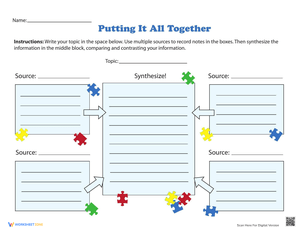
Nonfiction worksheets for 8th grade give ELA teachers focused informational reading practice that moves between whole-class instruction, independent work, intervention pull-outs, and sub folders without requiring a different plan for each use. Every worksheet is self-contained: a passage, a targeted question set, and an answer key. At the eighth grade level, the analytical reading demands shift significantly — students are expected to do more than locate facts. They trace how a central idea develops, evaluate evidence quality, recognize how text structure serves an author's purpose, and cite specific language to support claims. A worksheet that does not require that kind of reasoning is not actually preparing students for what the grade demands.
What Students Practice Across the Set
Each worksheet focuses on one or two reading skills rather than packing every standard into a single passage. That narrowness is intentional. When a student struggles with a question, the teacher can quickly identify whether the issue is with evidence citation, vocabulary inference, or central idea interpretation — not a vague "comprehension" problem that is hard to address in the next lesson.
- Central idea and development: Students name the author's main point and explain which specific details move that point forward across the passage — not just list what the passage mentions.
- Textual evidence: Questions ask students to point to particular phrases or sentences and explain how those words support their answer, not just reproduce a quote.
- Text structure: Worksheets include passages organized by cause and effect, problem and solution, chronological sequence, and comparison, with tasks that ask students to name the structure and explain why the author chose it.
- Vocabulary in context: Students encounter academic and domain-specific words and must infer meaning from the surrounding paragraph rather than recall a prior definition.
- Author's purpose and perspective: Students look at word choice, evidence selection, and tone to determine what the author wants readers to understand or accept.
- Short constructed response: Most worksheets end with a brief written task. Even two or three sentences of student explanation reveal far more than selected-response items about whether a student actually read and understood the passage.
Passage length across the set runs roughly 300 to 500 words — long enough to support analysis, short enough to complete in a 20-to-30-minute block without turning the activity into a reading stamina exercise rather than a skill lesson.
Reading Errors That Show Up Repeatedly in Grade 8 Nonfiction Work
The most consistent error in grade 8 informational reading is confusing a text's topic with its central idea. A student who understands that a passage is about clean water access will still write "This text is about clean water" as the central idea, when the author is actually arguing that municipal infrastructure investment is the only durable solution to that problem. That gap — between subject and argument — is where central idea instruction has to land, and it appears in student work constantly until it is taught directly with text in hand.
Evidence citation creates its own recurring problem. When asked to support an answer, students copy a long sentence or two and consider the question finished. They have found something relevant but have not explained how it proves the point. The question formats in these worksheets require students to connect the quoted language to the claim using their own words — which is exactly where the actual thinking happens and exactly where most students need the most repetition.
Text structure tasks reveal a subtler pattern: students label a passage "compare and contrast" because two things appear in it, without asking what the comparison is meant to accomplish. A passage might compare two approaches to waste treatment not to say they are different but to argue that one is demonstrably safer. Mislabeling the structure means missing the author's argument entirely, and it comes up every time this skill appears on a state assessment.
How to Work These Worksheets Into Your Lesson Planning
The most reliable classroom use is pairing each worksheet with a consistent reading process before students start: preview the title and any headers, annotate the passage using one or two specific marks (bracketing the central claim, circling key vocabulary), then move into the question set. Running that same sequence every time reduces the overhead of figuring out what to do and lets students put their attention on the reading skill itself. By late October in most eighth grade classrooms, the routine carries itself through without reminders.
Nonfiction worksheets for 8th grade also fill the instructional gaps that appear mid-week — the twenty minutes left when a lesson runs shorter than expected, or the block where students need independent practice while a small group works with the teacher on a skill they did not master the first time around. Keeping several worksheets sorted by skill in a classroom folder means those situations have a ready answer instead of requiring improvised planning.
Sub folders are another strong use case. A self-contained passage with clear directions, a question set, and a printed answer key does not require the substitute to understand the unit sequence. Students work independently, and the teacher returns to completed responses that are actually worth reviewing.
Working With the Range of Readers in a Grade 8 ELA Class
In most grade 8 classrooms, reading levels span five or more years. For students reading below grade level, the most effective adjustment is pre-teaching just one or two vocabulary words before they begin — not the full passage vocabulary, but the two terms most likely to block comprehension in the first paragraph. That small step keeps the focus on reading skill rather than letting content knowledge become the barrier.
The same nonfiction worksheets for 8th grade can serve students at different readiness levels when teachers adjust what they expect students to turn in rather than preparing an entirely different worksheet for each tier. Some students answer selected-response questions and then attempt one written response. Others cite evidence for every answer with a full explanation in their own words. The passage and questions remain constant; the response expectation shifts.
For students who need a more concrete entry point into the passage, annotating with a single purpose — underline the most important sentence in each paragraph, then decide whether those sentences point toward one idea — gives them a structured path through the text before they reach the question set. Students who do not need that structure skip it and work from the passage directly. Neither group requires separate materials to prepare.
Standard Alignment
These worksheets address the Reading Informational Text strand of the Common Core State Standards for grade 8, with primary emphasis on RI.8.1 (cite the textual evidence that most strongly supports an analysis), RI.8.2 (determine a central idea and analyze its development across a text), RI.8.6 (determine an author's point of view or purpose and analyze how it shapes the content and style of a text), and RI.8.8 (delineate and evaluate the argument and specific claims in a text). In practical classroom terms, RI.8.2 and RI.8.1 function together more than either standard does alone — naming a central idea without being able to point to the details that support it is not mastery of either standard. Worksheets aligned to RI.8.8 are generally more productive later in the year, after students have practiced evidence-based reasoning enough to evaluate whether an author's claims actually hold up under scrutiny.
Frequently Asked Questions
Do the worksheets come with answer keys, and are they detailed enough to use during small-group review?
Yes, each worksheet includes an answer key. For constructed-response items, keys provide an example response along with the key ideas students should address, which means a teacher can facilitate small-group discussion around a question without needing to read every student paper first.
What is the approximate Lexile range of the passages?
Passages in the set fall roughly in the 970–1120L range, which aligns with Common Core text complexity expectations for grade 8. A smaller number of worksheets use passages at the lower end of that band for targeted use with students who need additional support building toward grade-level text.
Can these worksheets be used for standardized test preparation?
The question formats — text-dependent selected response paired with short constructed response — closely mirror what students encounter on most state ELA assessments for grades 6 through 8. The emphasis on citing evidence, identifying central idea, and analyzing argument provides the most direct overlap with tested skills. Nonfiction worksheets for 8th grade that require written explanation alongside evidence selection are especially well matched to what test-prep practice actually needs to accomplish.
How long does each worksheet take during a typical class period?
Most worksheets take 20 to 30 minutes for on-level students working independently. Bell ringer use works well with shorter passages and two or three questions, which most students finish in 8 to 12 minutes. Full passage worksheets fit better in a dedicated practice block or as a homework assignment completed outside of class.












 Interactive Worksheet Maker
 Quiz Maker
 Word Search Maker
 Crossword Puzzle Maker
 Word Scramble Generator
 Sentence Scramble Generator
 Handwriting Worksheet Generator
 Name Tracing Generator
 Fill In The Blank Generator