8th Grade Oxymoron printable worksheets for Middle School ELA
These 8th grade oxymoron printable worksheets resources give ELA teachers a practical sequence that moves from identification through effect analysis and into student writing — the full range of what eighth graders are expected to do with figurative language, not just the recognition piece. The set works because oxymorons are compact enough to study in a single class block but rich enough to sustain real craft discussion when students go beyond labeling and start asking why a writer chose to put those two words together.
What Each Worksheet Covers
The set targets five distinct layers of oxymoron understanding, and that variety matters. Students who only complete matching and multiple-choice tasks learn to name oxymorons without being able to explain them — which means they'll struggle when an oxymoron appears in a poem or memoir and the question asks about tone rather than identification.
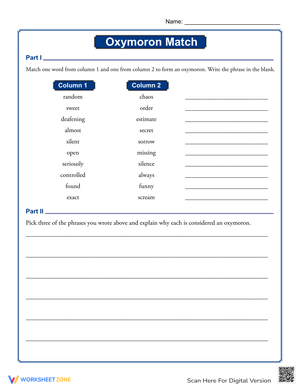
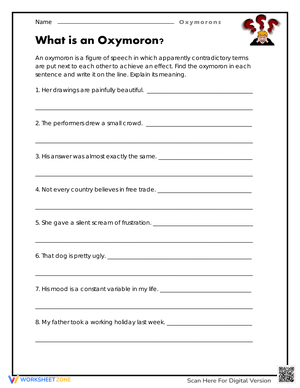
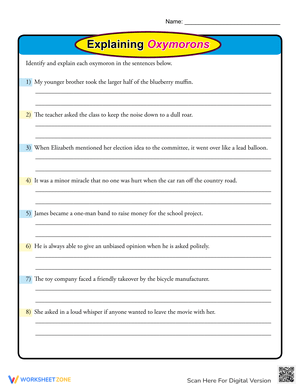
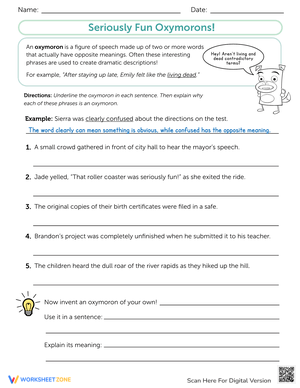
- Identification: Students underline the contradictory word pair within a sentence, not just in an isolated list.
- Literal-to-figurative translation: Students rewrite what the phrase means in plain everyday language.
- Effect analysis: Students describe what the oxymoron does — whether it creates tension, irony, humor, or emotional complexity.
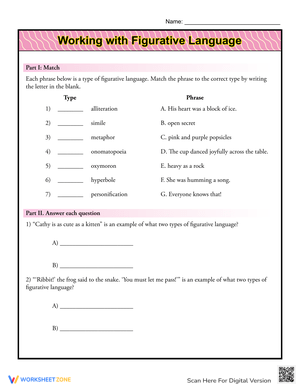
- Comparison and sorting: Students categorize examples as oxymorons versus related devices such as hyperbole, idiom, or paradox.
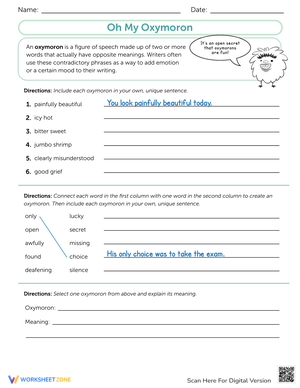
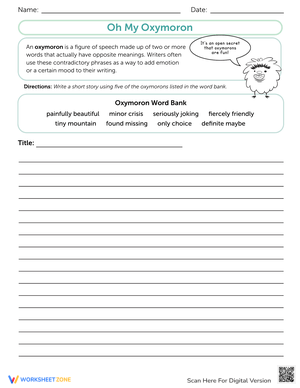
- Original writing: Students write their own sentences using an oxymoron purposefully, then explain why it fits the context they chose.
The writing task carries the most instructional weight. A student can produce a technically correct oxymoron — deafening silence — without understanding that the phrase works because it captures a physical sensation that ordinary language can't. Requiring students to explain their own choice turns a worksheet task into a genuine craft lesson.
Student Errors Worth Anticipating and Addressing
The most persistent confusion at this grade is the oxymoron-paradox overlap. Students who correctly identify deafening silence as an oxymoron will turn around and call "I must be cruel to be kind" an oxymoron too — because it has opposites in it. The distinction that sticks best is phrase-level versus statement-level: an oxymoron lives in two or three words pressed together; a paradox needs a full sentence to do its work. Worth spending five minutes on that boundary explicitly before releasing students to independent practice.
A second pattern shows up in written explanations. Even after students correctly identify an oxymoron, they flatten it in their own words. Asked to explain bittersweet, a student writes "it means happy and sad at the same time" — which is accurate but doesn't capture why the combination is more powerful than either word alone. A useful follow-up question on any worksheet: Why didn't the writer just say "mixed feelings"? That question forces students to confront what the contradiction actually contributes to meaning rather than simply translating it.
A third issue involves over-identification. Once students learn the term, they start flagging phrases with two words that could be loosely called opposites — dark comedy, living dead, occasionally compound adjectives with nothing genuinely contradictory about them. Worksheets that include clear non-examples help students build a more disciplined definition rather than applying the label to anything with two contrasting-sounding words.
Building These Worksheets Into Your Lesson Sequence
Oxymorons are short enough to study in a single class period but easy to build across a week. A practical sequence: introduce the term and work through four or five familiar examples together on Day 1, then use one worksheet focused on identification and literal translation on Day 2. By Day 3, students are ready for context-based effect questions — the same oxymoron in different sentences can create different tones, and that's worth discussing before students encounter the device in a short story or poem. Day 4 is a natural point for spiral review, mixing oxymorons with idiom, hyperbole, and paradox examples on the same worksheet. Day 5 uses a short original writing task as a formative check.
These worksheets also fit the smaller pockets of class time that don't support a full lesson. The 10 minutes at the start of Monday morning — after students have spent the weekend completely outside ELA — is a good moment for a quick identification worksheet that reactivates the concept without requiring reteaching from scratch. Exit tickets built from one or two items give teachers fast evidence on whether students have crossed from identification into effect analysis, which is the move that matters most at this grade.
One discussion-based extension that works particularly well with 8th grade oxymoron printable worksheets tasks: ask students to rank a set of five or six oxymorons from weakest to strongest effect, then defend their ranking in writing or in pairs. Students who expect a straightforward exercise quickly discover that figurative language involves judgment and choice, not just correctness — and that argument is worth having before they encounter oxymorons in literary analysis or their own narrative drafts.
Standard Alignment
These 8th grade oxymoron printable worksheets resources address two intersecting CCSS ELA-Literacy standards. CCSS.ELA-LITERACY.RL.8.4 asks students to "determine the meaning of words and phrases as they are used in a text, including figurative and connotative meanings" and to "analyze the impact of specific word choices on meaning and tone." Oxymoron practice hits both halves of that standard: students must determine what the contradictory phrase means and articulate the effect that specific word choice creates. CCSS.ELA-LITERACY.L.8.5 addresses figurative language understanding directly, requiring students to interpret figures of speech in context. In practical classroom terms, this means oxymoron instruction belongs in both the reading strand — during close reading and literary analysis — and the language strand, where teachers address vocabulary, connotation, and figurative expression as discrete skills that transfer across reading and writing contexts.
Adjusting the Set for a Range of Readers and Writers
Most adjustments for this skill involve varying the amount of context provided rather than simplifying the concept itself. Eighth graders across ability levels can understand what an oxymoron does — the question is how much support they need to arrive at that understanding independently.
- For students who need more support: Provide a short glossary of the examples used on each worksheet, plus a sentence frame for the explanation step: "The writer uses ___ to create a feeling of ___ because ___." That structure reduces the cognitive load of forming a written response while keeping the analytical thinking intact.
- For on-level practice: Students identify the oxymoron, translate its literal meaning, and write a sentence explaining its effect on tone — no additional support structure needed.
- For students who need a greater challenge: Have students compare an oxymoron with a near-equivalent paradox drawn from the same text or genre and argue in writing which device creates a stronger effect and why.
- For intervention groups: Focus on a single well-known oxymoron — deafening silence works consistently — and build outward from there. Literal meaning first, then effect, then one original sentence. Keep the example set narrow until the process is stable.
Students who freeze when facing open-ended figurative language prompts tend to respond better when each worksheet specifies a context: "Write a sentence using an oxymoron to describe a moment of relief" rather than "use an oxymoron in a sentence." That framing constraint is a genuine teaching tool — it forces students to think about purpose and fit rather than producing whatever grammatically correct example comes to mind first.
Frequently Asked Questions
What is an oxymoron, and how do I explain it so the definition actually sticks with 8th graders?
An oxymoron is a phrase built from two words that appear to contradict each other but combine to create a specific, recognizable meaning — bittersweet, jumbo shrimp, deafening silence. The definition holds better when students encounter it in context rather than in isolation. Starting with one strong example and asking "why do those words seem wrong together — and what does that wrongness communicate?" anchors the concept more reliably than a pure dictionary entry.
How do I help students stop confusing oxymoron with paradox?
The clearest classroom shorthand: oxymoron is a phrase, paradox is a statement. An oxymoron works in two or three words — alone together. A paradox needs a full claim to function — "the more you know, the more you realize you don't know." When both terms appear on the same worksheet, teach students to look at the unit size first. Tight word pair: likely an oxymoron. Full sentence or idea that requires unpacking before the contradiction registers: likely paradox.
Where in a figurative language unit do these worksheets fit best?
Oxymoron fits naturally in the middle of a figurative language sequence, after simile and metaphor — which are more concrete comparisons — and before paradox and irony, which require more inferential work. Teaching it in that position means students already have vocabulary for describing comparison and effect, which makes the discussions richer. The 8th grade oxymoron printable worksheets set also serves well as spiral review near the end of a unit, when students need to distinguish among multiple devices rather than study each one in isolation.
Can I assign these worksheets for homework, or do they work better as class activities?
Identification and translation tasks travel well as homework once the term has been introduced in class. Effect analysis and original writing tasks work better as class or partner activities — the conversation that happens when students compare their explanations of the same phrase does more teaching than the written task alone. A practical split: assign identification for homework, then open the next class with a short discussion of two or three items before moving into writing practice.
Clear All