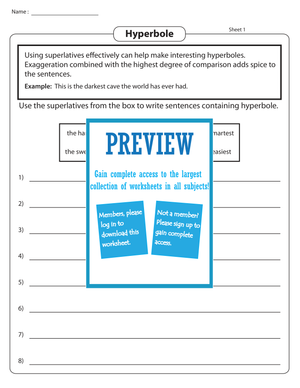
Hyperbole PDF Worksheets for 8th Grade Teachers
These hyperbole pdf worksheets for 8th grade give teachers a printable set that moves students from basic recognition all the way through intentional original writing. At this grade level, spotting that "I've told you a million times" is exaggeration is only the starting point — the real instructional goal is getting students to explain what the speaker actually means, articulate why the exaggeration works, and replicate that purposeful effect in their own sentences.
The Specific Skills Each Worksheet Targets
Grade 8 students working through these materials practice a connected but carefully sequenced set of tasks. Each worksheet keeps the skill focus narrow enough that students know exactly what they're being asked to do — not a blur of different figurative language types competing for attention at once.
- Sorting practice: Students read short sentence sets and separate exaggerated statements from literal ones, which forces them to apply the definition rather than just recall it.
- Meaning explanation: Students answer the question "What does the speaker actually mean?" — the most common checkpoint where 8th graders lose points on figurative language tasks.
- Literal rewrites: Rewriting an exaggerated sentence in plain language is the clearest test of whether a student genuinely understands the figurative-versus-literal divide.
- Effectiveness comparison: Students see two versions of the same sentence — one hyperbolic, one literal — and explain which is more effective and why. That step moves practice toward author's craft rather than definition recall.
- Original writing prompts: Students create their own hyperbole tied to a specific topic, mood, or intended audience. A prompt that asks for one example about school, one about sports, and one about waiting builds enough range to reveal whether students can actually produce the form.
- Passage-embedded identification: Finding hyperbole inside a short paragraph rather than in an isolated sentence is where the skill actually matters during reading. Each worksheet that includes a passage makes that transfer explicit.
Error Patterns to Watch For Before and After You Assign These
The most common error at this grade is not misidentification — students can usually catch obvious exaggerations. The breakdown happens at the explanation step. When asked what "I've been waiting forever" means, a significant number of students write "the person waited a long time" and stop. That's not wrong, but it misses the emotional quality the speaker is conveying: frustration, impatience, a kind of theatrical suffering. That interpretive layer is exactly what 8th grade figurative language instruction is supposed to reach.
A second pattern shows up consistently in student writing. When given a prompt to produce their own example, students substitute intensity words for actual exaggeration. "I was super tired" is not hyperbole. "I was so tired I fell asleep mid-sentence before I reached the verb" is. The distinction matters for the writing standard, and it surfaces again in later ELA courses. Projecting one example of each type side by side — without student names — and asking the class to decide which one creates a visual image tends to land the correction faster than restating the definition.
A third issue surfaces specifically in passage-embedded tasks. Students who identify hyperbole accurately in isolated sentences will sometimes read a full paragraph and circle the wrong line — often a vivid image or a simile rather than the exaggeration. The passage context requires holding more information in working memory while applying the definition at the same time, and that dual demand catches students who've only ever practiced with stripped-down sentences.
Building These Worksheets Into Your ELA Block
These materials fit naturally into the slots that frame a lesson rather than anchor it — the 8 to 10 minutes at the start of class before a whole-group discussion, or the last stretch of a period after new content has landed. A worksheet focused on identification makes a tight Monday warm-up when students are re-engaging after a weekend. By Wednesday, explanation and literal-rewrite tasks fit because students have already sharpened the basic definition through earlier repetition.
The progression from identification to original writing maps onto a gradual release arc without requiring separate resources at each stage. Identification tasks work well during whole-class time with brief teacher modeling. Explanation and rewrite tasks are well-suited for partner work. Original writing is released as independent practice. Cognitive demand rises steadily across the week without building anything new from scratch.
These worksheets also run without friction when you're out for a meeting or a professional development day. The directions are self-contained, the answer key is included, and a substitute doesn't need to interpret anything. That kind of reliability is why hyperbole pdf worksheets for 8th grade tend to earn a permanent slot in the substitute folder once teachers start using them regularly.
Standard Alignment
CCSS.ELA-LITERACY.RL.8.4 asks students to determine the meaning of words and phrases as they are used in a text, including figurative language. In classroom terms, that standard operates at two levels: identifying that a phrase is hyperbolic, and explaining what effect that choice creates in context. Sentence-level identification tasks in this set address the lower-demand version. The passage tasks address the full expectation — reading a piece of text and interpreting how one specific language choice shapes tone or meaning.
CCSS.ELA-LITERACY.W.8.3.D extends the same skill into production: students should use figurative language purposefully when writing narratives. The original writing prompts in these hyperbole pdf worksheets for 8th grade are built around that standard, asking students to create an example for a particular emotion or audience rather than simply generate anything that technically fits the definition. That distinction — purposeful versus technically correct — is what separates a standard-aligned writing task from a definition drill.
Adjusting the Set for a Mixed-Ability 8th Grade Class
For students still working on the foundational concept, start with the sorting task in isolation: ten sentences, five literal and five hyperbolic, sorted into two labeled columns. That task strips the skill to recognition and gives students a foothold before adding explanation or writing demands on top. Once sorting is consistent, the explanation questions are the right next step — not the passage tasks.
For students working above grade level, the original writing prompts extend naturally with a revision layer. After writing a hyperbole, ask them to rewrite it twice — once to make it funnier, once to make it sound angrier. That task asks students to think about how exaggeration shifts with tone and intent, which is a genuine craft question that connects directly to AP Language reasoning later on. Most 8th graders have never been asked to revise figurative language rather than just produce it, and the five-minute conversation that follows is almost always worth the time.
One honest limitation: students who struggle with reading fluency sometimes freeze at the passage tasks and skip the figurative language questions entirely. Reading the passage aloud as a class before releasing independent work keeps the hyperbole thinking at the center instead of letting decoding become the obstacle. The brief passages in this set are intentionally short because longer texts shift the cognitive load away from figurative language interpretation and onto comprehension.
Frequently Asked Questions
Does hyperbole show up on standardized assessments at the 8th grade level?
Yes. State ELA assessments and the NAEP reading framework both include figurative language identification and interpretation embedded inside longer passages — not in isolated sentences. Because assessments present figurative language in context, the passage-based tasks in this set give students more realistic preparation than sentence-level drills alone can provide.
How do I help students separate hyperbole from idioms when both appear in the same passage?
The quickest classroom distinction: idioms are fixed phrases — "kick the bucket," "break a leg" — that carry meaning as a unit and don't scale up or down in degree. Hyperbole involves deliberate exaggeration: the speaker takes something true and stretches it past the limits of reality. If students ask whether a phrase could be made more extreme and still function as the same kind of statement, that's usually hyperbole. If it's a set expression whose literal meaning has nothing to do with the intended meaning, it's likely an idiom. Having pairs apply both definitions to the same sentence surfaces the distinction faster than a whole-class explanation does.
What do I do when students keep writing intensity words instead of actual hyperbole on the writing prompts?
Project one student example of each — a genuine hyperbole and an intensity-word sentence — side by side without names. Ask the class to decide which one creates a picture, even an impossible one. "I was exhausted" produces no image. "I fell asleep before my head hit the pillow and slept through the entire next day" creates one. That visual-test framing corrects the pattern more reliably than restating the definition, and it turns a common writing error into a five-minute whole-class discussion instead of a private correction that only one student hears.
Are these resources appropriate for 7th grade, or could they stretch into 9th?
The hyperbole pdf worksheets for 8th grade are built for the grade 8 standard, which expects explanation, comparison, and original production — not just recognition. Strong 7th graders who have already moved past basic identification can work through the explanation and rewrite tasks without modification. For 9th grade, the original writing prompts extend naturally by adding a requirement to analyze how the hyperbole affects tone or voice, which aligns to the RL.9-10.4 expectation for that grade band.
Clear All