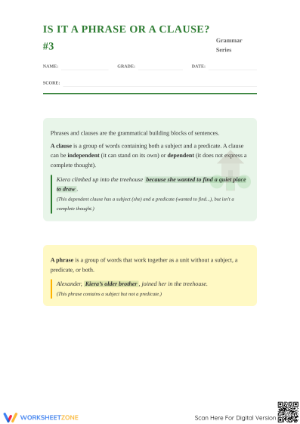
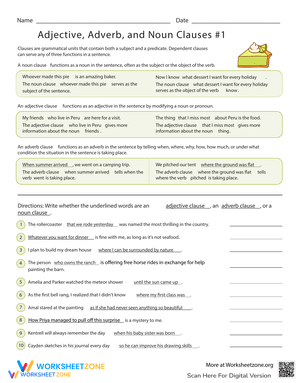
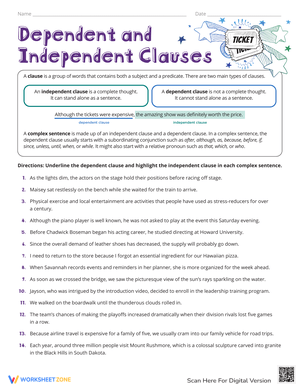
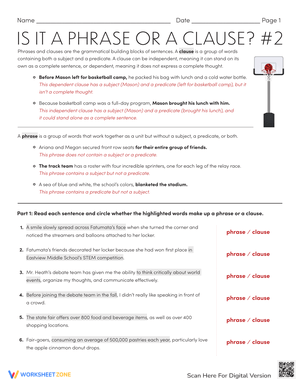
These 8th grade phrases and clauses printable worksheets resources give teachers a reusable grammar toolkit — something to hand a reteach group on Tuesday, set out at a station on Thursday, or use as a warm-up the Monday after a long weekend. Each worksheet moves students through sentence-structure work that matters most at this level: identifying, sorting, combining, and revising phrases and clauses in complete, age-appropriate sentences.
What's Inside the Set
The worksheets cover phrase-and-clause skills across several task types, moving from basic recognition toward applied revision:
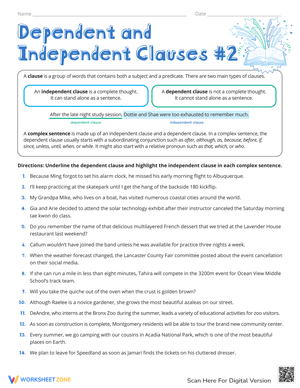
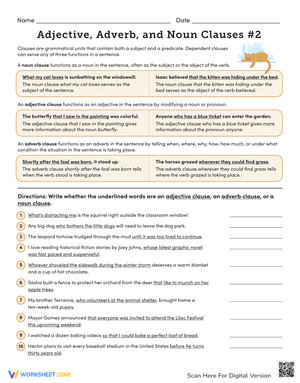
- Underline-and-label tasks targeting noun phrases, verb phrases, prepositional phrases, and verbal phrases — including participial, gerund, and infinitive constructions
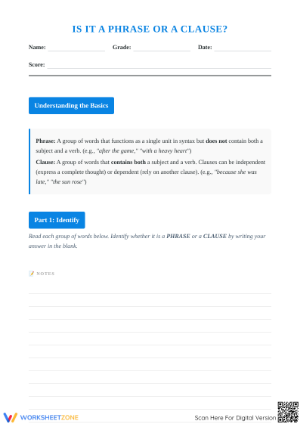
- Sorting tasks asking students to categorize groups of words as phrase, independent clause, or dependent clause
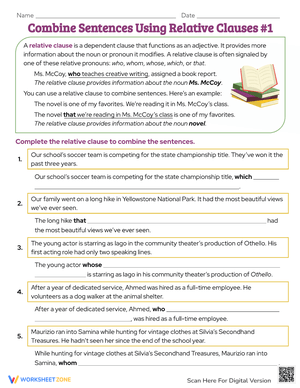
- Sentence-combining exercises where students attach dependent clauses or phrases to main clauses with correct punctuation and varied placement
- Revision work requiring students to fix fragments, expand simple sentences, and improve sentence variety in short passages
The verbal phrase work is where 8th grade grammar pushes hardest past what students typically covered in seventh grade. Gerunds, participles, and infinitives function as nouns, adjectives, and adverbs inside sentences — and many students have spent years reading sentences built on these structures without noticing them as distinct grammatical units. Several worksheets in the set target verbal phrases specifically, giving students enough repetition to move from recognition to intentional use.
Student Error Patterns That Surface With This Content
The most predictable mistake at this level is treating a long phrase as a clause. Students encounter something like Running through the hallway and shouting his name and label it an independent clause because the action words feel substantial. The verb-like quality of "running" and "shouting" convinces students that a main verb is present — even though both are participles, not finite verbs. This error shows up consistently in student work and, left unaddressed, tends to persist into high school writing as a recurring fragment problem.
A second pattern: students learn that a clause contains a subject and a verb, then label every such group as independent. Because she finished early has a recognizable subject (she) and verb (finished), so many students circle it as independent and move on. The fastest classroom correction is getting students to read the clause aloud and ask whether it expresses a complete thought in isolation. Worksheets that build that self-check step into the task create the habit faster than a class discussion alone.
A third error sits one step past identification: students who correctly name a dependent clause still punctuate it as a standalone sentence. Although the evidence was strong. They know the term; they haven't yet connected it to the writing decision. The revision worksheets in this set catch that error directly because students must correct the structure rather than simply categorize it.
Lesson-Planning Strategies That Work With This Set
A focused five-day sequence tends to hold up well for this content. Start with an identification worksheet as a pre-assessment or opening warm-up — it quickly shows which students carry solid footing from seventh grade and which need more time with fundamentals. A sorting task on day two formalizes the phrase-clause distinction. Day three works well for sentence-combining practice in pairs or small groups. Day four moves into revision work, and day five gives students a short original writing task where they apply what they've practiced all week. That cycle builds five spaced contacts with the same concept without turning grammar into a daily mini-lecture.
When teachers choose 8th grade phrases and clauses printable worksheets resources for homework, keeping the task focused pays off. Eight to twelve items gives students meaningful review without producing the avoidance that longer assignments tend to generate. For exit tickets, pulling two or three items from the end of a revision worksheet gives a fast read on whether students can distinguish and apply phrase-clause structures after instruction.
These worksheets also work cleanly as sub-day materials because directions are self-contained and no digital setup is required. A teacher can leave different worksheets for different groups, and a substitute can manage distribution without losing instructional time.
Standard Alignment
CCSS L.7.1a asks students to "explain the function of phrases and clauses in general and their function in specific sentences." By 8th grade, that foundation extends into L.8.1a, which specifies verbal functions — explaining the roles of gerunds, participles, and infinitives in particular sentences. These worksheets address both the clause-level work students should be consolidating from seventh grade and the verbal phrase skills named in L.8.1a. In classroom terms, this content belongs in instruction alongside or just before argument and informational writing units, when students are building sentences that embed dependent clauses and modify meaning through verbal constructions. Teachers working with state-level standards adapted from the Common Core will find both codes directly applicable.
Adapting the Set for Students at Different Entry Points
Students who need more support work best starting with worksheets that use shorter sentences and include only one structure type per item. The sorting-task format serves this group well because it provides a finite set of categories and reduces the demand of open-ended labeling. If a student is still conflating a subject-verb pair with an independent clause, pairing the worksheet with a brief list of common subordinating conjunctions gives them a concrete check to apply without stopping the task.
The 8th grade phrases and clauses printable worksheets set gives teachers enough variety to challenge students who are ready to move faster. After completing standard identification work, those students can write a one-sentence justification for each answer — "This is a phrase because it lacks a finite verb" — which surfaces gaps that circling and labeling never would. Revision worksheets work especially well at this level because they require students to act on their analysis: fix the structure, expand the idea, or restructure the sentence entirely.
A practical middle layer: after labeling structures in an identification worksheet, students choose two of their labeled examples and use each in an original sentence. This keeps the task grounded in the same target skill while giving students who finish early a meaningful challenge instead of idle time.
Frequently Asked Questions
What is the difference between a phrase and a clause, and where do 8th graders typically get confused?
A phrase is a group of words that lacks a functioning subject-verb pair. A clause has both a subject and a verb, but only an independent clause expresses a complete thought on its own. The common 8th grade confusion is equating length or action with completeness — longer phrases get treated as clauses, and dependent clauses get labeled as independent because students spot a subject and verb inside them without registering the subordinating conjunction that makes the whole thing incomplete.
How do these worksheets help students who already know the definitions but still produce fragments in their writing?
Knowing a grammar term and applying it in writing are different skills. The revision and sentence-combining worksheets close that gap by asking students to act on their knowledge — attach a clause correctly, fix a detached dependent clause, expand a simple sentence with a verbal phrase. That applied step is where the grammar term stops being vocabulary and starts shaping actual writing decisions.
Do these worksheets require a full unit introduction before students can use them independently?
These 8th grade phrases and clauses printable worksheets resources are built to launch after a brief modeled example — five minutes of teacher-led instruction is typically enough to start the identification work. Teachers don't need a full unit sequence in place before distributing an identification worksheet. For more complex tasks like revision, one shared example at the start of class makes independent work go more smoothly.












 Interactive Worksheet Maker
 Quiz Maker
 Word Search Maker
 Crossword Puzzle Maker
 Word Scramble Generator
 Sentence Scramble Generator
 Handwriting Worksheet Generator
 Name Tracing Generator
 Fill In The Blank Generator