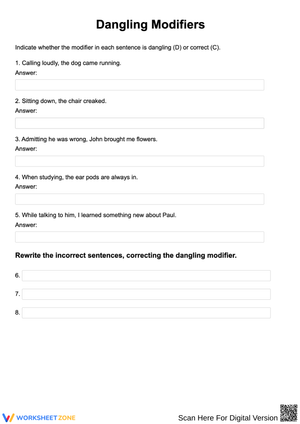
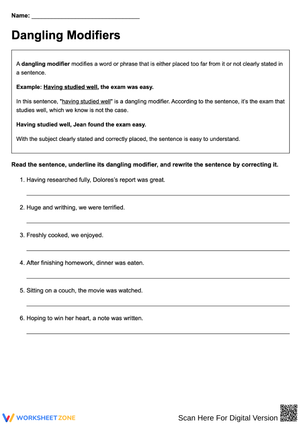
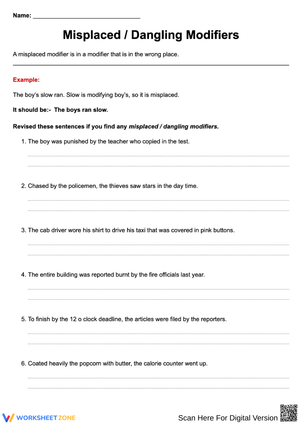
These 8th grade misplaced and dangling modifiers printable worksheets give teachers focused sentence-level practice that drops directly into grammar instruction, revision units, or editing routines without requiring a full class period. The errors students make with modifier placement are predictable enough to target precisely — and concrete enough that students can see exactly why a sentence misfires once they know what to look for.
What Each Worksheet Asks Students to Do
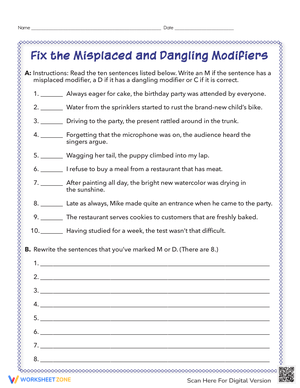
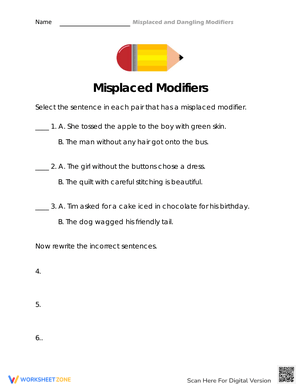
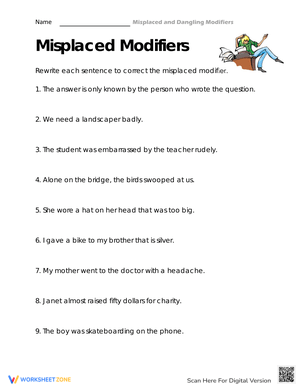
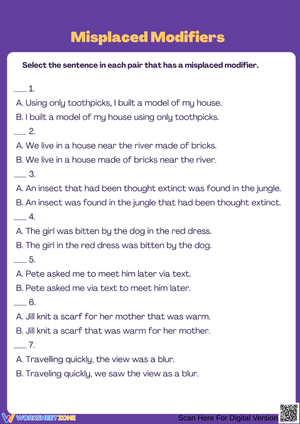
Effective modifier practice moves past labeling into actual revision. Each worksheet in the set builds from identification toward correction: students classify the error as misplaced or dangling, rewrite the sentence for clarity, and in many cases explain what changed between the two versions. That explanation step is what separates mechanical grammar drill from genuine revision practice — a student who can articulate why one sentence is clearer than another carries that awareness into their own writing, not just into the exercise.
Across the set, students work with these task types:
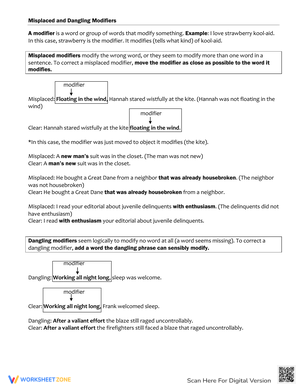
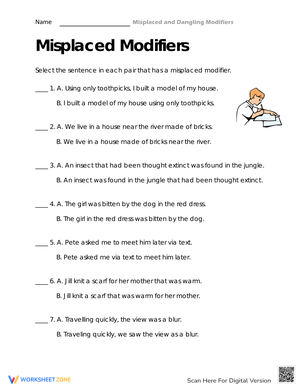
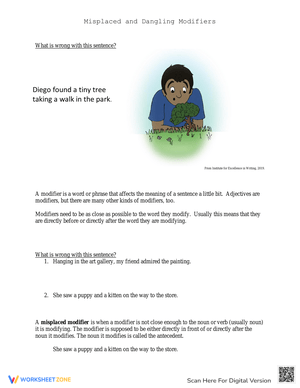
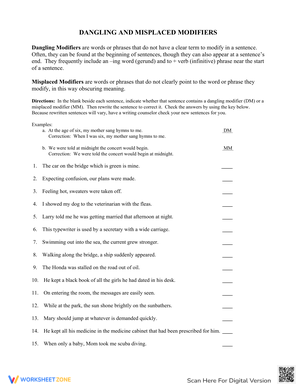
- Classification — determine whether an error is misplaced (the modifier is present but placed beside the wrong word) or dangling (the modifier has no logical noun in the sentence to attach to)
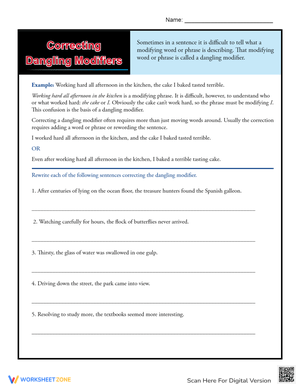
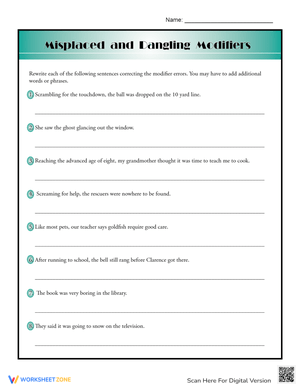
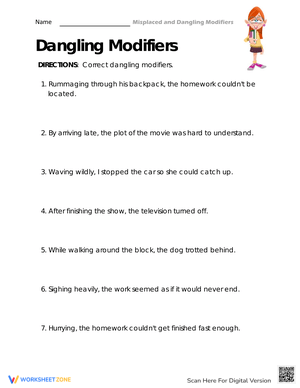
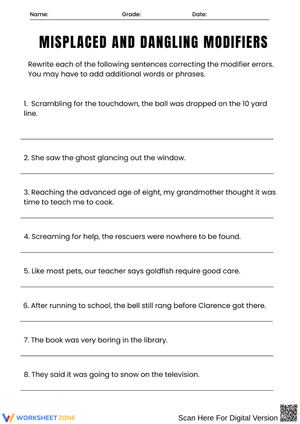
- Sentence rewriting — revise each sentence so the modifier sits immediately beside the noun or verb it actually describes
- Explanation tasks — state in writing what the original sentence implied versus what the corrected version actually says
- Passage-level editing — locate and fix modifier errors embedded in a short paragraph, practicing the skill in a less predictable context
- Mixed review — sentences that combine both error types without labeling them, requiring students to classify before correcting
Where Student Corrections Tend to Go Wrong
Misclassification is the most reliable error to anticipate. Students who have learned both definitions will still conflate them in practice — both feel vague and awkward, which makes it tempting to treat them as the same problem. They aren't. A misplaced modifier is usually fixed by relocating a phrase; a dangling modifier requires restructuring the sentence to supply a subject that phrase can attach to. That distinction is what drives the rest of the correction process.
The second pattern is the false fix. When students encounter a sentence like Barking loudly, the mail was sorted by the carrier, a common revision is to add a transition: The mail was sorted by the carrier while it was barking loudly. The student has changed the sentence without resolving the dangling phrase — "it" connects to nothing coherent. This error type appears consistently across class sets and signals that students need more modeling of full sentence restructuring, not just phrase movement. Reading revised sentences aloud catches this faster than reading silently because the logical problem becomes audible immediately.
A third issue emerges in passage-level editing tasks: students who fix errors correctly in isolated sentences start skipping over the same errors in running text. When they're working to comprehend a longer paragraph, the modifier problem stops registering. Shorter editing passages with clear syntax around the target error — rather than complex sentences throughout — give students a better chance of catching what they've been trained to find.
How to Build These Worksheets Into Your Lesson Plan
Short, repeated practice outperforms a single long session for this topic. Because modifier correction is a discrete skill — students either see the displacement or they don't — a few sentences daily during bell work will do more over two weeks than one class period devoted to the concept. When planning how to use 8th grade misplaced and dangling modifiers printable worksheets across a unit, the progression that holds up best is isolated practice on misplaced modifiers first, isolated practice on dangling modifiers second, then mixed review once students can distinguish between them.
- Bell work: three to four sentences for students to classify and rewrite before instruction begins — takes about six minutes and gives an immediate read on where the class stands
- Mini-lesson close: one focused worksheet used directly after direct instruction while the explanation is fresh
- Partner editing: students revise the same worksheet independently, then compare corrections — disagreements surface the exact point where understanding breaks down
- Exit ticket: one misplaced modifier and one dangling modifier to correct before students leave, giving the teacher a formative snapshot without much grading time
- Small-group reteach: one straightforward worksheet during independent writing time for students who still need targeted support while the rest of the class continues drafting
The most transferable extension is moving the skill directly into student drafts. After a practice session, students reread one paragraph from a piece they're currently writing and flag any opening phrase or descriptive clause for a modifier check. That step takes five minutes and connects the worksheet practice to real writing without requiring a new assignment.
Standard Alignment
The 8th grade misplaced and dangling modifiers printable worksheets in this set align most directly to CCSS.ELA-LITERACY.L.8.1.a, which asks students to explain the function of verbals — including participial phrases — in particular sentences. Dangling modifiers most often involve introductory participial phrases, making L.8.1.a the natural standard anchor for this instruction. The broader L.8.1 (command of standard English grammar and usage) covers the full range of modifier correction work across sentence types. Teachers incorporating modifier practice into revision units can also connect these resources to W.8.5, which addresses revising and editing writing to strengthen craft — modifier correction is genuine revision work, not isolated grammar enforcement.
Adjusting the Set for a Range of Learners
Students still building sentence sense need very short examples — eight to twelve words, one modifier, one clear problem. Before asking them to rewrite anything, have them underline the modifier phrase and draw an arrow to the word it's supposed to describe. That annotation routine slows the reading down enough that the displacement becomes visible. A reliable question stem for this group: What is this phrase actually describing? Students who freeze on the written revision can usually answer that question out loud, and the verbal answer gives them the foothold they need to write the correction.
Students working above grade level should move to passage-level editing worksheets quickly. The challenge there isn't the modifier concept — they likely grasp it — but detecting the error in running text where surrounding syntax is more complex. An extension that tests genuine understanding: ask students to take a correctly written sentence, intentionally introduce a modifier error, and trade with a partner to fix it. Writing a convincing error is harder than correcting one, and it forces students to think about the rule rather than pattern-match their way through the task.
Frequently Asked Questions
What is the difference between a misplaced modifier and a dangling modifier?
A misplaced modifier is a word or phrase that appears in the sentence but sits too far from the word it describes, creating an unintended or absurd meaning. A dangling modifier — usually an opening phrase — has no clear noun in the sentence that it logically connects to. The corrections are different: misplaced modifiers are resolved by repositioning the phrase; dangling modifiers require the sentence to be rewritten with a clear subject for the phrase to attach to.
Do the worksheets cover both error types separately before combining them?
Yes. The set includes worksheets focused on misplaced modifiers alone, worksheets focused on dangling modifiers alone, and mixed review sets that require students to classify before correcting. Teaching one type at a time before combining them reduces the cognitive load on students who are still learning to distinguish between the two patterns. Mixing them too early tends to produce the misclassification errors described above.
How do these worksheets support formative assessment?
The combination of classification and rewriting tasks makes it possible to pinpoint exactly where understanding breaks down. A student who labels the error correctly but writes a flawed revision needs more sentence-restructuring practice. A student who fixes isolated sentences but misses the same errors in a paragraph needs passage-level editing work. The 8th grade misplaced and dangling modifiers printable worksheets in this set give teachers enough task variety to distinguish between those two situations rather than treating all incomplete work as the same problem.
Can these worksheets be used with students who are below grade level in writing?
The sentence-level worksheets — particularly those that isolate one error type and use short, direct sentences — work well for students still developing confidence with sentence structure. Reading sentences aloud before asking students to revise removes some of the comprehension load and makes the problem audible as well as visible. Starting with sentences under twelve words long, with a single modifier error and no other distracting complexity, keeps the entry point manageable without changing the skill being practiced.












 Interactive Worksheet Maker
 Quiz Maker
 Word Search Maker
 Crossword Puzzle Maker
 Word Scramble Generator
 Sentence Scramble Generator
 Handwriting Worksheet Generator
 Name Tracing Generator
 Fill In The Blank Generator