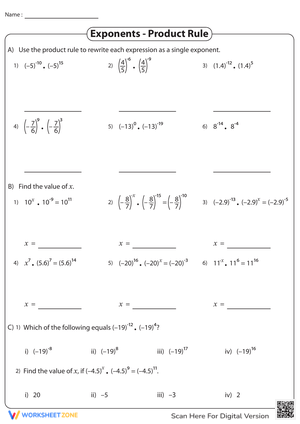
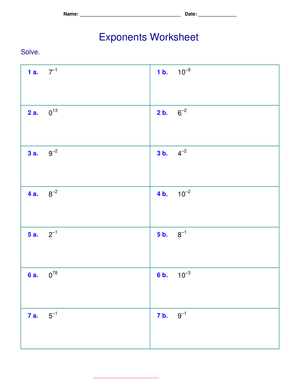
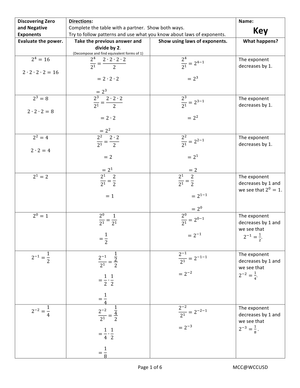
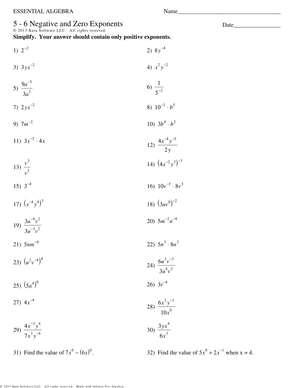
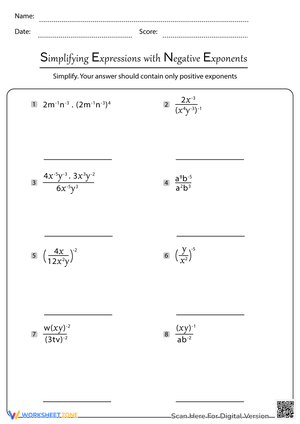
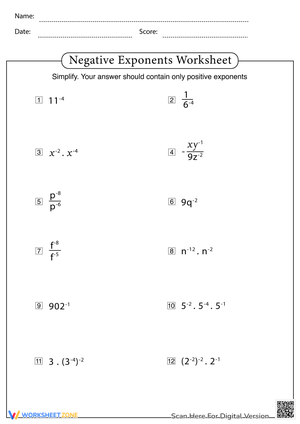
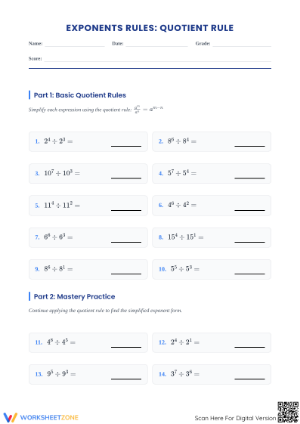
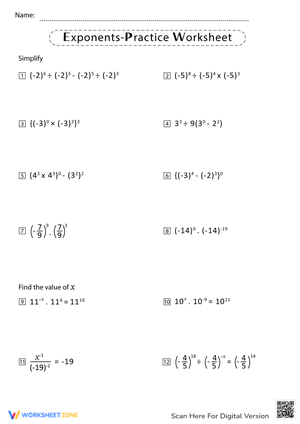
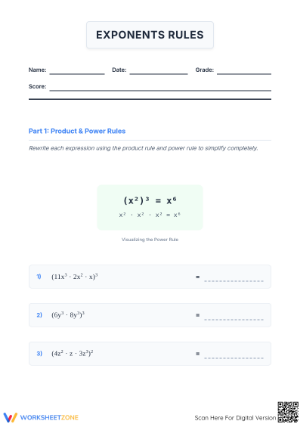
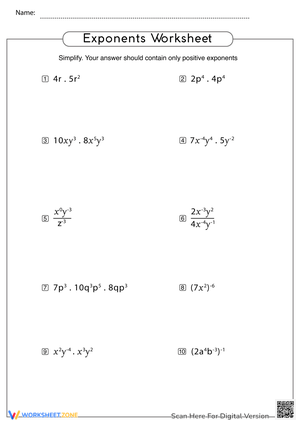
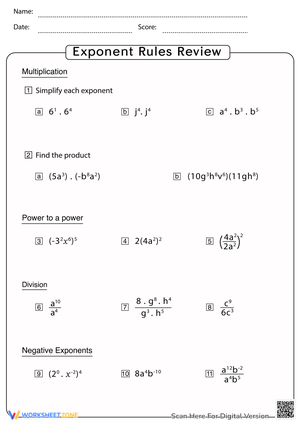
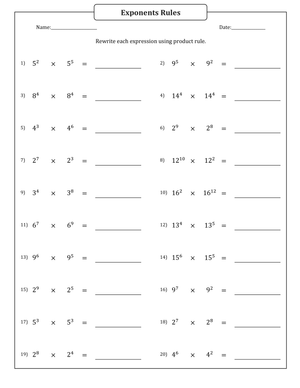
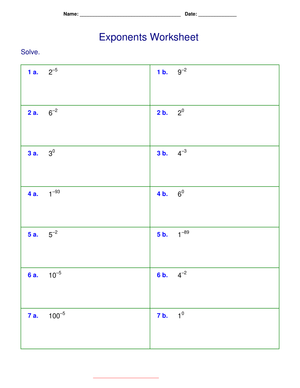
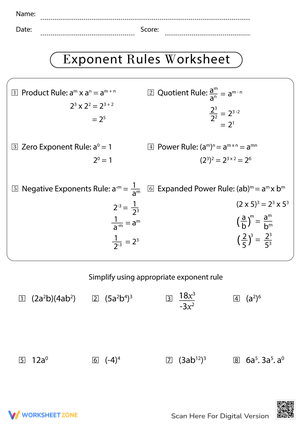
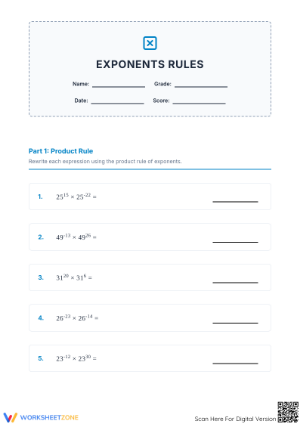
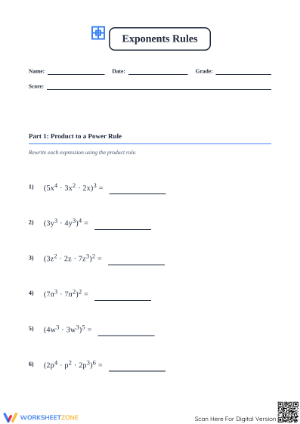
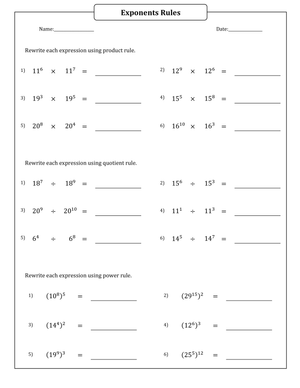
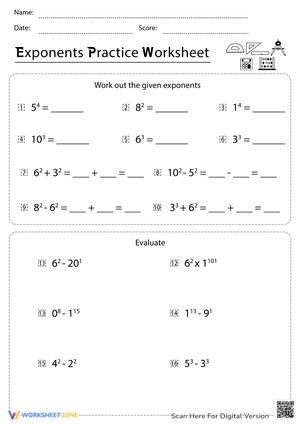
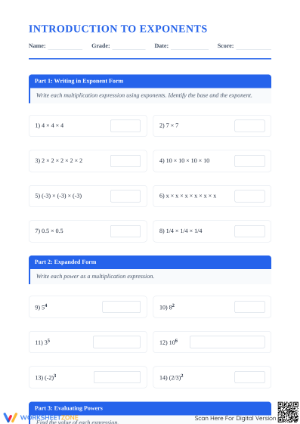
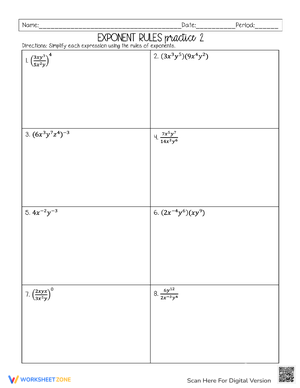
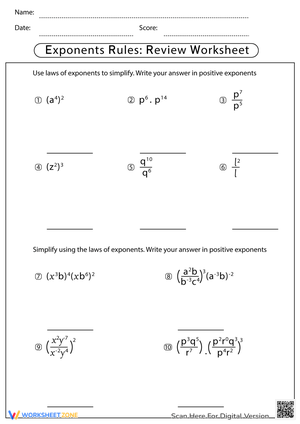
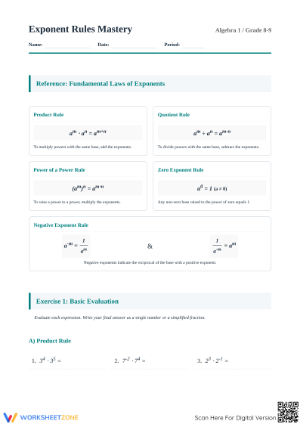
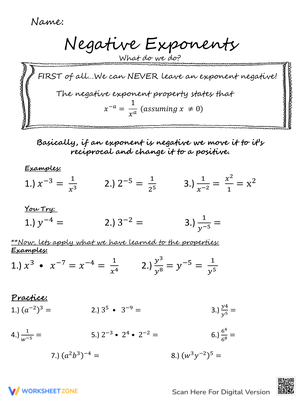
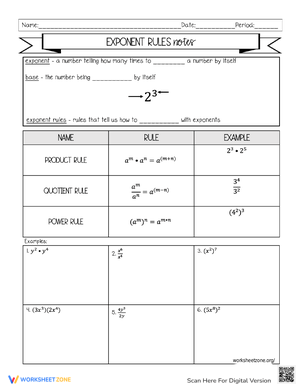
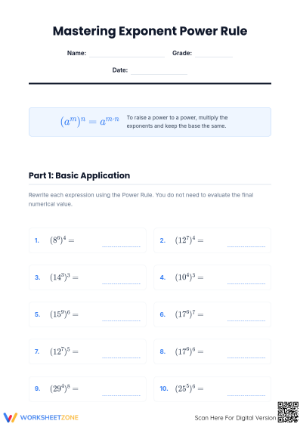
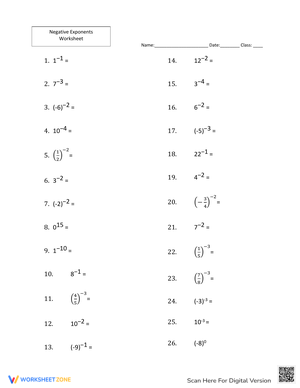
These 7th grade exponents worksheets resources give teachers ready-to-print practice that targets the exact moments where seventh graders get confused — right after direct instruction ends and before misconceptions have had time to calcify. The set covers reading and writing exponential notation, identifying the base and exponent, expanding powers as repeated multiplication, and evaluating expressions with whole-number exponents. Each worksheet includes an answer key and directions clear enough that students can work through it independently, whether in class or at home.
Student Mistakes That Show Up Before the Second Week
The most consequential error in grade 7 exponent work is also the most predictable: students read three to the fourth power as 3 × 4 and compute 12. They are genuinely surprised when the correct answer is 81. The visual layout of exponential notation — a small numeral positioned above and to the right of the base — does not naturally signal "multiply by itself repeatedly" to a student who has never worked with powers. This is a structural misread, not carelessness, and it will not resolve through more computation drill alone.
A second predictable error involves counting factors when expanding. A student who correctly writes five cubed as 5 × 5 × 5 will often undercount when the exponent is larger — writing four to the fourth power as 4 × 4 and stopping there, producing 16 instead of 256. They are reading the exponent as the number of multiplication signs rather than the number of factors. Worksheets that require students to write every factor before computing — and that include enough items to make that habit automatic — catch this pattern early.
A third error appears after students have set up the expansion correctly. They expand two to the fifth power accurately as 2 × 2 × 2 × 2 × 2, then try to multiply in chunks: 4 × 4 is 16, times 2 is... and they either rush or lose count. The expansion is right; the sequential computation is where they drop the thread. Step-by-step evaluation worksheets that show a running product at each multiplication stage give students a method for catching their own arithmetic errors, which makes correction faster for everyone.
Skills Covered Across the Set
Each worksheet in the 7th grade exponents worksheets collection focuses on one skill category rather than combining several task types on one worksheet. That narrow focus is intentional. When students must simultaneously read notation, expand, evaluate, and compare, the cognitive load obscures exactly where understanding breaks down and makes targeted feedback harder to deliver. Keeping tasks separated — especially early in the unit — makes student thinking visible.
- Reading and writing notation: Students see a power and identify the base and exponent, or read a verbal form such as "six to the second power" and write the exponential expression.
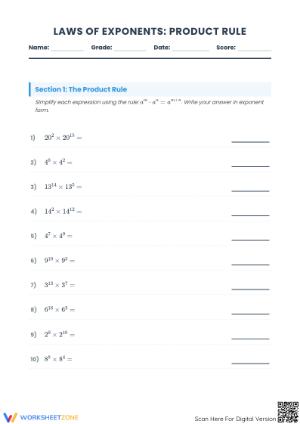
- Expanding: Given an expression, students write the full repeated multiplication — every factor — before computing anything. This worksheet type is the bridge between notation and evaluation.
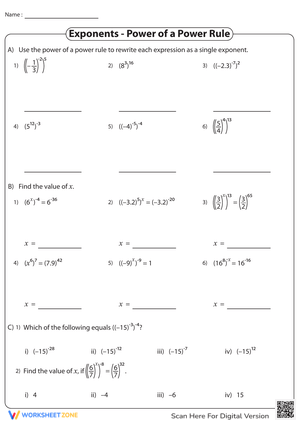
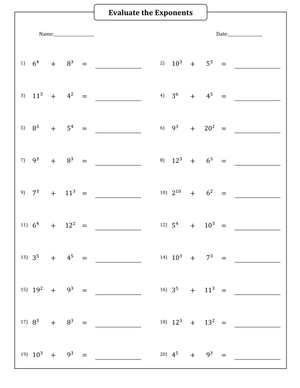
- Evaluating: Numerical expressions with whole-number bases and exponents, moving from simpler bases in earlier worksheets to larger values as the set progresses.
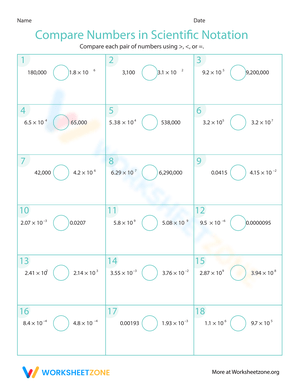
- Comparing and applying: Students evaluate two expressions and determine which is greater, or work through short word problems that require them to construct the expression themselves from a context.
The comparison worksheets are where real understanding shows. A student who evaluates both two to the fifth power and five to the second power correctly but still insists they should be equal has computation skill without number sense about magnitude — and these worksheets make that gap visible before it shows up on the unit test.
How to Work These Worksheets Into Your Teaching Week
A sequence that holds up in practice: use an identification worksheet on day one, right after direct instruction, before students have attempted any evaluation. Ten minutes of circling the base and underlining the exponent — followed by a partner check — surfaces notation confusion while it is still isolated from computation, making it far easier to address cleanly.
On day two, move to expansion-only practice. By day three, evaluation feels natural because students have built the expanded-form step as a habit rather than something they skip to reach the answer faster. That three-day arc — notation, then expansion, then evaluation — mirrors how the skill actually develops, which is different from the order topics appear in most textbooks.
Teachers who anchor their unit in 7th grade exponents worksheets materials and rotate the worksheet format by lesson goal tend to see fewer mixed-up procedures on the unit assessment. Assigning mixed-review work too early produces surface-level performance that hides persistent notation errors, which then resurface during order-of-operations instruction.
For the five minutes before end-of-class, two or three evaluation items pulled from the set function cleanly as exit data. The goal is not a grade — it is a quick read on whether students are still multiplying base times exponent or whether the expanded-form habit is holding. These worksheets also work well for sub days, since the directions are self-contained and students do not need a math-fluent substitute to get started.
Standard Alignment
The core content standard here is CCSS 6.EE.A.1, which asks students to "write and evaluate numerical expressions involving whole-number exponents." Many districts introduce this standard in sixth grade and revisit it in seventh as students build toward order of operations, integer exponents, and scientific notation. In a 7th grade classroom, exponent worksheet practice is most often functioning as either gap-filling from the prior year or fluency-building toward CCSS 8.EE.A.1 in eighth grade — and which role a worksheet is playing matters for how teachers select and sequence it. An identification or expansion worksheet is a reteaching tool. A mixed-review worksheet is an extension tool. Choosing between them requires knowing where students actually are, not just what the grade-level curriculum map says.
Matching Each Worksheet to the Right Learner
Students who are not yet secure with base-and-exponent identification need that worksheet without evaluation items alongside it. When identification and computation appear together, students who are shaky on notation tend to focus on the computation — which is more familiar — and skim the notation work they actually need. Keep these students on identification and expansion worksheets until the notation is automatic, then introduce evaluation.
For students who evaluate correctly but work slowly, the mixed-review worksheets build pace through volume. These students are seeing the same types of tasks, faster, with less step-by-step structure per item — and that gradual reduction of built-in guidance is what builds independent fluency rather than procedure-dependence.
Advanced students who evaluate whole-number exponents quickly can move to the comparison and application worksheets, which require reasoning about magnitude — is three to the fifth greater than or less than five to the third, and by how much? — rather than just applying a procedure. That kind of thinking connects directly to scientific notation and order-of-operations work later in the year.
One honest limitation worth naming: the expansion-first format occasionally frustrates students who are already fluent and find the intermediate steps redundant. If a student consistently writes correct final answers without showing the expansion, decide whether expanded form is the learning goal in that moment or simply a support structure for students still building the habit. Requiring it from every student at every stage is not always the right instructional call.
Frequently Asked Questions
Which exponent skills should most 7th graders be practicing?
Most 7th graders benefit from practice on reading and writing exponential notation, identifying the base and exponent within an expression, rewriting powers as repeated multiplication, and evaluating numerical expressions with whole-number exponents. Students extending the skill may also work on comparing powers or applying exponent notation in short word problems that require them to set up the expression from a real-world context.
Are these worksheets usable for homework, or only for classwork?
Each worksheet holds up well for homework because the directions are clear and task-specific. Students do not need to remember verbal instructions from class to complete the work. Answer keys support next-day review — teachers can project the key and have students self-correct before discussion, which takes far less class time than going item by item through every problem.
How does the set help students who have gaps from 6th grade?
Students who did not retain 6th-grade exponent instruction generally fall into one of two groups: those who never connected notation to meaning, and those who can read notation but cannot evaluate reliably. Grouping students by their specific gap — rather than by general ability level — makes the 7th grade exponents worksheets collection far more efficient to assign. A student who reads notation correctly does not need the identification worksheet; they need the step-by-step evaluation format instead. That distinction is easy to see after one day of identification practice, which is exactly why starting there is worth the time.













 Interactive Worksheet Maker
 Quiz Maker
 Word Search Maker
 Crossword Puzzle Maker
 Word Scramble Generator
 Sentence Scramble Generator
 Handwriting Worksheet Generator
 Name Tracing Generator
 Fill In The Blank Generator