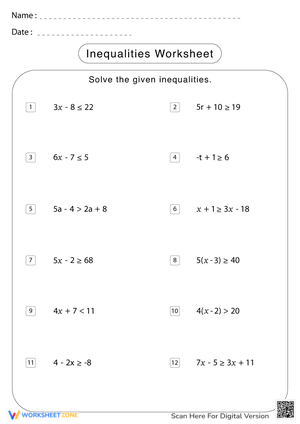
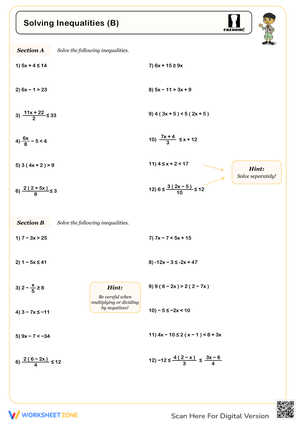
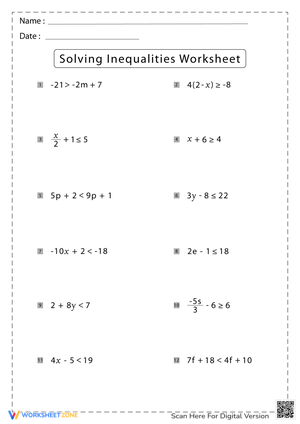
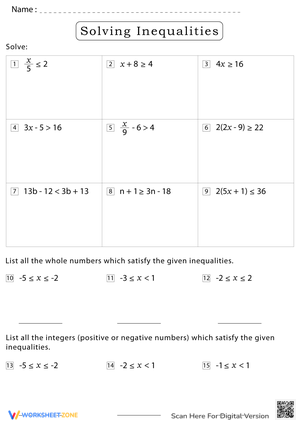
Solving inequalities printable worksheets for 7th grade give teachers a focused set of algebra practice resources organized by skill type, from one-step integer problems through multi-step work and word problems. Grade 7 is the entry point for understanding that a solution can represent an entire set of numbers rather than a single value, and that conceptual shift takes more than a few class periods to settle. These worksheets build the repetition students need across that whole arc.
What's Inside the Set
Each worksheet targets one specific skill layer rather than combining everything at once. That separation matters in practice: when students are still unsure which circle to draw on the number line, adding a two-step algebra problem to the same task splits their attention in unhelpful ways. The set includes:
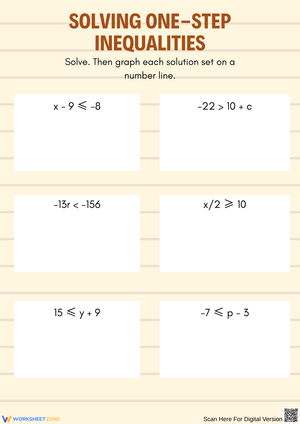
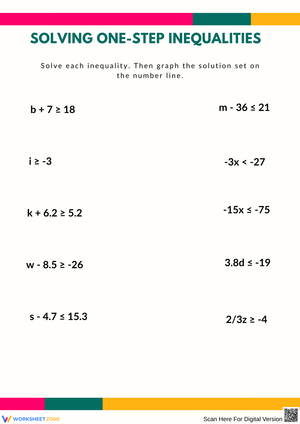
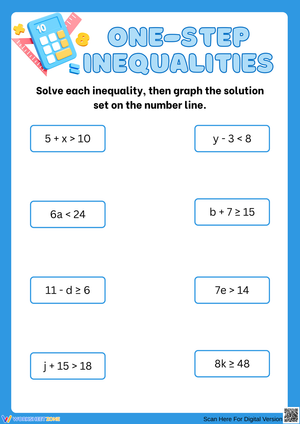
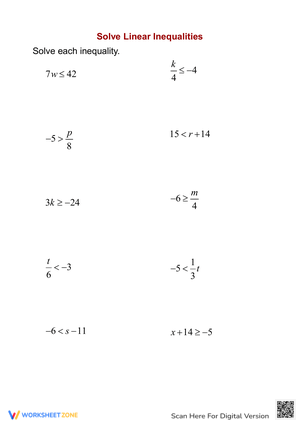
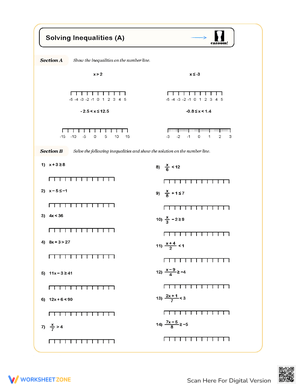
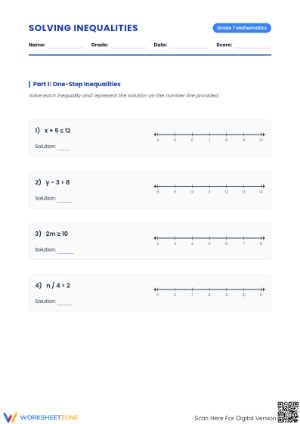
- One-step inequality solving: Addition, subtraction, multiplication, and division problems where students isolate the variable and write the solution.
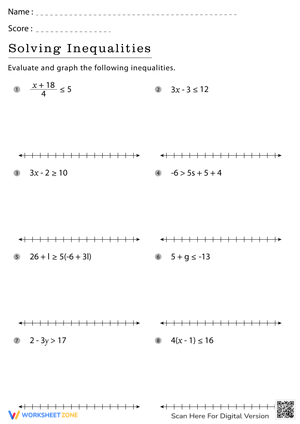
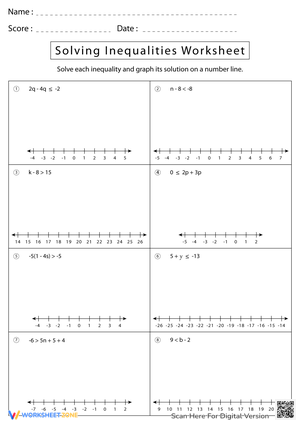
- Graphing on the number line: Students represent solution sets using open and closed circles and directional shading.
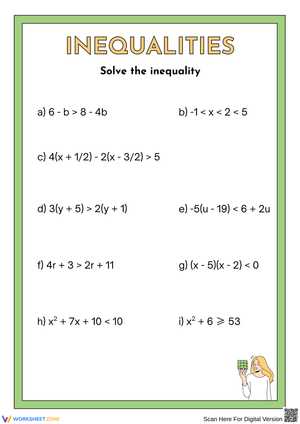
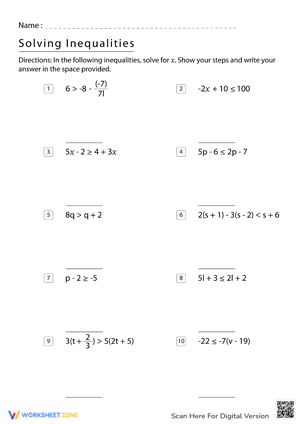
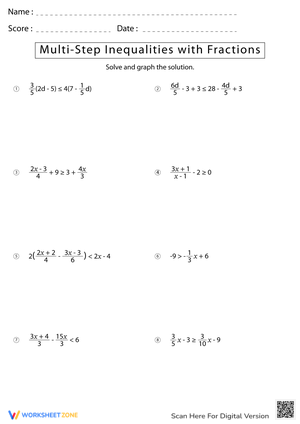
- Two-step and multi-step problems: Students combine operations, collect like terms, and record their reasoning in sequence.
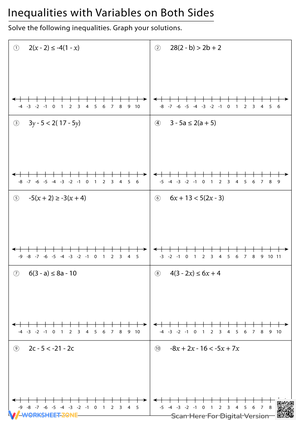
- Variables on both sides: Problems requiring simplification before isolation — a setup that builds systematic algebraic habits.
- Word problems: Students write an inequality from a real-world context, solve it, and interpret the solution set in terms of the situation.
The skill progression moves through integer cases first, then into problems with rational numbers. Students who can only work with whole numbers are not ready for the algebra demands of 8th grade, so the rational number worksheets are not extras — they are the bridge.
Frequent Mistakes Students Make That Teachers Need to Catch
The most common error at this level is solving the numeric step correctly and then leaving the inequality symbol unchanged after multiplying or dividing by a negative number. A student who divides both sides by negative two, writes the correct quotient, but keeps a less than symbol — when it should now be greater than — will check their arithmetic, see no mistake, and feel confident. The error only surfaces when you ask them to substitute a value from their solution set into the original inequality and test it. That testing habit is worth spending a full class period on early in the unit.
Graphing errors fall into two categories. The open versus closed circle question trips up students who spent earlier grades plotting exact points on coordinate planes — a closed dot is all they know, so they draw it by default. Direction errors happen when students graph before fully reading the solution; they shade the wrong half of the number line more often than students who pause to state the solution in words first. A classroom norm worth enforcing: say it before you shade it. For word problems, the error is usually in symbol selection. "No more than" correctly triggers less than or equal to for most students, but "exceeds" reliably produces less than instead of greater than in a surprising number of papers.
Putting These Worksheets to Work in Your Classroom Routine
Getting the most from solving inequalities printable worksheets for 7th grade means matching each worksheet to a specific instructional purpose rather than assigning them as general practice after every lesson. A few patterns that hold up across different class setups:
- Bell ringers: Three to five one-step problems fill the first eight minutes of class, reviewing the previous day's skill while attendance settles.
- Targeted reteach: Pull a small group after a quick formative check and give them the one-step worksheet while the rest of the class works on two-step problems. The familiar format means the group can work without constant direction.
- Exit tickets: Cut a worksheet into strips of two problems and hand one strip to each student in the last five minutes. Collect them sorted by table group for a fast class snapshot.
- Sub plans: A clean PDF with an answer key on a separate worksheet is one of the few resources that survives a substitute day without confusion about expectations.
- Pre-assessment warm-up: Assign the one-step worksheet the day before introducing two-step work to surface gaps before new content lands on top of them.
The Friday before a unit test is another reliable slot. Students who have worked through several different worksheet types across the week arrive at that review session in a noticeably more confident state than students who saw three days of notes and nothing else.
Matching Worksheets to Student Readiness Levels
Differentiation here is primarily about where in the skill sequence each student is working. Students who are still unsteady with integer operations should start with one-step worksheets using small whole numbers — the inequality concept is the new piece, and everything else needs to be automatic. Once they move through that confidently, the two-step worksheets with integers follow. Students who are ready to move faster can work through solving inequalities printable worksheets for 7th grade that include rational numbers and word problems simultaneously, which is closer to how these skills appear on standardized assessments.
For students who struggle when asked to graph before they have a reliable solving process, separating the tasks helps: assign the solving worksheet first, check it, then move to the graphing worksheet once the solution-writing is solid. The opposite adjustment works for advanced students — ask them to write a word problem context that produces a given inequality, then solve and graph it. That inversion reveals whether they understand what a solution set represents, not just how to find one.
Standard Alignment
These worksheets align to CCSS 7.EE.B.4b, which requires students to solve word problems leading to inequalities of the form px + q is greater than r or px + q is less than r, graph the solution set on a number line, and interpret the answer in context. This standard sits at the end of the Grade 7 expressions and equations progression intentionally — students need fluency with one-step solving and number line representation before word problem and multi-step demands are reasonable. Teachers in states using their own frameworks will find similar placement: one-variable inequality solving is consistently a 7th grade expectation, and the instructional order the worksheets follow reflects that consensus.
Frequently Asked Questions
Which worksheet should I start with at the beginning of the unit?
Start with one-step integer problems paired with graphing on the number line within the same worksheet. Students need to build the connection between a symbolic solution and its visual representation early, before the algebra grows complex enough to crowd out that conceptual work.
Do the worksheets address the sign-reversal rule for negative operations?
Yes. The multiplication and division worksheets include problems that require students to divide or multiply by a negative value and reverse the symbol. These problems appear after students have practiced the standard operation types, so the reversal rule lands as a specific and memorable exception rather than one more thing to track from the start.
Are these resources useful outside of 7th grade?
Solving inequalities printable worksheets for 7th grade at the one-step and graphing level work well for 6th grade enrichment when students have mastered one-step equations and are ready for the next conceptual layer. The multi-step and variables-on-both-sides worksheets are appropriate for 8th graders who need to revisit the topic before moving into more advanced algebra work.
Are answer keys included?
Each worksheet comes with a corresponding answer key. For intervention settings, having students self-check after completing a small section — rather than at the end of the full worksheet — closes the feedback loop faster. When a student corrects an error immediately rather than finding it the next day, the correction is more likely to stick.













 Interactive Worksheet Maker
 Quiz Maker
 Word Search Maker
 Crossword Puzzle Maker
 Word Scramble Generator
 Sentence Scramble Generator
 Handwriting Worksheet Generator
 Name Tracing Generator
 Fill In The Blank Generator