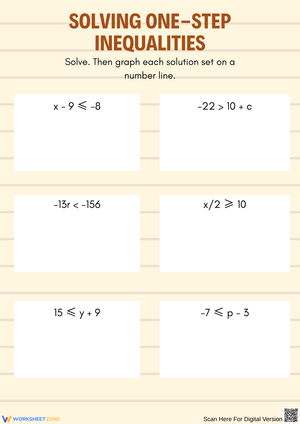
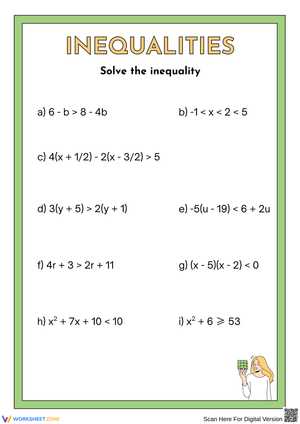
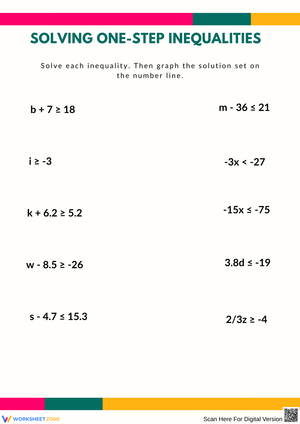
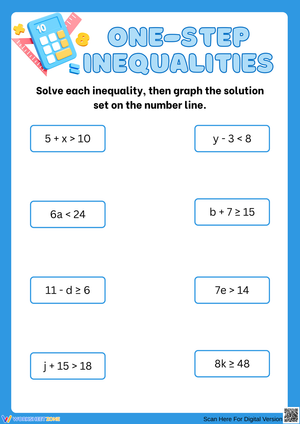
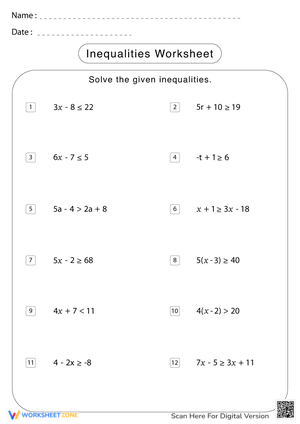
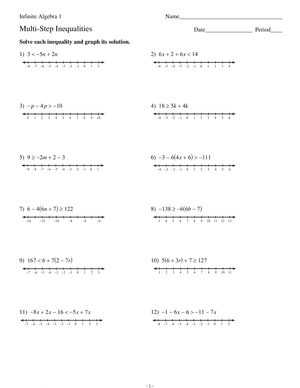
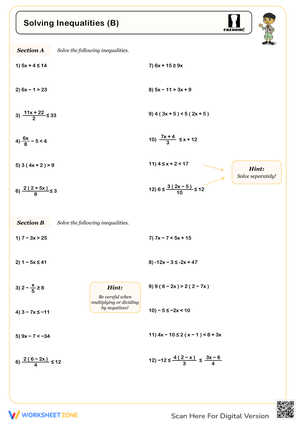
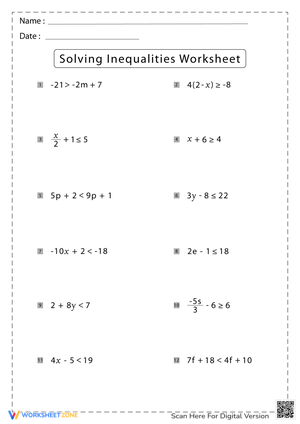
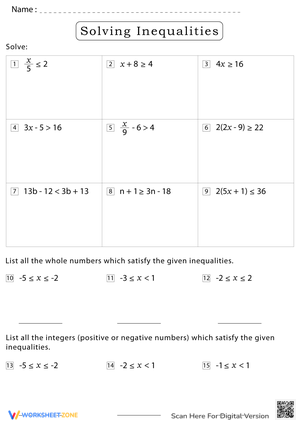
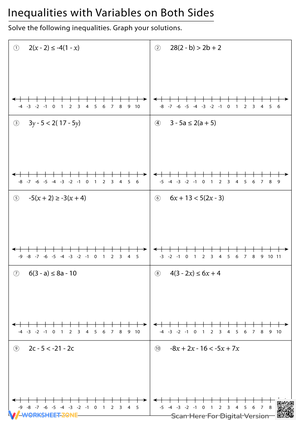
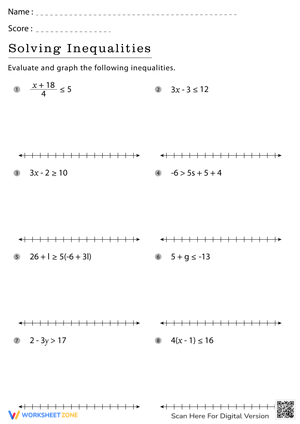
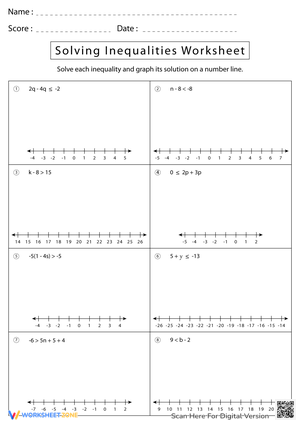
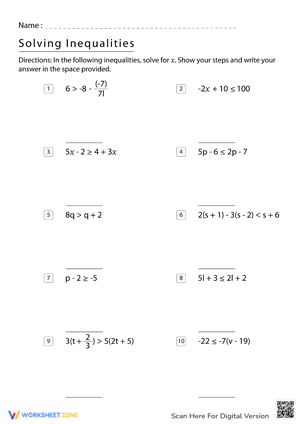
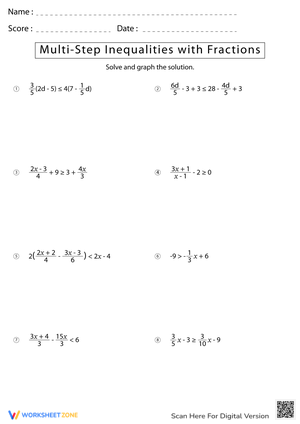
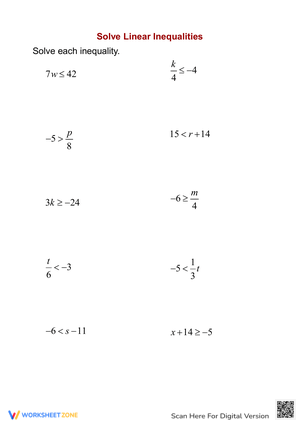
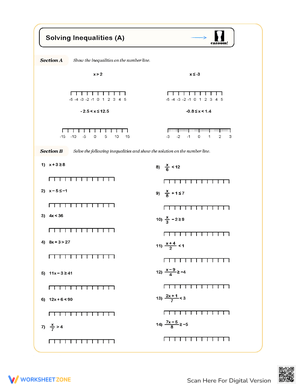
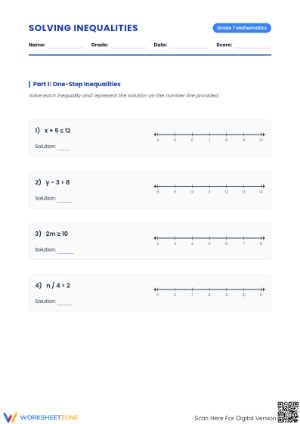
These inequalities worksheets for 7th grade give math teachers ready-to-use, focused practice across the full arc of inequality instruction — from translating verbal statements into symbols to solving two-step problems to graphing solution sets on a number line. Each worksheet targets a specific skill, so the resources match individual lesson objectives rather than landing as a broad mixed review before students are ready for it. Answer keys come with every set, which makes the worksheets useful for station rotation, homework checks, and sub-plan days alike.
The Specific Skills Each Worksheet Builds
At the 7th grade level, inequality work sits at a genuine developmental hinge. Students arrive knowing how to solve one- and two-step equations, and the symbolic notation looks familiar enough that many assume the same procedures carry over entirely. They mostly do — except for one critical case. A well-organized set of worksheets uses that conceptual overlap deliberately: most of what students already know transfers, but specific worksheets isolate the new and harder cases so the differences become visible rather than blurring into the equation routine.
- Writing inequalities from verbal descriptions using phrases like at least, no more than, fewer than, and exceeds
- Solving one-step inequalities with addition, subtraction, multiplication, and division — including the sign-reversal case
- Solving two-step inequalities with integers and rational numbers
- Graphing solution sets on number lines with correct open or closed endpoint circles
- Interpreting solution sets in context: budgets, weight limits, temperature ranges, and similar real-world constraints
- Checking solutions by substituting test values on both sides of the solution boundary
Those last two skills — interpretation and solution-checking — often disappear from worksheets that focus only on symbolic procedures. Including them helps students understand that an inequality describes a range of values, not just a single threshold to cross.
Mistakes Students Make That These Worksheets Help You Catch
The sign-reversal rule produces more errors in this unit than anything else. A student who correctly solves 3x = 12 by dividing both sides by 3 will apply the same step to an inequality like negative three times x greater than twelve — dividing both sides by negative three — and write x greater than negative four without pausing, because the division felt right and the symbol never changed. The reversal feels arbitrary until students see the underlying logic: if you start with 1 and negative 5, where 1 is to the right on the number line, and multiply both by negative 3, you get negative 3 and 15 — now 15 is to the right, and the order has flipped. Worksheets that pair the algebraic steps with that number-line check help the rule stick faster than repeated verbal reminders alone.
The open-versus-closed circle distinction is a separate, persistent problem. Students can state the rule correctly — open circle for strict inequality, closed for "or equal to" — and still draw a filled dot on a strictly greater than graph, because years of plotting ordered pairs built a strong habit of marking endpoints with a solid circle. The correction happens through repeated exposure with immediate feedback, not more explanation.
Word problems bring a third difficulty. When a situation says "a student needs to save at least $50," many students write s = 50 rather than s greater than or equal to 50 — reading "at least" as naming a specific value rather than a lower boundary. Each worksheet in the word-problem section includes a brief translation step before the full problem: students underline the key phrase, identify whether it points toward larger or smaller values, and then commit to a symbol. That pause at exactly the right moment catches most translation errors before they calcify into habit.
Getting the Most From These Worksheets Across a Unit
During direct instruction, teachers who use these inequalities worksheets for 7th grade assign each worksheet immediately after teaching its corresponding skill — writing inequalities after the introduction, one-step solving after that lesson, and so on. That pacing prevents students from conflating procedures before they have had time to consolidate each one. Cognitive load stays manageable when symbolic work, graphical representation, and contextual interpretation are introduced in sequence rather than all at once.
For bell-ringer work, a four- to six-problem mini-set drawn from a previous worksheet covers spaced retrieval without eating into instructional time. The eight minutes before students transition to the next period is a practical window for assigning the graphing section of a worksheet as an exit task — collect it, sort the results by error type that evening, and use that information to plan the next day's small-group reteach. That sorting is faster and more diagnostic than reading through a full assignment looking for patterns.
Station rotation works particularly well with this content because the three main representations — symbolic, graphical, and numerical — map naturally to three stations. One station has students solve and record inequality solutions. A second has students graph on pre-drawn number lines. A third presents short real-world scenarios where students write the inequality, solve it, and then test one value in the solution set. Each station uses a different mode, so students get repeated exposure without repeating the same procedure in a loop.
Standard Alignment
These resources address CCSS 7.EE.B.4b, which requires students to solve word problems leading to inequalities of the form px + q greater than r or px + q less than r, graph the solution set on a number line, and interpret the answer in context. That standard typically falls in the second half of the first semester of 7th grade, after students have worked through 7.EE.B.4a on solving equations — which is why worksheets that bridge equation fluency into inequality reasoning are better paced than resources that introduce inequality symbols without any connection to what students already know. The related standard 7.EE.B.1, which covers operations with linear expressions, provides the algebraic groundwork students need before two-step inequality problems become manageable.
Adjusting the Set for a Range of Readiness Levels
Students come into the inequalities unit with very different levels of equation fluency, and that gap shows up quickly. For students still building confidence, start with worksheets that use integer-only problems and include a number line printed directly beneath each item. That format reduces the challenge on two fronts at once: familiar number types and a ready-made visual model let students focus on inequality logic rather than managing calculation, graphing, and number type simultaneously.
On-level practice adds rational numbers — fractions and decimals — and asks students to produce the number line graph independently rather than complete a pre-drawn one. That shift from built-in visual to independent graphing is where many students discover they leaned on the printed line more than they recognized. Challenge worksheets go further: multi-part word problems ask students to write the inequality, solve it, graph the solution set, and then evaluate whether a specific value satisfies it — with a sentence explaining the reasoning. That explanation step surfaces whether students understand the solution set conceptually or are executing procedural steps by rote.
One practical note: keep the learning target identical across tiers. All students write, solve, and graph inequalities. What changes is the number type, the language complexity of the word problems, and whether visual support is built into the worksheet or expected from memory. The inequalities worksheets for 7th grade in this set are organized so teachers can pull the right tier without building separate assignments from scratch.
Frequently Asked Questions
What skills are covered across the set?
Each worksheet addresses one focused area: writing inequalities from verbal statements, solving one-step inequalities, solving two-step inequalities with rational numbers, graphing solution sets on a number line, or interpreting solutions in real-world contexts. Mixed-review worksheets at the end of the set ask students to select the right approach on their own, which reflects what end-of-unit assessments typically require.
How should I handle the sign-reversal rule before students make the mistake repeatedly?
Teach the rule during direct instruction using a side-by-side comparison: show the same inequality solved correctly, with the reversal, and incorrectly, without it. Then have students test a value from each result on the number line to see which one holds. After that demonstration, assign a worksheet that isolates negative-coefficient problems before mixing them into a general review. Students who practice the reversal in a focused set recognize it faster when it reappears among other problem types later in the unit.
Do the worksheets include answer keys?
Yes. For graphing problems, the key shows the correct open or closed circle and the direction of shading — not just the symbolic answer. For word problem items, the key shows the inequality as written from the context before the simplified form, so teachers and students can trace exactly where a translation error occurred rather than just seeing that the final answer was wrong.
Can these be used for intervention after a unit assessment?
Because each skill stays in its own worksheet, teachers can pull exactly the resource that matches the error pattern from the assessment. A student who graphed solutions correctly but missed every sign-reversal problem needs a different follow-up than one who struggled with word-to-symbol translation. Using the inequalities worksheets for 7th grade this way turns reteach time into targeted work rather than a full re-delivery of the unit.













 Interactive Worksheet Maker
 Quiz Maker
 Word Search Maker
 Crossword Puzzle Maker
 Word Scramble Generator
 Sentence Scramble Generator
 Handwriting Worksheet Generator
 Name Tracing Generator
 Fill In The Blank Generator