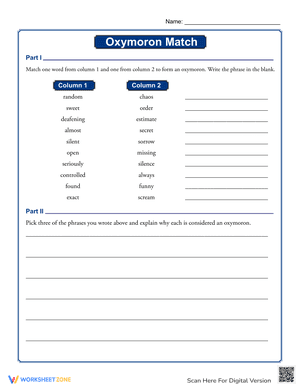
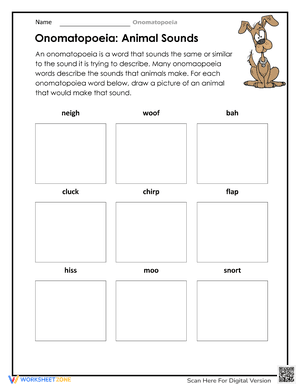
These figurative writing printable worksheets for 7th grade address a specific instructional gap: students who can correctly identify a metaphor in a mentor text can rarely explain why the author chose that comparison over a plain alternative, and even fewer apply that decision deliberately in their own drafts. Each worksheet moves students through recognition into revision and original composition — the two skills that actually transfer to stronger narrative and descriptive writing — rather than stopping at matching terms to definitions.
The Work Each Worksheet Asks Students to Do
The set targets simile, metaphor, personification, hyperbole, idiom, and imagery, with consistent emphasis on why a device creates a specific effect rather than simply marking it with a label. Students underline examples in model sentences, rewrite plain sentences using a targeted device, and compose short original passages where mood and word choice have to align. A typical revision prompt gives students a sentence like The auditorium filled with students and asks them first to make the scene feel threatening, then to make it feel joyful — using different figurative choices for each. That distinction between deploying a device and choosing the right device is the core of the practice.
Several worksheets also treat idiom and hyperbole as explicit tone tools. Students who reach for hyperbole in every emotional moment — "I was dying of embarrassment," "I've told you a million times" — flatten their writing rather than intensifying it. Each worksheet in that portion of the set asks students to mark where a device sharpens a passage and where it starts to undercut the mood instead. That kind of evaluative reading directly prepares students for revision decisions in their own drafts.
Error Patterns Worth Watching in Student Drafts
The most persistent error at this grade level is tone-blind figurative language. A student writing a tense, difficult scene will drop in a cheerful simile — "the sky was like a lemon popsicle" — because it sounds literary, not because it fits. On a recognition task, that sentence earns full credit. It is only inside a full paragraph that the mismatch becomes visible. Revision worksheets that ask students to match a specific device to a specified mood expose this error directly, because students must defend their word choice in context rather than just produce a grammatically correct simile.
Circular comparisons are a close second. "The river moved like flowing water" satisfies the form of a simile while transferring no meaning — students write it because the structure looks right even when the content is empty. A simile only improves the writing when the comparison tells the reader something the literal version could not. Watching students revise these circular attempts, often with genuine surprise when they notice the problem, is one of the more diagnostic moments in a figurative language unit.
Personification also generates a specific error pattern: students animate an object with a verb that clashes with the surrounding tone. "The clock screamed at me" fits a high-pressure testing scene. That same phrase dropped into a quiet Sunday morning reads as a mismatch students rarely catch unless comparison tasks put both versions side by side for direct discussion.
Fitting These Worksheets Into a Writing Unit
The most effective placement for figurative writing printable worksheets for 7th grade is immediately after students have read a mentor text that uses the target device with clear intent — not during isolated vocabulary review. Running the worksheet within two or three days of the mentor text reading keeps the connection between reading and writing concrete. Students who annotated personification in a Gary Soto essay arrive at the writing task with a real example already in mind rather than an abstract definition.
Within a typical two-week writing unit, the worksheets fit naturally into several distinct instructional slots:
- Bell ringers: One plain sentence, one rewrite using a target device, one sentence naming the effect. Five minutes at the start of class builds fluency across the unit without cutting into drafting time.
- Writing workshop: Longer revision worksheets work here, when students have a draft in front of them and can apply the device to writing they actually care about finishing.
- Small-group reteaching: Students still confused about a specific device benefit from a structured task with one clear model before moving into open composition.
- Pre-conference warm-up: A mixed identification and revision task the day before writing conferences gives a fast read on which students need targeted support before one-on-one time.
Assigning figurative language practice disconnected from a current writing project tends to produce technically correct sentences students have no intention of ever using again. These worksheets do their best work inside a genre study — narrative, poetry, or descriptive writing — rather than as a standalone vocabulary unit.
Adapting Each Worksheet Across Writing Readiness Levels
For students who stall at blank sentence-writing prompts, structured starters remove the paralysis without removing the thinking. A frame like "The hallway was like ___" or "The cafeteria noise ___-ed as if ___" provides the device while leaving the comparison entirely to the student. That format works because it narrows one decision at a time — students focus on the quality of the comparison rather than getting stuck on which device to use. Figurative writing printable worksheets for 7th grade that include optional sentence starters let teachers offer or withhold that support based on what individual students need, without printing a different version for each group.
Advanced writers need the opposite: constraints that push past first instincts. A paragraph-level challenge prompt — write four sentences describing one moment, using exactly two different devices, with both choices consistent in tone — forces craft decisions that a simple "add a simile" task never demands. Students who habitually reach for hyperbole benefit especially from a prompt that excludes it, because that constraint surfaces how much they rely on a single device and how narrow their range actually is when pushed to make a different choice.
Standard Alignment
These resources connect most directly to CCSS.ELA-LITERACY.L.7.5, which asks seventh graders to demonstrate understanding of figurative language, word relationships, and nuances in word meanings — including interpreting figures of speech in context and distinguishing shades of connotation. The original composition and revision tasks also address CCSS.ELA-LITERACY.W.7.3d, which calls specifically for the use of precise language, relevant sensory details, and figurative language to capture action and convey experience in narrative writing. Teachers often find these two standards easier to assess together through a revision task than through separate reading and writing activities.
For teachers working in states that use TEKS rather than Common Core, the closest parallels are TEKS 7.10, which covers literary composition and the use of language to shape meaning, and TEKS 7.6B, which asks students to analyze how an author's use of figurative language achieves specific purposes. The application tasks in the set address both the production and the analysis side of those standards.
Frequently Asked Questions
Are these worksheets meant for a reading unit, a writing unit, or both?
Both, and the sequence matters. Identification and analysis tasks fit most naturally in a reading unit — students locate a device, explain the effect, and note what the author seems to be doing with it. The revision and original composition tasks belong in a writing unit, ideally timed so students are working in the same genre they are currently drafting. The set is strongest when reading and writing reinforce each other, not when figurative language instruction lives on a separate track from whatever writing students are producing.
What mentor texts pair well with this kind of practice at the 7th grade level?
Short pieces tend to outperform novel excerpts here because students can hold the whole text in view while discussing figurative language choices. Gary Soto's personal essays, Langston Hughes's shorter poems, and selected vignettes from Sandra Cisneros's The House on Mango Street all carry dense figurative language with clear tonal intent — which makes the discussion before writing concrete rather than speculative. The most useful mentor texts are ones where students can point to a specific device and immediately answer the question of why the author chose it over the literal version.
How do these worksheets work for students who read below grade level or have IEPs?
Figurative writing printable worksheets for 7th grade that include a visual side-by-side — a plain sentence next to its figurative revision, with the device labeled — reduce the cognitive demand of understanding what a device looks like before students are asked to produce one. For students with reading challenges, completing the identification portion aloud or within a small group first means the writing task starts from shared understanding. The sentence-revision format is also more accessible than open composition for many below-level writers, because it provides a starting sentence, a bounded task, and a defined space — three conditions that help rather than hinder when a student is still building writing fluency.
Can these worksheets function as formative assessment during a writing unit?
Revision and original composition tasks give more useful formative data than multiple-choice recognition questions during a writing unit. They show whether a student understands a device well enough to deploy it with control and with the right tone — a more actionable data point than a correct answer on a matching task. For formal assessment, look at whether the student's figurative language choice fits the mood and context of the surrounding writing rather than grading technical correctness alone. A simile that is grammatically perfect but tonally wrong tells you something important about where a student actually is in their understanding.















 Interactive Worksheet Maker
 Quiz Maker
 Word Search Maker
 Crossword Puzzle Maker
 Word Scramble Generator
 Sentence Scramble Generator
 Handwriting Worksheet Generator
 Name Tracing Generator
 Fill In The Blank Generator