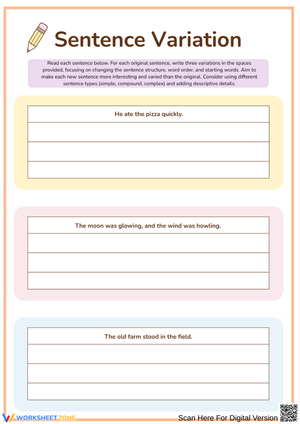
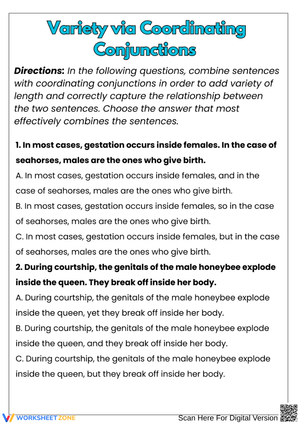
These 7th grade sentence variety printable worksheets give teachers focused revision tasks that slot directly into writing instruction — not isolated grammar exercises students complete and immediately forget. Each worksheet targets a specific move: changing sentence openings, combining related ideas, expanding bare statements, or improving paragraph rhythm. The set works across narrative, informational, and argumentative writing without requiring a separate grammar unit.
The Revision Moves Each Worksheet Targets
Sentence variety at this grade level is not about labeling grammar structures. It is about teaching students to hear when writing sounds repetitive and to make deliberate choices that fix it. Each worksheet builds that skill through active revision rather than multiple-choice identification.
- Paragraph revision: Students rewrite short passages where every sentence opens the same way — the most common pattern visible in actual 7th grade drafts.
- Sentence combining: Students merge three or four short related sentences into one or two smoother, more mature ones without losing the original meaning.
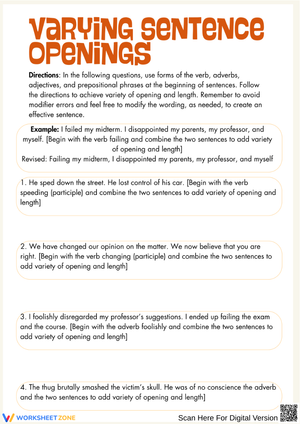
- Opening variation: Students practice starting sentences with adverbs, prepositional phrases, dependent clauses, and participial phrases — then verify that the revised sentence still makes logical sense.
- Sentence expansion: Students take bare-minimum sentences and add detail through appositive phrases or embedded clauses.
- Contrast revision: Students compare a flat paragraph against a revised version and identify which specific changes improved clarity or rhythm.
The contrast task earns its place because students who freeze when asked to revise abstractly can usually respond to a direct comparison. At this stage, hearing the difference between a repetitive paragraph and a revised one tends to land faster than memorizing the definition of a compound-complex sentence.
Where Student Attempts at Variety Typically Break Down
The most predictable error appears when students start opening sentences with participial phrases. After a few examples, they write things like "Running down the hallway, the announcement surprised everyone." The dangling modifier is invisible to them because they were focused on the opening, not on whether the phrase's implied subject matches the rest of the sentence. A quick correction routine — ask students to underline who or what performs the action in each opening phrase — catches this before it becomes a fixed habit.
A second pattern: students confuse "longer" with "more varied." When asked to combine sentences, they chain clauses together with "and" and "and then" until a single construction runs past four lines. The result is technically longer but harder to follow. Asking students to choose the most effective combination from two or three provided options forces them to evaluate rather than just produce — which is why the worksheets include that format rather than leaving combining open-ended.
There is also the one-short-sentence fix. Students learn that brief sentences create emphasis, so they drop one into a paragraph and consider the revision complete. That is worth addressing directly: variety means the full paragraph moves at an effective rhythm, not that one sentence in five happens to be brief.
How to Fit These Worksheets Into Your Writing Week
The most reliable use is the bell ringer. Project a repetitive paragraph, read it aloud so students can hear the sameness, then hand out the worksheet. Students revise independently for the first eight or ten minutes while you circulate, and you debrief two or three revisions before moving into the lesson proper. That structure fits inside fifteen minutes and requires almost no preparation.
During writing workshop, these worksheets work as a mid-draft revision tool. Once students have a paragraph or two down, hand them a sentence-combining worksheet and ask them to apply the same move to one section of their own writing immediately afterward. The transfer step — worksheet first, own draft second — is what keeps the practice from feeling like busywork. Without it, students complete the task and return to writing the same way they always have.
These 7th grade sentence variety printable worksheets also slot naturally into sub plans and literacy centers. The tasks are self-contained enough that students can work through them without extended teacher explanation, and the directions stay consistent enough that a substitute can manage the session without a detailed script.
Standard Alignment
These worksheets address CCSS.ELA-LITERACY.W.7.5, which calls for students to strengthen writing through planning, revising, and editing with attention to purpose and audience. Revision for sentence variety is one of the most direct applications of this standard — it asks students to return to existing writing and make purposeful structural changes, exactly what W.7.5 describes. Teachers who track standards during writing workshop can use these worksheets as documented practice without building a separate grammar unit around them.
The set also connects to CCSS.ELA-LITERACY.L.7.3a, which asks students to choose language that expresses ideas precisely and concisely, eliminating wordiness and redundancy. When students revise repetitive sentence patterns, they are doing the practical work this standard names. Together, these two codes show why sentence variety belongs inside writing instruction rather than on the margins of it.
Adapting the Worksheets for Writers at Different Readiness Levels
For students still working on sentence-level control, narrow the task. Instead of revising a full paragraph, ask them to rewrite three sentence openings from a provided list, or combine two specific sentence pairs. Including a completed model alongside the task — one finished example showing a possible revision — reduces the cognitive demand of generating a response while still requiring students to write. Sentence-combining tasks are particularly useful for this group because students can build smoother writing without generating new content from scratch.
On-level students handle the mixed-task format well: one section on combining, one on opening variation, one paragraph to revise independently. Adding a brief reflection prompt after the revision — "What specific change made the writing sound clearer?" — moves the practice from mechanical to analytical and takes less than two minutes.
For advanced writers, the most productive adjustment is removing the provided passage entirely. Ask them to pull a paragraph from their current draft and revise it for rhythm and pacing, deciding when a short sentence should stay short for emphasis and when a longer structure builds momentum. Genre awareness becomes relevant here, too: the variety choices that work in an action scene differ from those in an analytical paragraph. The 7th grade sentence variety printable worksheets in this set include open-revision tasks that work particularly well at this tier because they do not lock students into a single correct answer.
Frequently Asked Questions
Are these worksheets meant to replace grammar instruction or supplement it?
They supplement it. The tasks are revision-focused rather than identification-focused, which means students who cannot yet define a dependent clause can still improve a paragraph by rewriting three repetitive openings. The doing often clarifies the concept faster than the definition does, and teachers can follow up with formal terminology once students have experienced what the structure actually accomplishes in a piece of writing.
How often should these appear during a writing unit?
Once or twice a week works well, especially during drafting and revision phases. Spreading the practice across several weeks through short sessions produces stronger results than working through every worksheet consecutively. Students need time between sessions to try the revision moves in their own writing — that application is where the habit actually forms.
Do the passages reflect authentic middle school writing or polished textbook sentences?
The passages are written to sound like actual 7th grade student writing — not carefully crafted models with one deliberate error inserted, but genuinely flat, repetitive paragraphs of the kind that appear in real drafts. That realism matters because students recognize the pattern and are more likely to transfer the revision skill to their own work when the sample writing resembles what they actually produce.
Can these worksheets serve as homework?
Yes, though the transfer step matters even more when students work independently. Pairing the homework with a concrete draft requirement — "rewrite two sentence openings in your current essay before tomorrow's class" — gives the practice a real purpose beyond completing the task. The 7th grade sentence variety printable worksheets in this set are short enough that the worksheet and the draft revision together fit within a reasonable homework window.












 Interactive Worksheet Maker
 Quiz Maker
 Word Search Maker
 Crossword Puzzle Maker
 Word Scramble Generator
 Sentence Scramble Generator
 Handwriting Worksheet Generator
 Name Tracing Generator
 Fill In The Blank Generator