These 7th grade naaman printable worksheets resources give teachers a ready-to-use set built around 2 Kings 5 — a Bible story that rewards close reading precisely because the main character's most important choices are internal. Naaman's arc from resistant commander to grateful follower is not simply a plot sequence; it is a case study in how pride and frustration complicate even clear guidance. That layered tension is what makes this material genuinely worth teaching at this grade level rather than treating as a simple retelling exercise.
What Each Worksheet Targets
Seventh graders are developmentally past elementary retelling. They can track cause-and-effect chains, infer emotional states from behavior, and write short evidence-based responses — and the Naaman story puts all three skills to work. The set focuses on these tasks:
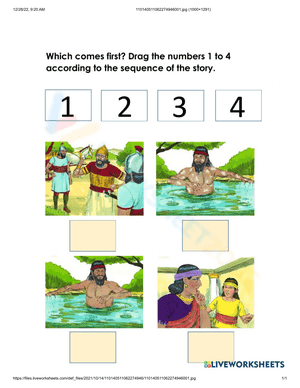
- Sequencing major events: Students order the key story beats — the servant girl's message, Naaman's arrival in Israel, Elisha's instruction, Naaman's angry refusal, the servants' intervention, the washing in the Jordan, and the return to Elisha. Placing these in order forces students to hold the full arc in mind.
- Cause and effect: Students explain what triggered Naaman's frustration and what changed his decision. The answer is not obvious — it requires reading the servants' dialogue carefully rather than skimming past it.
- Character trait analysis: A before-and-after chart tracks evidence of Naaman's pride at the story's opening and his humility by the end, with students citing specific lines rather than restating the theme in general terms.
- Vocabulary in context: Terms including commander, prophet, obedience, leprosy, and humility appear in matching and sentence-completion tasks that build comprehension before students move to analysis.
- Written reflection: Each worksheet includes at least one constructed response asking students to connect Naaman's choices to a situation where taking advice felt difficult.
The reflection tasks are the ones that generate the most genuine classroom conversation. When students have to explain a time they resisted good guidance, the story stops being ancient history and starts feeling like something they recognize from their own week.
Common Misconceptions to Watch For and Correct
The most consistent error in student work on this story is inverting the cause-and-effect relationship between obedience and healing. Students write that Naaman "became humble because he was healed," when the actual sequence runs in the opposite direction: Naaman obeyed first, and the healing came after. That inversion flattens the entire theme. If healing caused humility, the story is about a miracle; if obedience preceded healing, the story is about a choice. Catching that reversal before students write their reflection paragraph saves a lot of confused drafts.
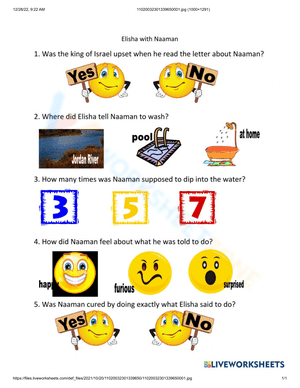
A second pattern worth anticipating: when asked to identify evidence of Naaman's pride, students frequently cite his anger at Elisha without naming the deeper reason — that Naaman had expected a dramatic ritual fitting a man of his rank. Students often write "he was mad" or "he didn't want to listen," but they miss that the objection was fundamentally about status and expectation. A targeted follow-up question like What specifically did Naaman expect Elisha to do, and what did Elisha actually do instead? pulls the more precise answer out. The worksheets include prompts structured to push students past that surface-level response.
How to Build These Worksheets Into Your Lesson Plans
The most efficient structure for a single class period is a brief story review first — either a read-aloud of 2 Kings 5 or a guided summary — followed immediately by the sequencing activity while details are still fresh in working memory. Comprehension questions come next, moving from recall to inference. Finish with the reflection prompt. That flow handles the full lesson in 35 to 45 minutes without feeling rushed.
For teachers who want to spread the material across two days, the character trait worksheet works well as a stand-alone item on day two, after students have had time to sit with the story. Partner work on that worksheet is particularly productive: assign one student to track events and the other to track Naaman's emotional state at each point. When pairs compare notes, the discussion almost always circles back to the servants' dialogue in 2 Kings 5:13 — the moment where the turning point actually lives. That exchange is easy to gloss over in a first reading, so building structured discussion around it pays off.
The 7th grade naaman printable worksheets set also fits naturally into a Monday morning warm-up routine following a Sunday school or chapel lesson on the same passage. The academic tasks — vocabulary, sequencing, written response — give students a structured way to process a story they may have only encountered in a devotional frame the day before.
Naaman as a Behavioral Case Study for Middle Schoolers
One of the more productive teaching moves with this story is reframing Naaman not as a distant historical figure who received a miracle but as a decision-maker facing a situation seventh graders recognize immediately: being given simple advice that feels beneath your dignity. Naaman had status, expectations, and a strong sense of how his healing should look. When Elisha's instruction turned out to be ordinary and humbling — wash in a muddy river seven times — Naaman's first response was to walk away.
That reaction is extremely legible to a 13-year-old who has ever dismissed a teacher's correction because it felt embarrassing, or ignored advice because the person offering it didn't seem important enough. Framing a class discussion around that parallel does not require diluting the religious or historical content. It gives students a way into the story through their own experience of pride and frustration, which then makes the analysis questions feel purposeful rather than assigned. The reflection worksheets in the set are built to support exactly that kind of connection.
Differentiating These Worksheets Across Ability Levels
The 7th grade naaman printable worksheets set includes natural entry points for students at different reading levels, which matters in most seventh-grade classrooms where reading confidence varies by two or three grade levels within the same room.
Students who need more structured support do better when vocabulary is introduced before the comprehension questions rather than alongside them. Providing a word bank and sentence starters for the reflection prompt reduces the cognitive load at the writing stage without removing the thinking task itself. For sequencing, a cut-and-sort version where students arrange pre-written event cards works better than a blank timeline for students who struggle with open-ended recall — they can focus on order and logic rather than getting stuck on what to write down first.
On-level students handle the standard mixed format — short-answer comprehension, a trait chart, and a paragraph response — without additional support. For students who move through that quickly, the strongest extension is an open-ended analytical prompt: Naaman had both power and a problem. Explain how having power almost prevented him from solving the problem. That question requires sustained argument, not just retelling, and it distinguishes genuine analytical thinking from summary dressed up as analysis.
Frequently Asked Questions
What grade levels are these Naaman worksheets appropriate for?
The set is built for seventh grade, with tasks that expect inference, cause-and-effect reasoning, and short constructed response. With a word bank and sentence-starter support added, the materials can work for advanced sixth graders. For eighth grade, the open-ended extension prompts carry most of the instructional weight.
Can these worksheets be used in a Sunday school or homeschool setting?
Yes. The academic framing — sequencing, comprehension, character analysis — transfers cleanly to both homeschool and Sunday school contexts. The reflection prompts work especially well for small-group discussion in either setting. The one practical adjustment worth making for Sunday school is trimming the full comprehension question set to the three or four items most relevant to that session's discussion theme.
How long does a typical Naaman lesson take using this set?
A focused period of 40 to 45 minutes covers the story review, sequencing activity, comprehension questions, and exit reflection. If the character trait worksheet and written reflection are separated into a second session, each day runs closer to 30 minutes of actual task time. The 7th grade naaman printable worksheets set is organized so teachers can use individual worksheets independently or in sequence depending on how much time the lesson allows.
Do students need prior Bible knowledge to use these worksheets?
No. Each worksheet includes a summary or guided reading section that gives students the necessary context from 2 Kings 5. Students who already know the story can move through that section quickly; students encountering Naaman for the first time get enough background to complete the tasks without needing separate instruction beforehand.
















 Interactive Worksheet Maker
 Quiz Maker
 Word Search Maker
 Crossword Puzzle Maker
 Word Scramble Generator
 Sentence Scramble Generator
 Handwriting Worksheet Generator
 Name Tracing Generator
 Fill In The Blank Generator