For Grade 6 students, learning to identify and label the parts of an animal cell builds the foundational vocabulary they will use throughout their science education. These printable animal cell labeling worksheets in PDF format give teachers a ready-to-use resource that pairs a clear diagram with structured labeling tasks, making it easy to introduce, reinforce, or assess cell biology concepts. Whether you are starting a new unit on living things or wrapping up a lesson on organelle functions, a well-designed labeling worksheet keeps students actively engaged with the material.
What Students Label on an Animal Cell Diagram
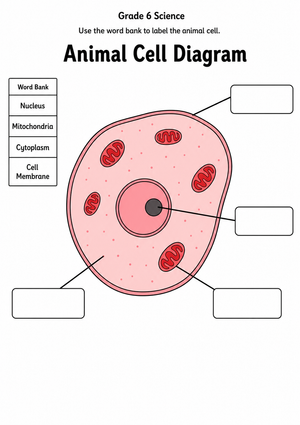
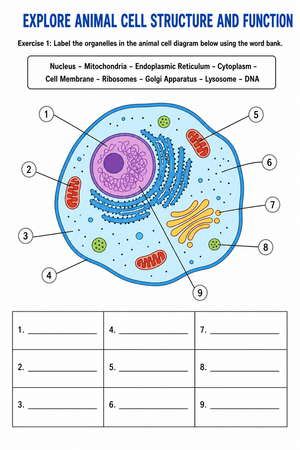
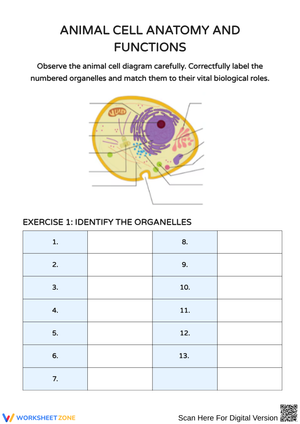
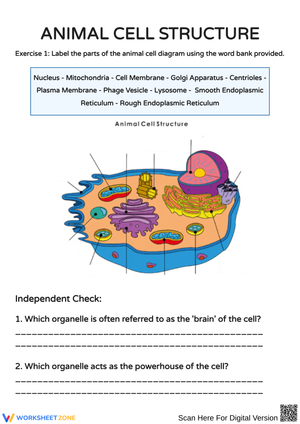
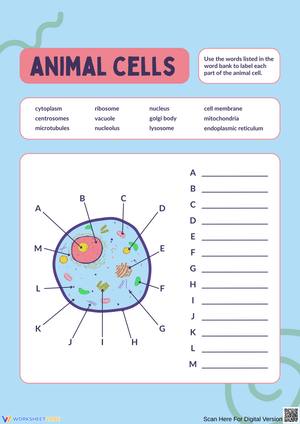
A Grade 6 animal cell labeling worksheet typically focuses on the organelles students are expected to know at the middle school level. The core structures included on most diagrams are:
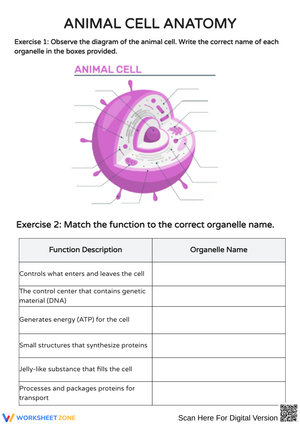
- Cell membrane – the flexible outer boundary that controls what enters and exits the cell
- Cytoplasm – the gel-like fluid that fills the cell and suspends the organelles
- Nucleus – the control center that contains the cell's genetic material
- Mitochondria – the organelles that produce energy through cellular respiration
- Ribosomes – tiny structures where proteins are assembled
- Endoplasmic reticulum (smooth and rough) – a network that processes and transports proteins and lipids
- Golgi apparatus – packages and ships proteins to their destinations inside or outside the cell
- Lysosomes – contain enzymes that break down waste materials
- Vacuoles – small storage sacs that hold water, nutrients, or waste
Covering these nine structures gives Grade 6 students a complete picture of animal cell organization without overwhelming them with advanced detail. Each organelle name on the worksheet connects directly to a function students can describe in their own words.
Classroom Implementation
Animal cell labeling worksheets are flexible enough to fit several instructional moments throughout a unit. Here are practical ways to use them in a Grade 6 science classroom:
- Pre-assessment: Distribute the worksheet before instruction to gauge prior knowledge. Students who can already name several organelles may be ready for extension tasks.
- Post-lesson review: After direct instruction or a video, have students complete the worksheet independently to consolidate what they just learned.
- Formative quiz: Use the no-word-bank version as a low-stakes quiz to check retention before a unit test.
- Partner activity: Pair students and have them quiz each other using the diagram, taking turns pointing to structures and naming them.
- Study guide: Send the completed and corrected worksheet home as a study tool before a summative assessment.
Differentiating is straightforward with a two-version approach. Provide the word bank version to students who need additional support, and challenge advanced learners with the blank version where they must recall every term independently. An included answer key saves grading time and lets students self-check during review sessions.
One often-overlooked strategy is asking students to write a one-sentence function next to each label after they finish the diagram. This small addition shifts the task from pure memorization to genuine comprehension. When students connect the name of an organelle to what it actually does, they are far more likely to retain the information for a unit test and apply it when reading science texts later in the year.
Alignment with Science Standards
These worksheets support the expectation in NGSS MS-LS1-2, which asks middle school students to develop and use models that describe the function of a cell as a whole and the specific roles of organelles within it. A labeled diagram is exactly the kind of scientific model this standard envisions. When students annotate a cell diagram with both names and functions, they are practicing the science and engineering practice of developing and using models in a concrete, grade-appropriate way.
Frequently Asked Questions
1. What organelles should 6th graders know how to label on an animal cell diagram?
Grade 6 students are generally expected to identify and label the cell membrane, cytoplasm, nucleus, mitochondria, ribosomes, rough and smooth endoplasmic reticulum, Golgi apparatus, lysosomes, and vacuoles. These nine structures represent the core organelles covered in most middle school life science curricula and align with NGSS expectations for this level.
2. How is an animal cell different from a plant cell in 6th-grade science?
Animal cells do not have a cell wall, chloroplasts, or a large central vacuole—three structures that plant cells possess. This distinction is a standard comparison point in Grade 6 science, and many labeling worksheets include a plant cell diagram alongside the animal cell so students can see the differences side by side.
3. How can I use an animal cell labeling worksheet as a formative assessment?
Remove the word bank from the standard worksheet and ask students to label the diagram from memory. Collect the papers and quickly scan for patterns—if most students miss the same organelle, that signals a concept to revisit before moving on. This takes about 10 minutes of class time and gives you actionable data without a formal test.
4. What NGSS standard covers animal cell structure in middle school?
NGSS MS-LS1-2 addresses structure and function at the cellular level. It expects students to develop and use models to describe the function of a cell as a system and the roles of the organelles within it. Animal cell labeling activities directly support this standard by having students build and annotate a scientific model of the cell.












 Interactive Worksheet Maker
 Quiz Maker
 Word Search Maker
 Crossword Puzzle Maker
 Word Scramble Generator
 Sentence Scramble Generator
 Handwriting Worksheet Generator
 Name Tracing Generator
 Fill In The Blank Generator