




























Views
Downloads
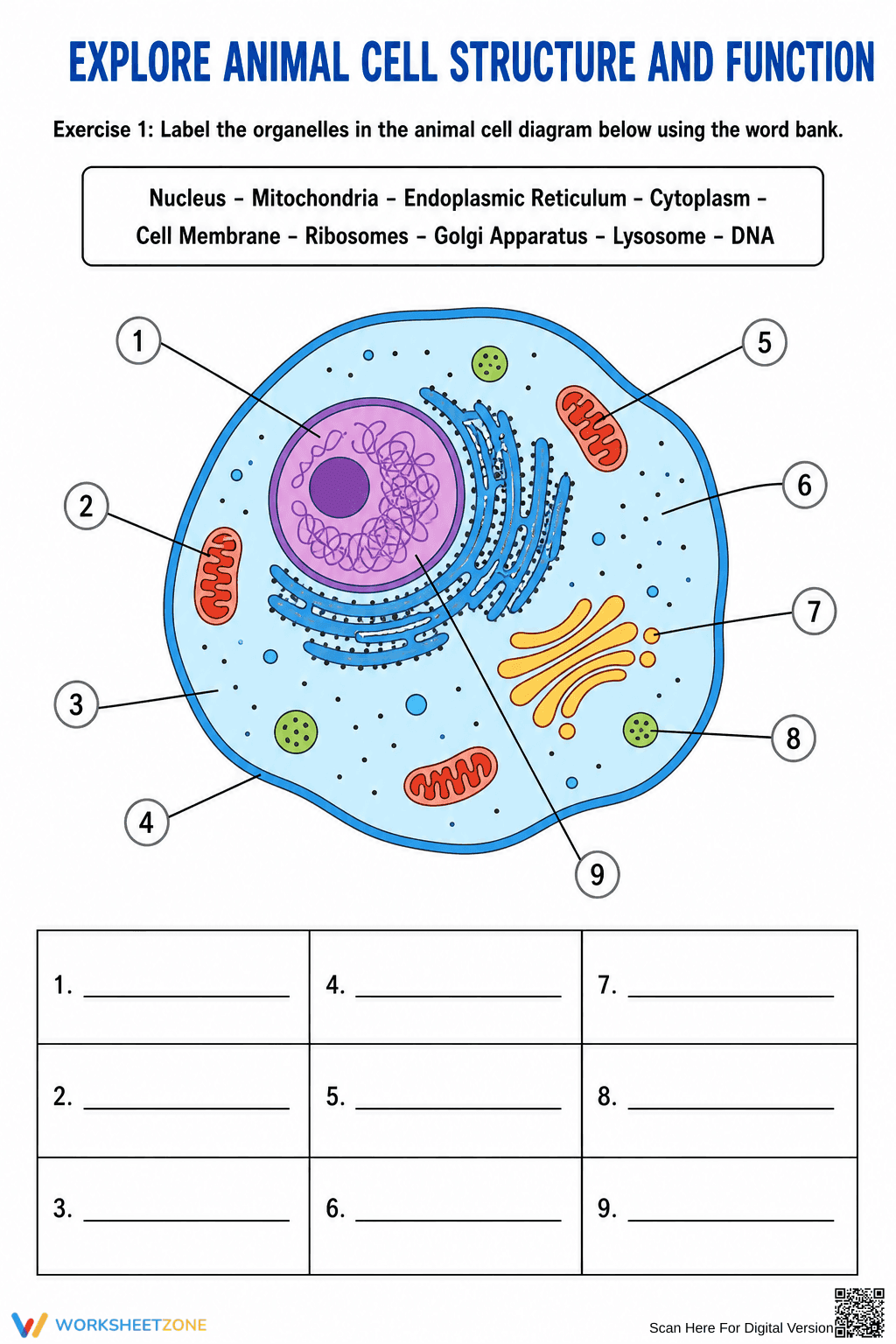


Grade 6-8 Animal Cell — Printable No-Prep Worksheet

Paste this activity's link or code into your existing LMS (Google Classroom, Canvas, Teams, Schoology, Moodle, etc.).
Students can open and work on the activity right away, with no student login required.
You'll still be able to track student progress and results from your teacher account.
This middle school science worksheet helps students master animal cell structure and function by connecting visual models to biological roles. By labeling a detailed diagram and matching organelles to their specific jobs, students build a strong foundational understanding of how cellular components work together to sustain life.
At a Glance
- Grade: 6-8 · Subject: Science
- Standard:
MS-LS1-2— Describe how cell parts contribute to overall function- Skill Focus: Animal cell structure and function
- Format: 2 pages · 17 problems · Answer key included · PDF
- Best For: Independent practice or sub plans
- Time: 15–25 minutes
This two-page resource features a clear, high-quality animal cell diagram with nine distinct organelles to identify using a provided word bank. The second page transitions from visual identification to conceptual understanding, offering eight function descriptions that students must match to the correct organelle name. An answer key is included for accurate grading.
Zero-Prep Workflow
- Print (1 minute): Simply download the PDF and print double-sided to save paper. No special materials or prior setup are required.
- Distribute (1 minute): Hand out the worksheet as a standalone assignment. The clear instructions and included word bank allow students to begin immediately.
- Review (3 minutes): Use the provided answer key to quickly check student responses or project it on the board for self-grading.
With under two minutes of teacher prep time, this resource is perfect for emergency sub plans.
Standards Alignment
This worksheet is directly aligned with Next Generation Science Standard MS-LS1-2: Develop and use a model to describe the function of a cell as a whole and ways parts of cells contribute to the function. The activity reinforces the relationship between structure and function. Both standard codes can be copied directly into lesson plans, IEP goals, or district curriculum mapping tools.
How to Use It
Deploy this worksheet after direct instruction to reinforce new vocabulary. It serves as excellent independent practice. Alternatively, use it as a formative assessment at the end of the week to gauge retention before a unit quiz. While students work, observe whether they rely heavily on the word bank for the matching section; this indicates they may need more review on organelle functions versus visual identification. Expected completion time is 15 to 25 minutes.
Who It's For
This resource is designed for middle school science students in grades 6 through 8. The built-in word bank provides natural scaffolding for learners who struggle with spelling or recall, making it accessible for diverse classrooms. It pairs perfectly with an introductory lesson on living systems or a 3D cell modeling project, giving students the vocabulary foundation they need before moving on to more complex biological concepts.
Mastering scientific vocabulary and visual models is a critical step in middle school biology. This resource aligns with MS-LS1-2, helping students describe how cell parts contribute to overall function. According to Fisher & Frey (2014), providing students with structured opportunities to interact with complex academic vocabulary significantly increases their long-term retention and comprehension of scientific texts. By combining visual diagram labeling with descriptive matching tasks, this worksheet engages multiple cognitive pathways, reinforcing the material more effectively than rote memorization alone. The dual-format approach ensures that learners can connect the physical location of an organelle to its biological purpose, which is a foundational skill for advanced life science courses. This targeted practice builds the competence necessary for students to succeed in subsequent units on genetics, cellular respiration, and complex human body systems.


