6th Grade Moss worksheets for Life Science Lessons
These 6th grade moss worksheets resources give life science teachers a targeted, printable way to teach nonvascular plants, spore reproduction, and the connection between plant structure and habitat — without the sprawl of a full textbook chapter. Each worksheet in the set addresses a specific task: labeling a diagram, reading a short informational passage, sequencing the life cycle, or comparing moss with vascular plants on a structured chart.
The Specific Skills These Worksheets Target
The core concepts here are modest in number but demanding in terms of student precision. Students must understand that moss lacks the vascular tissue — xylem and phloem — that moves water through most familiar plants. That single distinction explains why moss stays close to moist ground rather than growing tall. It also explains why moss has rhizoids rather than true roots: rhizoids anchor the plant but do not pull water upward through a transport system the way true roots do.
Each worksheet builds toward four understandings that teachers can realistically assess by the end of a one- or two-day lesson:
- Moss is a nonvascular plant with no true roots, stems, or leaves with internal transport tissue
- Moss reproduces by spores — not seeds, not flowers
- Moisture is necessary for reproduction because sperm must swim through water to reach the egg
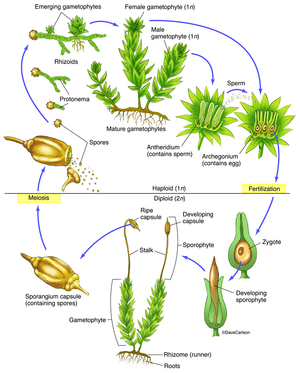
- The life cycle alternates between a gametophyte generation (dominant and visible) and a sporophyte generation
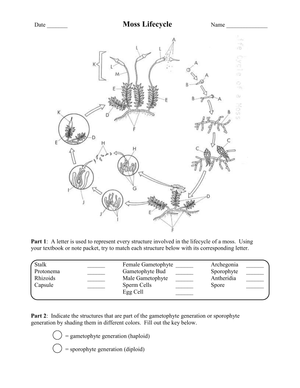
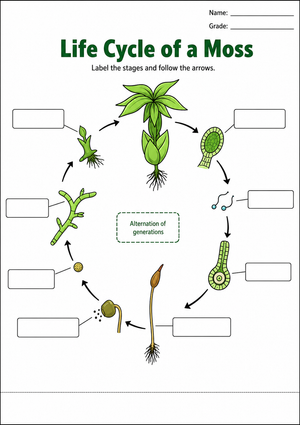
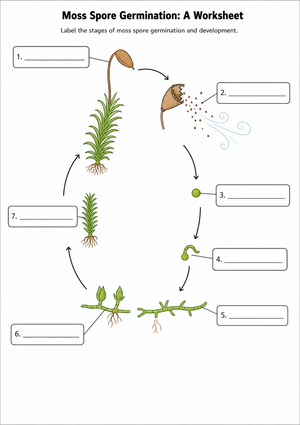
Alternation of generations is the most abstract piece for this age group. The worksheets handle it through a sequencing format — students place labeled stages in order rather than read a dense paragraph explaining the biology. That keeps the concept accessible without stripping it of accuracy.
Errors Students Make That These Worksheets Help You Catch
The most persistent mistake is students marking true roots on a moss diagram. Because rhizoids look root-like in photographs, students assume the label carries over from what they learned about vascular plants. A student who correctly labeled a root system on a bean plant diagram will default to the same vocabulary for moss without slowing down to read carefully. A labeling worksheet that lists "rhizoid" and "true root" as two distinct answer choices forces that distinction into the open — and makes the correction a teachable moment rather than a red mark on a test.
The second common error involves spores and seeds. Students who have worked with flowering plants treat "spore" as a synonym for "seed" — just a smaller version of the same thing. That conflation shows up in written explanations with phrasing like "Moss grows from a seed called a spore." A compare-and-contrast chart that asks students to record how each structure is produced, dispersed, and developed exposes the confusion quickly. When both columns show the same answer, you know exactly what the next class discussion needs to address.
A third pattern worth watching: some students decide that moss is "not really a plant" because it doesn't match the mental image of plant-ness they've assembled from trees, grass, and garden vegetables. The vocabulary worksheet helps here — when students write a working definition of plant and then test whether moss satisfies it, the classification question becomes productive rather than frustrating.
Building These Worksheets Into Your Lesson Sequence
A two-day structure works well for most teachers. On the first day, run the vocabulary and diagram worksheet as guided practice during the final 15 minutes of a 50-minute period, after a brief direct-instruction segment introducing nonvascular plants. On the second day, open with the sequencing activity as a warm-up — it takes about 8 minutes and reactivates what students heard the day before — then move into the reading passage and compare-and-contrast chart during independent work time. That rhythm means students encounter the same core ideas three times across two class meetings, which builds retention without the repetition feeling redundant.
The compare-and-contrast chart earns its place as a fast formative check. When a student examines moss alongside a fern and a flowering plant in the same worksheet, misconceptions surface without waiting for a quiz. You can scan responses as you circulate during the last 10 minutes of class and know exactly what needs revisiting the next morning. If three students wrote that moss produces seeds, that's the opening of Monday's warm-up.
For teachers building a plant diversity unit across several weeks, a 6th grade moss worksheets set fits naturally at the beginning of the sequence — before ferns, gymnosperms, and angiosperms — so that nonvascular plants establish the baseline for every comparison that follows. Introducing moss after vascular plants tends to undercut the organizational logic students have already started building.
Standard Alignment
These worksheets connect most directly to NGSS MS-LS1-5, which asks students to construct a scientific explanation based on evidence for how environmental factors influence the growth of organisms. The moss-habitat relationship is a precise application: students explain why moist, shaded environments support moss growth, linking reproductive biology — sperm require water to reach the egg — to real-world distribution patterns. That is exactly the type of evidence-based explanation MS-LS1-5 targets at the middle school level.
The activities also address the crosscutting concept of Structure and Function. Students compare the structural features of nonvascular and vascular plants and explain what each feature allows or prevents — a direct match to the expectation that middle schoolers describe how structure determines function. Teachers in states with their own science standards can generally map the nonvascular plant content to the plant diversity or life science strand at grade 6 or 7, depending on where the state's scope and sequence places plant classification.
Adjusting the Set for a Range of Learners
For students who need more support, sentence frames provide a useful structure without removing the thinking. Frames like "Moss reproduces by ______, not by ______" and "Moss is found in ______ places because ______" keep the language goal manageable while still requiring students to use accurate vocabulary. Those students can complete the vocabulary matching and diagram labeling first, then attempt the framed written responses, before considering whether the open-ended compare-and-contrast chart is appropriate for them that day.
Students who move quickly can extend the compare-and-contrast chart into a full written argument — not just filling in a column, but constructing a paragraph that connects habitat, structure, and reproduction in one coherent explanation. A prompt like "Use at least two pieces of evidence to explain why moss is classified differently from a sunflower" pulls from every part of the unit and produces a response that is genuinely difficult to fake without understanding. That's a meaningful distinction from simply restating facts.
A 6th grade moss worksheets set also works well as station material in mixed-readiness classrooms. Different worksheets can be assigned based on student readiness, and the compare-and-contrast chart functions as the common anchor task that every student completes — even if the depth of the written response varies considerably across the room.
Frequently Asked Questions
When in a plant unit should I teach moss?
Moss works best at the start of a plant diversity sequence, before ferns, gymnosperms, and angiosperms. Teaching it first gives students a reference point: nonvascular, spore-producing, moisture-dependent. Every plant group that follows gets compared against that starting point. Introducing moss after vascular plants tends to blur the organizational structure students are trying to build.
Do students need to see live moss to use these worksheets?
No, but some visual anchor helps. A projected close-up photograph is usually enough to support the diagram labeling task. If your building has a shaded sidewalk edge or a north-facing exterior wall, a brief two-minute observation before returning to class gives students a concrete reference. The worksheets are written to work with classroom photographs when outdoor access isn't practical.
How long does each worksheet take a typical 6th grader to complete?
Most worksheets run 10–20 minutes for students working independently. The reading passage with comprehension questions takes longer for slower readers, while the vocabulary matching and life cycle sequencing run shorter. Plan the diagram labeling as a guided-practice activity the first time through — especially if students haven't worked with plant structure diagrams before — and then assign it independently if you use a similar format again later in the unit.
Are these appropriate for students who struggle with reading-heavy tasks?
The diagram labeling and sequencing worksheets don't require extended reading, making them accessible for students who find text-heavy tasks difficult. The reading passage is the most text-intensive worksheet in the set and can be read aloud as a class or assigned separately. A 6th grade moss worksheets resource that includes both visual and text-based tasks gives teachers more flexibility to match the activity to the learner without redesigning the whole lesson.
Clear All