6th Grade Phases of the Moon Worksheets for Science Class
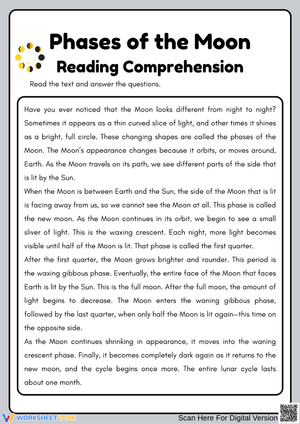
These 6th grade phases of the moon worksheets give teachers a structured way to address one of the most visually confusing topics in middle school space science. Students work through labeling, sequencing, and explaining the lunar cycle — practice that moves them past picture memorization and toward understanding the geometry behind each phase.
What Each Worksheet Asks Students to Do
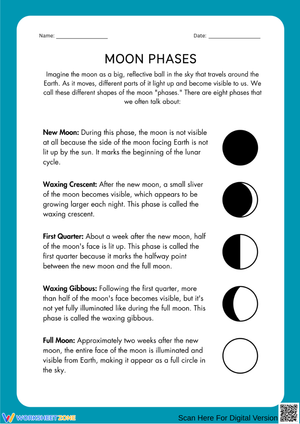
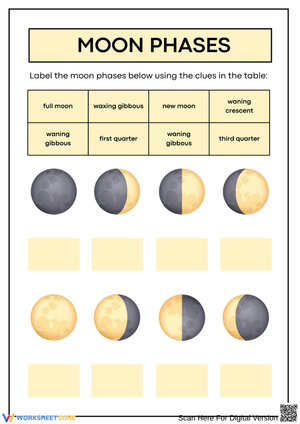
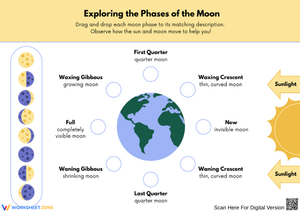
The eight named phases — new moon, waxing crescent, first quarter, waxing gibbous, full moon, waning gibbous, third quarter, and waning crescent — anchor the vocabulary work across the set. Labeling those phases is the entry point, not the destination.
Beyond naming, each worksheet asks students to:
- Sequence all eight phases in correct order around a 29.5-day cycle
- Sort phases as waxing (visible lit area growing) or waning (visible lit area shrinking)
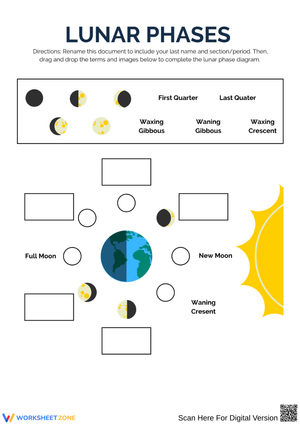
- Read Sun-Earth-Moon position diagrams and match them to the visible phase they produce
- Write brief explanations for why the Moon's appearance changes even though the Moon itself has not changed shape
When 6th grade phases of the moon worksheets pair labeling tasks with written explanation prompts, they reveal something a completed diagram alone cannot — whether students understand the underlying geometry or simply recognized the shapes from a classroom chart.
Errors Students Make That These Worksheets Bring Into the Open
The most persistent misconception in any moon phase unit is that Earth's shadow causes the regular phases. It does not. The phases result from the Moon's changing orbital position, which determines how much of its sunlit half is visible from Earth. Earth's shadow only matters during a lunar eclipse. Students who hold this belief can still label all eight phases correctly by matching images to names — which is exactly why written explanation tasks matter more than labeling accuracy alone.
A second problem appears with the gibbous phases. Waxing gibbous and waning gibbous look nearly identical unless students are tracking which side is lit and whether that lit portion is growing or shrinking. Most students need to see the distinction applied across several diagrams, with clear sunlight-direction arrows in the artwork, before it holds reliably in memory.
Third, students who sequence the phases correctly through the full moon often reverse the waning order afterward, placing waning crescent before waning gibbous. Cycle diagrams that require students to continue the arc themselves — rather than fill in a static list — catch this error before it gets reinforced through repeated practice.
Building These Worksheets Into Your Lesson Sequence
The most reliable order starts with a physical model — a flashlight and a foam ball, or a strong lamp positioned across the room — and then moves to a worksheet where students label all eight phases and answer two or three cause-and-effect questions about position and light. That handoff grounds the diagram work in something students have already seen move in real time, which matters for a topic where the spatial relationships are genuinely hard to hold in the mind.
Station rotations work well for this unit. One station sorts sequence cards; a second uses a worksheet where students draw the sunlight angle for each phase position; a third runs the Oreo cookie model, shaping the cream to show each phase. A short wrap-up task — one sentence per phase connecting the appearance to the Sun-Earth-Moon arrangement — ties the stations together in a way that pure hands-on work alone does not.
Exit tickets fit naturally into this topic. A quick check showing one phase image and asking two questions — name the phase, then sketch the orbital arrangement — takes under five minutes and generates clear formative data. If several students reverse the waning phases, that is more useful to know on Thursday afternoon than after the unit test. The 6th grade phases of the moon worksheets formatted for short exit checks make that closing routine easy to run without losing instructional time.
Tailoring the Worksheets for a Mixed-Readiness Class
Most worksheets include a word bank for phase names. Students still building vocabulary use it as a reference; removing it for students who are ready turns the same task into a retrieval exercise with noticeably higher demand. The same worksheet, two versions, two different levels of cognitive challenge — that flexibility matters when a class has a wide range of readiness levels.
For students who struggle with spatial reasoning, pre-shading the sunlit portion of the Moon diagrams before they begin labeling reduces the cognitive load of decoding an unfamiliar visual. Once the image is easier to read, the science question becomes cleaner and students can focus on actual reasoning rather than diagram interpretation.
Students who move ahead quickly benefit from a blank orbit diagram where they place the Moon at each phase position, draw the sunlit half, and label from their own construction rather than from a pre-built image. That version requires genuine understanding of the geometry, not image recognition. Sentence starters on explanation prompts — "The Moon appears as a waxing crescent because..." — help students who need language support; removing the starter and asking for unprompted written reasoning raises the ceiling for students ready to work without it.
Standard Alignment
These worksheets address NGSS MS-ESS1-1, which asks students to develop and use a model of the Earth-Moon-Sun system to describe the cyclic patterns of lunar phases. The standard is placed at the middle school level because it requires students to move beyond recognizing what the Moon looks like on different nights into causal reasoning about why it looks that way — a distinction that depends on the kind of position-based, diagram-driven practice that 6th grade phases of the moon worksheets offer across multiple lesson formats.
Frequently Asked Questions
Why do students keep saying Earth's shadow causes the moon phases?
The misconception persists because it feels logical before instruction. The Moon goes dark, so something seems to be blocking the Sun. The actual cause — the Moon's orbital position determining which part of its sunlit side faces Earth — is more abstract and takes multiple representations to internalize. Worksheets that pair a phase image with the corresponding Sun-Earth-Moon diagram for that same moment give students a direct way to confront the faulty reasoning, rather than simply encounter the correct answer on a vocabulary list.
How many separate practice encounters do students typically need before sequencing is reliable?
Most students need three to four spaced encounters across different formats — an initial class model, a hands-on activity, a guided worksheet with a word bank, and a later retrieval worksheet without support. Concentrating all of that practice into a single class period rarely produces durable results. Spreading it across several days gives each layer time to settle before the next is added, which is why spaced retrieval practice matters more than any individual task in the set.
Do these worksheets assume students have already observed the moon at night?
No. The reasoning tasks are diagram-based and work regardless of prior personal observation. For classes where real-time night viewing is difficult, a teacher-provided photo log — images of the Moon taken across one complete cycle — pairs well with any worksheet in the set. Students who have never paid attention to the Moon at night can still work through position diagrams; the photo reference just makes the abstract 29.5-day cycle feel grounded in something visible.
Clear All