In 6th grade science, the focus shifts from general observations of living things to a deeper investigation of cellular structures. Students learn that all living organisms are composed of cells, and that these cells contain specialized parts that perform specific functions. Printable worksheets serve as excellent tools to reinforce classroom lectures, laboratory investigations, and textbook readings. They offer students a tangible way to practice identifying organelles and explaining their roles within the cell.
Standards Alignment for Cell Structure Units
When planning a unit on cell structure, alignment with academic standards is essential for ensuring educational quality. The parts of the cell printable worksheets for 6th grade are designed to support performance expectation MS-LS1-2, as described in NGSS MS-LS1-2 From Molecules to Organisms: Structures and Processes (nextgenscience.org). This expectation requires students to develop and use a model to describe the function of a cell as a whole and the ways parts of cells contribute to that function. Resources highlighted by NSTA: Middle School Life Science - Cells (nsta.org) emphasize the importance of using visual models to teach these concepts effectively.
To meet this expectation, 6th grade students must go beyond simple memorization of organelle names. They need to understand how the nucleus, mitochondria, cell membrane, and other structures work together to support the life of the cell. Printable worksheets that feature modeling activities, system analysis, and function matching help students build the conceptual models required by MS-LS1-2. By interacting with these diagrams, students can visualize the cell as a system of interacting parts, which is a core concept in middle school life science education.
Key Cell Organelles for 6th Grade Science
As outlined in CK-12 Life Science for Middle School: Parts of the Cell (ck12.org), a successful cell unit focuses on the primary organelles that 6th grade students are expected to master. High-quality worksheets target these key organelles to build a strong foundational understanding.
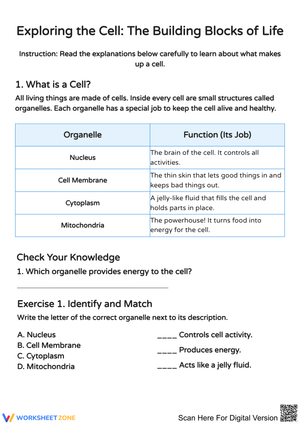
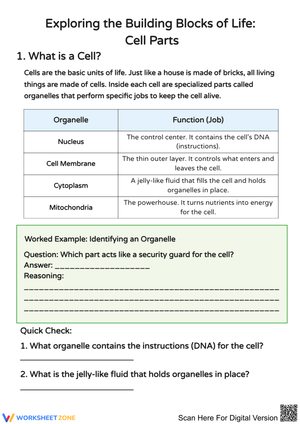
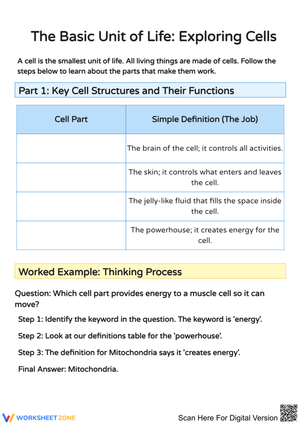
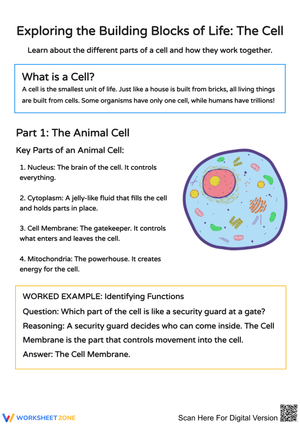
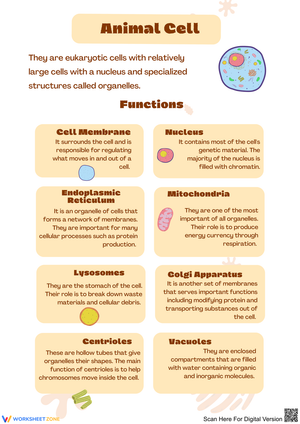
The Nucleus: Often referred to as the control center of the cell, the nucleus contains the genetic material and directs all cellular activities. Worksheets depict the nucleus as a prominent, spherical structure near the center of the cell, helping students identify it quickly.
The Cell Membrane: This flexible outer barrier controls the movement of substances into and out of the cell. Printable activities help students understand its selective permeability through labeling and simple transport scenarios.
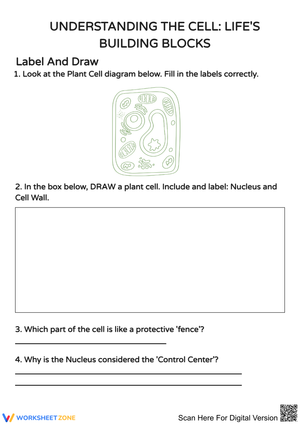
The Cell Wall: Exclusive to plant cells, the cell wall provides structural support and protection. Worksheets emphasize this rigid outer layer to help students distinguish plant cells from animal cells.
Mitochondria: Known as the powerhouses of the cell, mitochondria convert nutrients into usable energy. Worksheets often feature close-up diagrams of the folded inner membrane to help students recognize their unique shape.
Chloroplasts: Found in plant cells, chloroplasts capture light energy to perform photosynthesis. Printable diagrams highlight these green, oval structures, allowing students to connect them directly to plant energy production.
Cytoplasm and Vacuoles: Cytoplasm is the gel-like fluid that fills the cell and suspends the organelles. Vacuoles are storage sacs that hold water, nutrients, and waste. Worksheets typically contrast the single, large central vacuole of a plant cell with the smaller, multiple vacuoles found in animal cells.
Types of Cell Worksheets for the Classroom
To keep students engaged and cater to different learning styles, teachers should utilize a variety of worksheet formats. Using different styles of parts of the cell printable worksheets for 6th grade ensures that students approach the topic from multiple angles, reinforcing their understanding and retention.
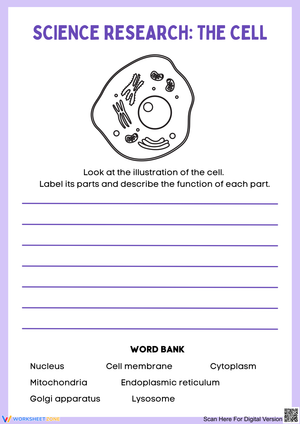
Diagram Labeling Worksheets: These printables feature detailed diagrams of plant and animal cells. Students use a word bank or their prior knowledge to label each organelle. This activity builds spatial awareness and helps students recognize the physical appearance of each cell part.
Organelle Function Matching: These worksheets list organelles in one column and their corresponding functions in another. Students draw lines or write letters to match each structure with its job. This format is excellent for quick formative assessments and vocabulary reinforcement.
Plant vs. Animal Cell Comparison: Venn diagrams and comparison charts are perfect for highlighting the differences between plant and animal cells. Students identify which organelles are shared and which are unique to plants.
Cell Analogy Activities: One of the most popular middle school science activities is the cell analogy worksheet. Students compare the cell to a city, a factory, or a school. For example, the nucleus is compared to the city hall, and the mitochondria are compared to the power plant. These worksheets encourage critical thinking and help students relate abstract biological functions to familiar real-world systems.
Teacher Tips
An effective strategy for teaching cell structures is to have 6th grade students use color-coding on their printable diagrams before attempting to label them. Assigning specific colors to specific organelle functions—such as coloring all energy-related structures like mitochondria and chloroplasts in shades of yellow and green, and control structures like the nucleus in blue—helps students build visual associations between an organelle's appearance and its biological role. This simple step reduces cognitive overload and improves long-term retention of complex cellular anatomy.
When introducing parts of the cell printable worksheets for 6th grade, consider scaffolding the learning process. Start with highly guided worksheets that include word banks and clear definitions. As students gain confidence, transition to independent practice sheets where they must identify organelles without clues. This gradual release of responsibility helps students build self-reliance and prepares them for assessments.
Additionally, try integrating these printables with hands-on activities. For instance, after students complete a labeling worksheet, have them build a three-dimensional cell model using clay or recycled materials. They can use their completed worksheet as a reference guide during the building process. This combination of visual, tactile, and written activities ensures that all students can master the curriculum expectations.
Use short matching worksheets as bell ringers at the start of class. This quick activity activates prior knowledge and gets students focused on science as soon as they sit down. It also gives you time to assess which concepts need a quick review before starting the main lesson.
You can also use these worksheets for cooperative learning. Divide students into pairs and give them a single cell diagram to label together. Encourage them to discuss their reasoning for each label. This collaborative approach promotes scientific discourse and allows students to clarify misconceptions among themselves.
Frequently Asked Questions
1. What are the most important cell parts for 6th grade students to learn?
In 6th grade science, students should focus on the primary organelles that are central to basic cell functions. These include the nucleus, cell membrane, cell wall, cytoplasm, mitochondria, chloroplasts, and vacuoles. Mastering these key structures provides a solid foundation for more advanced biology topics in later grades.
2. How do these worksheets align with middle school life science standards?
These worksheets directly support performance expectation MS-LS1-2 by requiring students to model and describe how different parts of the cell contribute to its overall function. Rather than just memorizing vocabulary, the activities encourage students to analyze the relationships between organelles and understand the cell as an integrated biological system. More details on this expectation can be found at NGSS MS-LS1-2 From Molecules to Organisms: Structures and Processes (nextgenscience.org).
3. Do these printables include both plant and animal cell diagrams?
Yes, comprehensive worksheet collections include distinct diagrams for both plant and animal cells. Comparing these two cell types is a standard requirement in the 6th grade curriculum, helping students identify unique plant structures like the cell wall and chloroplasts, as well as shared organelles like the nucleus and mitochondria.
4. How can I use cell analogies to help my students understand organelle functions?
Cell analogy worksheets are highly effective for middle schoolers. You can ask students to compare a cell to a familiar system, such as a school, a city, or a sports team. For example, students might compare the cell membrane to the school security guard or the mitochondria to the cafeteria. This helps translate abstract biological processes into concrete, relatable concepts.












 Interactive Worksheet Maker
 Quiz Maker
 Word Search Maker
 Crossword Puzzle Maker
 Word Scramble Generator
 Sentence Scramble Generator
 Handwriting Worksheet Generator
 Name Tracing Generator
 Fill In The Blank Generator




 BACK TOSCHOOL